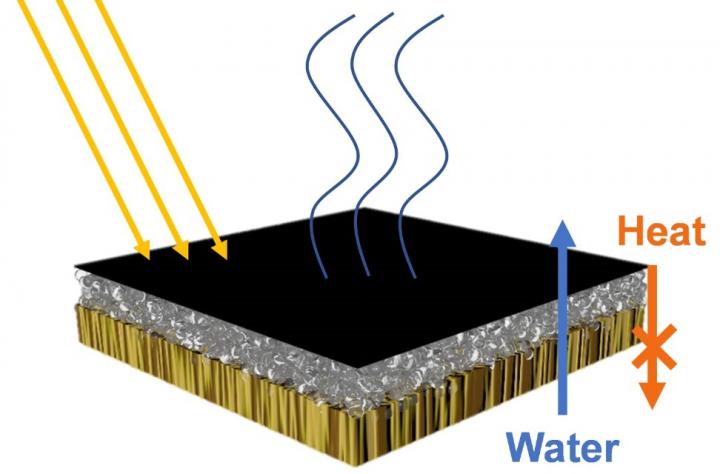
Credit: Adapted from Nano Letters 2020, DOI: 10.1021/acs.nanolett.0c01088
According to the United Nations, about one-fifth of the world’s population lives in areas where water is scarce. Therefore, technologies to produce clean water from undrinkable sources, such as seawater, river or lake water, and contaminated water, are urgently needed. Now, researchers reporting in Nano Letters have developed a wood-based steam generator that, with the help of bacterial-produced nanomaterials, harnesses solar energy to purify water.
A solar steam generator is a device that uses the abundant energy of the sun to separate pure water from its contaminants by evaporation. Many different versions of these devices have been developed, with varying efficiencies. To design better solar steam generators, researchers must find ways to improve light absorption, heat management, water transport and evaporation. Shu-Hong Yu and colleagues at the University of Science and Technology of China wanted to combine all four improvements in a single device. They chose wood as the basis of their generator because of its sustainability and porous structure, which allows rapid water transport.
The researchers made their device with the help of bacteria that produced long cellulose nanofibers, which bound the layers of the device together. The team added bacteria to the surface of a block of wood and allowed them to ferment. Then, they sprayed an aerosol of glass bubbles — tiny hollow spheres that provide excellent thermal insulation — onto the surface. The glass bubbles became embedded in the cellulose nanofibers produced by the bacteria, forming a hydrogel. Finally, the researchers added carbon nanotubes, which tangled with the cellulose nanofibers to form a light-absorbing, water-evaporating top layer. The device works by transporting water upward through the wood to the light-absorbing layer, which is heated by the sun. The water evaporates, and the steam is collected and condensed to produce pure water. The insulating layer of glass bubbles keeps heat from being transferred downward through the device and lost, and the nanoscale structures lower the energy required for water vaporization. As a result, the new device has a higher evaporation rate and efficiency than most existing solar steam generators.
###
The authors acknowledge funding from the National Natural Science Foundation of China, the Chinese Academy of Sciences and the Fundamental Research Funds for the Central Universities.
The paper’s abstract will be available on July 8 at 8 a.m. Eastern time here: http://pubs.
The American Chemical Society (ACS) is a nonprofit organization chartered by the U.S. Congress. ACS’ mission is to advance the broader chemistry enterprise and its practitioners for the benefit of Earth and its people. The Society is a global leader in providing access to chemistry-related information and research through its multiple research solutions, peer-reviewed journals, scientific conferences, eBooks and weekly news periodical Chemical & Engineering News. ACS journals are among the most cited, most trusted and most read within the scientific literature; however, ACS itself does not conduct chemical research. As a specialist in scientific information solutions (including SciFinder® and STN®), its CAS division powers global research, discovery and innovation. ACS’ main offices are in Washington, D.C., and Columbus, Ohio.
To automatically receive news releases from the American Chemical Society, contact [email protected].
Follow us: Twitter | Facebook
Media Contact
Katie Cottingham
[email protected]