Researchers have developed a sperm-sorting microfluidic device that operates without a pump, without a centrifuge and without external actuation, driven solely by a hydrostatic pressure difference between two reservoirs. Instead, it relies on nothing more than a carefully arranged field of microscopic channels, a modest difference in fluid height, and two of the sperm cell’s own instincts: the tendency to swim against a gentle current, known as rheotaxis, and the habit of hugging surfaces, known as thigmotaxis. The device, described in Biomedical Microdevices, recovered highly motile bull sperm at concentrations of up to 2.4 million cells per millilitre within 30 minutes, a level the authors note is close to the concentration range commonly used for bovine in vitro fertilisation.
Roughly half of infertility cases are attributed to male factors, including impaired sperm motility and reduced sperm count, and conventional sperm preparation techniques such as density gradient centrifugation expose sperm to physical stress that can damage DNA. In cattle breeding, the authors note that declining conception rates lead to more open days and substantial economic losses for farmers, and that conception rates after embryo transfer with in vitro-produced embryos remain lower than after artificial insemination. The authors proposed the device to select highly motile sperm non-invasively under physiologically relevant conditions, avoiding the centrifugation used in conventional sperm preparation methods such as density gradient centrifugation.
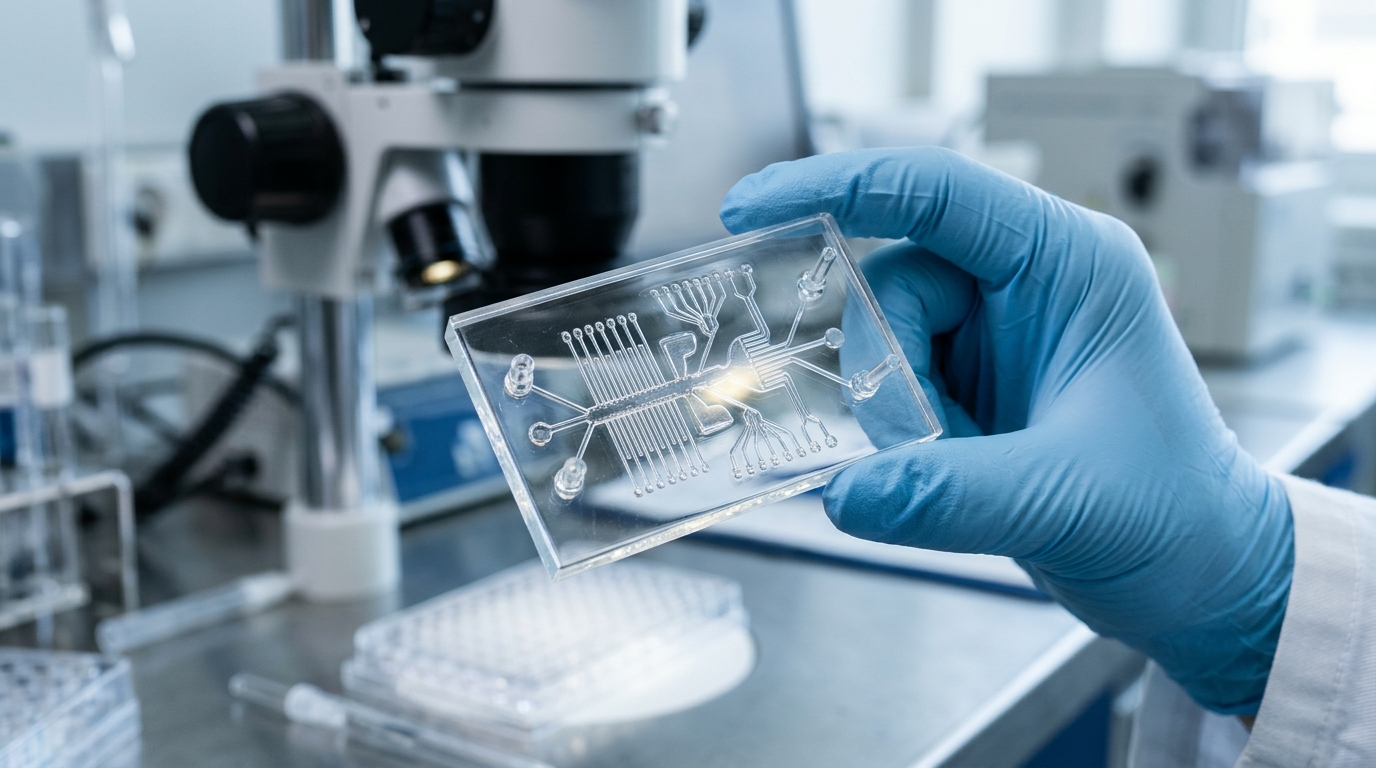
Their answer is a device they call the multiple parallel-channel sperm sorter, or MPSS. It is fabricated in polydimethylsiloxane, a soft silicone polymer, using standard soft-lithography techniques, and bonded irreversibly to a glass slide after oxygen plasma treatment. The microchannels are strikingly small: 5 millimetres long, 50 micrometres wide and just 10 micrometres high, dimensions comparable to the length of a sperm cell itself. That scale is deliberate. Because the channel width is comparable to the sperm body length, the device facilitates boundary-following thigmotactic behaviour, and the authors state this design enhances the contribution of thigmotaxis to sperm transport.
The driving force is entirely passive. The collection reservoir and microchannels are first filled with culture medium, then a sperm suspension is loaded into the semen reservoir. The difference in fluid volume between the two reservoirs creates a hydrostatic pressure head that pushes fluid from the collection reservoir toward the semen reservoir through the channels. Motile sperm, responding to this flow through rheotaxis, swim upstream against the current and accumulate in the collection reservoir. The whole assembly is incubated at 38.5 degrees Celsius for 30 minutes, after which the contents of the collection reservoir are harvested and analysed with a sperm motility analysis system measuring curvilinear velocity, straightness, beat cross frequency and amplitude of lateral head displacement.
The researchers tested two architectures. The basic configuration links a single semen reservoir to a single collection reservoir through multiple parallel channels, with the number of channels set at 40, 80 or 120. The cross-shaped configuration connects four semen reservoirs to a central collection reservoir, allowing total channel counts of 160, 240 or 320. Each experiment used frozen semen from a single Japanese Black bull, thawed and prepared fresh, with four independent replicates per condition. Across all channel counts tested in the basic configuration, the collected sperm showed significantly higher curvilinear velocity, straightness and beat cross frequency than sperm in the semen reservoir, while amplitude of lateral head displacement showed no significant difference, indicating selective recovery of highly motile sperm.
Recovery did not scale linearly with channel number, however. When the team extended from the basic 40-channel design to cross-shaped devices with 160, 240 and 320 channels, a 4-, 6- or 8-fold increase in channels yielded only about 2.3-, 3.2- and 4.1-fold increases in recovered sperm concentration. The maximum recovery efficiency was 2.4 ± 0.3 percent, corresponding to a total recovery of 2.3 × 10⁵ sperm in 30 minutes, which the authors identify as an important limitation of the device. The culprit, the researchers found, is thigmotaxis itself. Sperm that successfully reach the collection reservoir tend to accumulate near the bottom surface and corners, and a substantial fraction then wander back into the microchannels they came from, undoing much of the gain from adding more channels.
To understand this behaviour quantitatively, the team built an agent-based numerical model in which individual sperm are treated as discrete stochastic agents whose swimming directions and speeds are sampled from distributions measured in the actual experiments. A phenomenological thigmotaxis term reduces both the wall-normal velocity component and the deflection angle as a sperm approaches a wall, reproducing the characteristic accumulation of cells near surfaces. The simulations, averaged over five independent runs with different random seeds, showed that approximately 53 percent of the sperm reaching the collection reservoir in the basic configuration re-entered the channels; a representative microscopic observation of the cross-shaped device found a re-entry ratio of about 69 percent.
The model also revealed a subtler hydrodynamic constraint. Because fluid flows through all parallel channels simultaneously, increasing the channel count accelerates the decay of the hydrostatic head over time. With an initial volume difference of 20 microlitres, the mean flow velocity dropped by 5.2 percent over 30 minutes for 40 channels but by 34.7 percent for 320 channels. At a larger initial volume difference of 40 microlitres, the velocity reduction approached 90 percent for the highest channel count. The experiments showed that smaller initial volume differences produced higher recovered sperm concentrations, though the authors caution that an excessively small hydrostatic head may lead to flow instability such as backflow during device handling.
Reservoir geometry mattered as well. When the reservoir base area was held constant, increasing the aspect ratio from square toward elongated shapes showed a marginally decreasing, statistically non-significant trend in sperm concentration, which the authors attribute to discrepancies between designed and fabricated geometries arising from elastic deformation during the punching process. A device with an aspect ratio of 5.43 showed an approximately 13 percent reduction in effective reservoir base area relative to the design, which increased the mean flow velocity in the channels and made it harder for sperm to swim upstream. The authors conclude that reservoir geometries close to a square shape are preferable for maximising sperm recovery, and that the cross-shaped configuration is an effective strategy because it increases the total number of channels within the same reservoir base area while mitigating the adverse effects of elongated reservoir geometries. Channel spacing, by contrast, showed no statistically significant effect on recovered concentration in the experiments, though the simulations suggested a marginal decrease at wider spacings because sperm pooled near corners are more likely to re-enter channels positioned close to those corners.
The researchers are candid about the device’s limitations. Recovery efficiency remains relatively low, although the authors state it is comparable to or higher than those reported for several rheotaxis- and/or thigmotaxis-based microfluidic devices, and the study used only four independent replicates from a single bull, so future studies with more independent experiments are warranted to validate robustness and reproducibility. The agent-based model is behaviour-based rather than physics-based, ignores sperm-sperm interactions, and simulates only the collection reservoir rather than the full device, so it may overestimate re-entry. The PDMS surface also gradually reverts from hydrophilic to hydrophobic within hours, which could complicate field deployment. The authors flag that a direct head-to-head comparison with density gradient centrifugation, including measures of DNA fragmentation, fertilisation potential and embryo development, remains essential future work. The platform's pump-free, centrifugation-free operation and low equipment requirements simplify sperm preparation, and the authors state that future work will focus on suppressing thigmotaxis-induced sperm re-entry to improve recovery performance and on evaluating the fertilisation potential and subsequent embryo development of the selected sperm.
Subject of Research: A pump-free microfluidic device that sorts highly motile sperm using rheotaxis and thigmotaxis in parallel microchannels
Article Title: Hydrostatically driven microfluidic sorting of highly motile sperm using multiple parallel microchannels via rheotaxis and thigmotaxis
Article References: Hyakutake, T., Ikeno, H., Takahashi, R., Yasui, M., Mita, M., Yumoto, S., Akiyama, K., Tsukahara, H., & Shirasawa, A. (2026). Hydrostatically driven microfluidic sorting of highly motile sperm using multiple parallel microchannels via rheotaxis and thigmotaxis. Biomedical Microdevices, 28(4), Article 74. https://doi.org/10.1007/s10544-026-00858-2
Image Credits: AI Generated
DOI: 10.1007/s10544-026-00858-2
Keywords: microfluidics, sperm sorting, rheotaxis, thigmotaxis, assisted reproduction, bovine IVF, hydrostatic pressure, PDMS, agent-based modelling, parallel microchannels, recovery efficiency, Hydrostatically
News Source: Denise Maddox. (November 5, 2026). Pump-free microfluidic chip sorts the strongest sperm by exploiting their own swimming instincts. Scienmag.