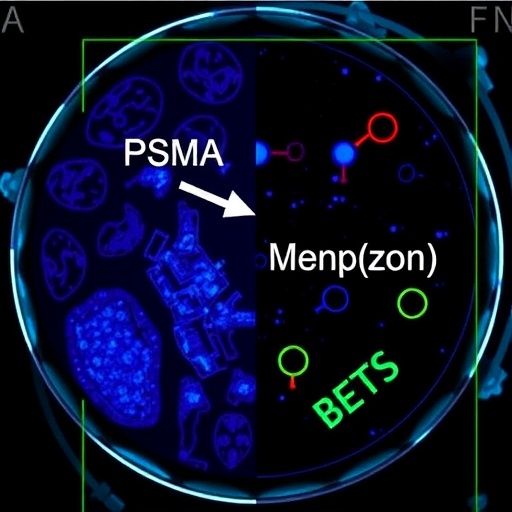
In a groundbreaking study poised to redefine therapeutic approaches for prostate cancer, researchers have unveiled a promising combination strategy that synergizes the tumor-targeting precision of alpha-emitting radioligands with the epigenetic modulation properties of BET bromodomain inhibitors. The innovative research, conducted by Liukaityte, Stenberg, Kleinauskas, and their colleagues, explores the integration of [^212Pb]Pb-AB001, a lead-212 labeled ligand targeting Prostate-Specific Membrane Antigen (PSMA), in tandem with bromodomain and extraterminal domain (BET) inhibitors, demonstrating remarkable in vitro efficacy against prostate cancer models.
Prostate cancer remains a leading cause of cancer morbidity and mortality worldwide, with therapeutic resistance and tumor heterogeneity posing formidable barriers to curative treatment. Conventional therapies, including androgen deprivation and chemotherapy, often succumb to resistance mechanisms. Targeted radioligand therapy (RLT) targeting PSMA has gained traction due to PSMA’s almost exclusive and abundant expression on prostate cancer cells, facilitating selective delivery of cytotoxic agents. The alpha-emitter lead-212, with its high linear energy transfer and short path length, offers potent localized DNA damage, minimizing off-target effects and enhancing therapeutic index.
The study meticulously engineered the radioligand [^212Pb]Pb-AB001 to leverage PSMA’s tumor-specific expression. By conjugating lead-212 to the AB001 molecule, researchers harnessed the alpha particle emissions to induce irreparable double-strand breaks in DNA within prostate cancer cells, triggering apoptosis. Despite the impressive cytotoxic potential, monotherapy with targeted alpha radioligands often faces limitations, including suboptimal efficacy in heterogeneous tumor microenvironments and cellular survival adaptations that blunt responses.
.adsslot_RYO490U8Cj{width:728px !important;height:90px !important;}
@media(max-width:1199px){ .adsslot_RYO490U8Cj{width:468px !important;height:60px !important;}
}
@media(max-width:767px){ .adsslot_RYO490U8Cj{width:320px !important;height:50px !important;}
}
ADVERTISEMENT
Recognizing this, the research team investigated the combinatorial use of BET bromodomain inhibitors, compounds that interfere with epigenetic readers involved in regulating gene expression critical for cancer cell survival and proliferation. BET proteins, particularly BRD4, facilitate transcription of oncogenes and pathways integral to tumor growth. Pharmacological inhibition impairs these transcriptional programs, sensitizing cancer cells to DNA damage and disrupting repair mechanisms.
In vitro models of prostate cancer treated with the [^212Pb]Pb-AB001 radioligand exhibited significant cell death, corroborating prior evidence of alpha radiation’s lethality. However, when combined with BET inhibitors, the prostate cancer cell lines showed markedly enhanced cytotoxicity, surpassing additive effects and implying synergy. This dual approach not only delivered direct DNA damage but simultaneously suppressed the transcriptional machinery required for adaptive responses and DNA repair, effectively preventing cancer cells from mounting resistance strategies.
This research also highlights the importance of PSMA as a vehicle for precise delivery. The biodistribution and selectivity conferred by the AB001 ligand ensure that alpha emissions preferentially localize within PSMA-expressing tumor sites, mitigating collateral normal tissue toxicity. This targeted approach is especially significant given the potency of alpha-emitters and their potential for hematologic and renal toxicities if misdirected.
Furthermore, the study’s use of the radioisotope lead-212 provides advantageous decay kinetics for clinical translation. With a half-life of approximately 10.6 hours, it offers a balance between sufficient time to localize in tumors and rapid decay to limit prolonged radiation exposure. Additionally, lead-212 decays to alpha-emitting bismuth-212, further enhancing therapeutic payload without increasing off-target risks.
Despite these encouraging preclinical findings, the scientists underscore that in vitro data is a foundational but initial step. Translating the combined therapy into in vivo systems and ultimately clinical settings entails navigating complex pharmacodynamics, dosimetry, and toxicity profiles. Nonetheless, the anticipation is that this fusion of targeted alpha radioligands with epigenetic inhibitors could substantially extend the therapeutic window for advanced prostate cancer patients, particularly those with castration-resistant disease.
Moreover, the conceptual framework established here invites potential exploration in other malignancies expressing tumor-specific antigens amendable to alpha radioligand targeting. Integrating epigenetic modulation to disable cancer cell plasticity and repair could be a transformative theme across oncology therapeutics, reinvigorating radiopharmaceutical development strategies.
This investigation is also notable for advancing precision medicine paradigms. By exploiting the molecular vulnerability of PSMA and combining distinct mechanistic classes—radiotherapy and epigenetic therapy—it exemplifies how rational drug design can create synergistic regimens that overcome monotherapy limitations. The work stands as a testament to interdisciplinary collaboration among radiochemists, molecular biologists, and oncologists.
Importantly, the use of bromodomain inhibitors is not without challenges, including off-target effects and development of resistance mutations. However, their transient application alongside a potent radioligand could mitigate long-term toxicities while maximizing cancer cell eradication. Future studies might optimize dosing schedules, evaluate biomarkers predictive of response, and assess combinatorial toxicities in sophisticated preclinical models.
Clinical trials stemming from this line of research hold promise to redefine salvage options for patients with metastatic prostate cancer, a setting where new effective therapies are critically needed. Given the escalating incidence of prostate cancer worldwide and the increasing recognition of PSMA as a versatile therapeutic target, the impact of such novel combination therapies could be monumental.
In summary, the study by Liukaityte and colleagues pioneers a compelling avenue in prostate cancer treatment by uniting the targeted cytotoxic power of a lead-212 labeled PSMA radioligand with the transcriptional silencing capabilities of BET bromodomain inhibitors. Through rigorous in vitro experimentation, they demonstrate enhanced prostate cancer cell killing that offers a new therapeutic blueprint. As research progresses, this synergistic strategy may well usher in a new era of alpha-radioligand therapies with augmented potency and precision.
Given the urgent clinical demand to improve outcomes in aggressive prostate cancers and overcome resistance mechanisms, the integration of novel alpha-emitting radiopharmaceuticals with epigenetic agents represents one of the most exciting frontiers in oncology today. The convergence of these two modalities exemplifies how innovative molecular targeting can transform cancer therapy, laying the groundwork for future translational success and ultimately improving patient survival and quality of life.
Subject of Research: Combination therapy targeting prostate cancer using PSMA-targeted alpha-emitting radioligand [^212Pb]Pb-AB001 and BET bromodomain inhibitors.
Article Title: Combination of PSMA targeting alpha-emitting radioligand [^212Pb]Pb-AB001 with BET bromodomain inhibitors in in vitro prostate cancer models.
Article References:
Liukaityte, R., Stenberg, V.Y., Kleinauskas, A. et al. Combination of PSMA targeting alpha-emitting radioligand [^212Pb]Pb-AB001 with BET bromodomain inhibitors in in vitro prostate cancer models. Med Oncol 42, 362 (2025). https://doi.org/10.1007/s12032-025-02925-9
Image Credits: AI Generated
Tags: alpha-emitting radioligandsBET bromodomain inhibitorscancer morbidity and mortalityDNA damage mechanisms in tumorsepigenetic modulation in cancerinnovative cancer research methodslead-212 radiation therapyprostate cancer treatment strategiesprostate-specific membrane antigenPSMA-targeted therapytargeted radioligand therapytherapeutic resistance in prostate cancer