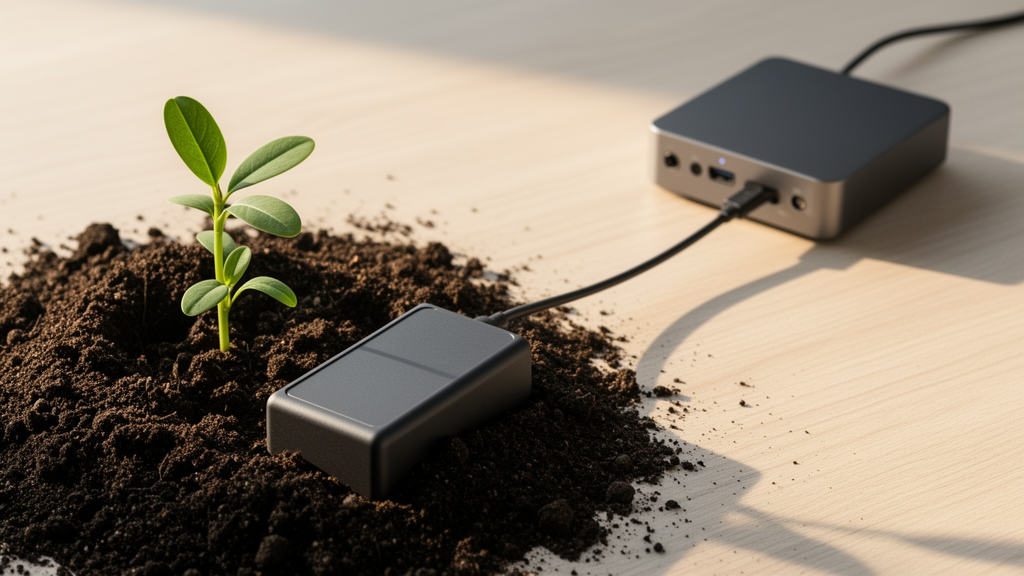
A case study published in Cambridge Prisms: Water describes the engineering and preliminary evaluation of a prototype sonification system designed to provide real-time auditory decision support during manual irrigation tasks. Sonification, which refers to the systematic representation of data through non-speech sound, was implemented to help growers monitor soil-moisture levels without forcing them to shift their visual focus away from delicate watering operations. The project specifically targeted manual watering routines for shallow-rooting plants, where improper water application frequently leads to substantial resource loss through surface runoff or deep percolation below active root zones. By converting live and logged hydrometric sensor streams into dynamic chordal audio displays, the system enables operators to hear subsurface water percolation as it happens while evaluating historical moisture fluctuations across compressed listening sessions.
The broader investigative background is situated within mounting international pressures on global freshwater supplies, compounded by structural inefficiencies in agricultural water use. United Nations assessments in early 2026 declared that global water resources had entered a state of water bankruptcy, with approximately 5.52 billion people residing in water-insecure nations and roughly 4 billion experiencing acute water scarcity for at least one month each year. Agriculture currently accounts for an estimated 72 percent of global freshwater withdrawals, yet roughly 40 percent of the water diverted for farm-level irrigation is lost before crops can utilize it. In manual watering regimes, this waste predominantly stems from surface runoff, occurring when applied water fails to infiltrate the soil surface, and deep percolation, which arises when excess water migrates beneath the active root zone. The authors emphasized that improving the efficiency and accuracy with which operators interpret soil-moisture dynamics is essential for mitigating these widespread losses.
Conventional decision support tools for irrigation management have overwhelmingly relied on visual interfaces and computerized dashboards that summarize sensor networks and automated delivery schedules. While graphical charts, visual telemetry, and digital readouts are well established in commercial settings, they demand continuous focal visual attention that conflicts directly with physical watering actions. Visual perception extracts detail from narrow focal centers, whereas auditory perception inherently processes multiple simultaneous sonic layers across broader acoustic fields. When an operator is holding a watering tool and carefully directing moisture toward fragile, shallow-rooting potted vegetation, glancing away at a visual screen disrupts physical workflow and delays reactive adjustments. The research team argued that sonification offers a non-intrusive sensory channel, providing a supplementary stream of information that complements existing visual tasks rather than attempting to displace traditional visual analysis methods.
System development advanced through two sequential iterations to establish how best to render hydrometric measurements into intelligible acoustic signals on low-power hardware. The first iteration functioned as a proof of concept using an MH-series hygrometer interfaced with an Arduino Uno R3 board to drive Frequency Modulation synthesis through a five-watt, four-ohm external speaker. Although this early assembly demonstrated that physical soil-moisture values could be converted into sound in a low-resource environment, it was severely hampered by hardware constraints. The ATmega328P microcontroller was limited to producing a single nine-bit audio channel at an operating sample rate of 31.25 kilohertz, which degraded sound intelligibility. Furthermore, the expansive parameter space of Frequency Modulation synthesis proved unnecessarily complex and poorly matched to tracking a single sensor data stream in real-world environments.
To overcome these processing and perceptual constraints, the second prototype transitioned to a Raspberry Pi Pico 1 microcontroller paired with a Pimoroni Pico Audio Pack. This upgraded hardware configuration incorporated a PCM5100A digital-to-analog converter, which supports 32-bit stereo audio at 384 kilohertz, although the Pico hardware itself operates with a cap of 16-bit stereo output at 48 kilohertz. The migration to this embedded computing stack supported robust real-time digital signal processing via CircuitPython and its dedicated C and C++ computational libraries, synthio and ulab. To ensure that operators could reliably perceive audio cues in noisy agricultural, horticultural, or outdoor settings where small external speakers fail, the developers integrated a PAM8908JER stereo headphone amplifier to enable direct, isolated headphone listening during field deployment.
The core auditory engine in Prototype 2 was restructured around a weighted two-point interpolative wavetable synthesis algorithm. In this mathematical architecture, the resulting sound output is calculated by interpolating between two distinct single-cycle waveforms according to a normalized moisture data coefficient. The synthesizer deploys three parallel oscillators arranged across the root, third, and fifth intervals of a musical chord triad, preserving harmonic cohesion as the underlying values vary. Wavetable A generates simple, smooth sine waves, whereas Wavetable B produces dense, harmonic-rich sawtooth waves containing both odd and even frequency partials. Moisture readings are mapped onto an inverted scale: dry conditions yield higher fundamental chord frequencies with rough, buzzy, spectral-dense sawtooth timbres, whereas increasing soil moisture lowers the chord pitch while morphing the timbre into smooth, darker sine tones that intuitively evoke dampness.
Prototype 2 provides three distinct operational firmware modes to accommodate diverse monitoring contexts: live sonification mode, logged sonification mode, and data-logging mode. In data-logging mode, the device acts purely as an automated recorder, sampling sensor data at a rate of one hertz and storing the measurements within the two-megabyte on-board flash memory of the Raspberry Pi Pico, with expansion possible through supplementary memory modules. Live sonification mode is engaged during active watering tasks, where holding down an integrated push-button triggers a continuous chordal triad that updates dynamically with changing probe resistance. As water infiltrates the soil around the sensing element, the operator immediately hears the chord pitch drop and its timbre purify, confirming that applied water has reached the root depth without requiring physical probe re-inspection.
The logged sonification mode addresses retrospective trend evaluation over longer timescales, enabling users to evaluate overnight moisture decay or historical drainage patterns across a compressed presentation. Rather than generating a sustained tone, the logged mode translates recorded measurement sequences into rapid, rhythmic chordal pulses, where each discrete reading is sonified as an individual acoustic burst lasting 0.125 seconds followed by a 0.8-second release. A rounded acoustic envelope is maintained by initiating the release phase before the 0.2-second attack reaches full amplitude, resulting in a new pulse sounding approximately every 1.125 seconds. In a documented test sequence comprising 108 historical data points, the entire recorded timeline was audibly rendered in approximately two minutes and two seconds, allowing listeners to track the rate of moisture loss and assess drying curves without reviewing numeric spreadsheets.
Preliminary human-factors testing was conducted with a cohort of nine participants to evaluate the perceptual clarity and communicative effectiveness of the prototype interface. After undergoing a brief familiarization session where they listened to reference audio corresponding to saturated and parched baseline conditions, participants tested the device on two physical plants—one recently irrigated and one dry. In live sonification testing, six of the nine participants accurately identified which plant was wetter based solely on chord pitch and timbre, assigning mean moisture scores of 3.44 to the wetter specimen and 2.44 to the dry specimen on a five-point scale. When evaluating the logged mode, six of nine participants correctly detected the downward moisture trajectory across the 108-point compressed sequence. A standardized BUZZ usability assessment across all participants yielded an average score of 64.00 out of a theoretical maximum of 77, with a standard deviation of 7.16, providing empirical evidence that non-expert users can distinguish coarse moisture differences through acoustic feedback alone.
Despite encouraging perceptual results, the investigators highlighted critical physical and agronomic limitations that restrict the present design. The hardware relies on an MH-series hygrometer with a six-centimeter physical probe, restricting measurements entirely to near-surface substrates and leaving deeper root layers unmonitored. When exposed to damp soil over long intervals, low-cost resistive hygrometer prongs suffer from calibration drift and metal corrosion, confining the current unit to short-term or overnight deployments. Furthermore, because soil compaction, uneven substrate texture, and species-specific water requirements alter hydrometric readings, the device requires manual baseline calibration for each soil and plant variety. The authors stressed that the initial user trial evaluated only subjective interpretability, leaving the system’s actual real-world efficacy in reducing water consumption and runoff volumes as an unresolved question requiring future field trials.
Subject of Research: Soil-moisture sonification for decision support in manual irrigation
Article Title: Soil-moisture sonification for decision support during manual irrigation: A case study
Article References: Roddy, S. (2026). Soil-moisture sonification for decision support during manual irrigation: A case study. Cambridge Prisms: Water, 4, Article e22. https://doi.org/10.1017/wat.2026.10033
Image Credits: AI Generated
Keywords: sonification, soil moisture, manual irrigation, decision support systems, shallow-rooting plants, wavetable synthesis, Raspberry Pi Pico, auditory display, water conservation, surface runoff, deep percolation, agricultural technology, environmental sensing, audio feedback, CircuitPython, hydrometrics, hydroinformatics
News Source: Denise Maddox. (November 23, 2026). Prototype Soil Moisture Sonification System Translates Irrigation Data into Audio Feedback. Scienmag.