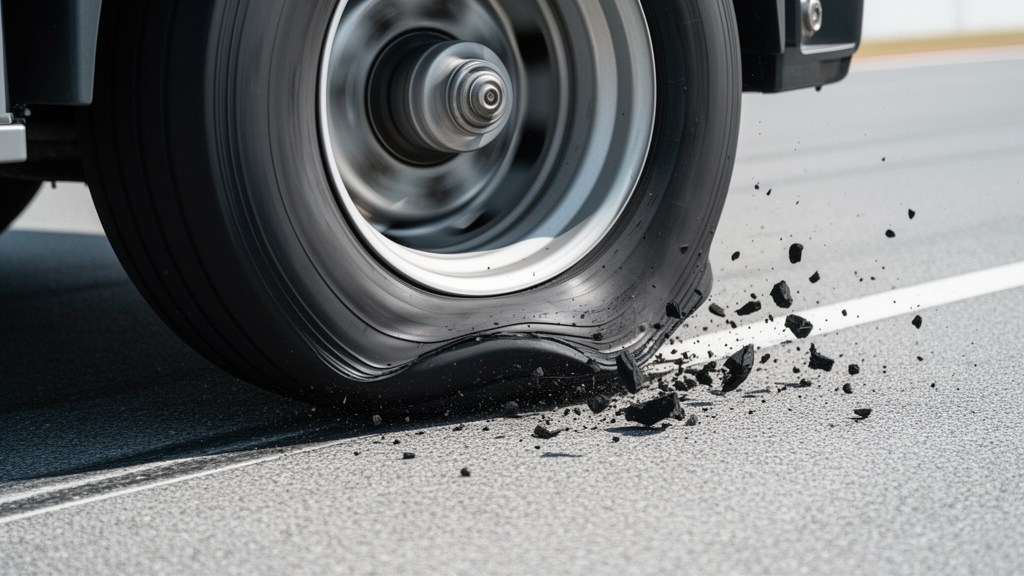
Automotive researchers have developed an indirect tyre pressure monitoring method that combines full-vehicle suspension dynamics with an adaptive forgetting extended Kalman filter to estimate wheel radial stiffness and detect catastrophic blowouts in as little as two to five milliseconds. Because an acute tyre blowout unfolds within approximately one hundred milliseconds, conventional direct tyre pressure monitoring systems, which rely on wheel-mounted radio-frequency sensors that update only once every four to thirty seconds, struggle to supply timely telemetry to on-board electronic stability systems. Writing in Frontiers in Mechanical Engineering, investigators from the State Key Laboratory of Intelligent Vehicle Safety Technology and Chongqing University established a computational framework that infers internal tyre pressure without dedicated pressure transducers. By treating the radial stiffness of all four wheels as state variables in a nonlinear full-vehicle suspension model, the algorithm calculates ongoing dynamic states from vertical acceleration readings.
Maintaining correct inflation pressure is essential for passenger vehicle safety and fuel economy, yet prevailing detection systems face persistent performance and operational hurdles. Direct tyre pressure monitoring systems utilize wireless wheel units powered by internal batteries, but their high component costs, maintenance demands, and restricted radio transmission intervals limit their responsiveness during rapid decompression. Conversely, conventional indirect systems analyze secondary phenomena such as wheel speed differentials, rotational resonance frequencies, or image-based deflection models.
To overcome these limitations, the research team structured a comprehensive state-space representation capturing the vertical, roll, and pitch motions of a passenger vehicle traversing uneven ground. Assuming that previewed road profile elevation can be gathered through forward-looking cameras, millimetre-wave radar, or inertial measurement units, the physical model couples the sprung mass of the chassis to four independent unsprung wheel masses through suspension springs, dampers, and tyre contact patches. Neglecting tyre damping phenomena, the governing differential equations account for vehicle pitch and roll moments of inertia, axle spacings, and lateral track widths. The corresponding measurement output vector incorporates the vertical accelerations of the sprung and unsprung masses across all four corners, data readily gathered by standard automotive chassis accelerometers and streamed across the vehicle controller area network.
Because suspension springs and hydraulic shock absorbers display marked nonlinear behaviour during chassis travel, the authors calibrated equivalent structural parameters using an optimization scheme before executing state estimation. Utilizing a virtual C-Class hatchback model traversing an ISO-A random road surface at eighty kilometres per hour within the CarSim environment, the investigators implemented a genetic algorithm to minimize the root-mean-square error between simulated vehicle responses and theoretical model predictions. Configured with a population size of two hundred individuals, a crossover probability of zero point eight, and a termination ceiling of thirty generations, the genetic solver rapidly converged after the eighteenth iteration, yielding a final optimal fitness value of two point three six three. This identification procedure established precise nominal baselines, including a sprung mass of twelve hundred sixty-seven point seven five kilograms, front and rear suspension spring stiffnesses of twenty-seven thousand ninety-six and thirty-one thousand eight hundred seventy-five newtons per metre, and nominal tyre radial stiffnesses of two hundred sixty-eight thousand newtons per metre.
With the suspension dynamics defined, the authors conducted an observability analysis to guarantee that dynamic tyre stiffness could be reconstructed from onboard accelerometer measurements. Discretizing the continuous state equations through the forward Euler method, the team calculated the Lie derivatives of the measurement vector to construct a nonlinear observability matrix. Mathematical rank evaluations demonstrated that the observability matrix maintains full rank across driving velocities spanning from forty to one hundred twenty kilometres per hour over diverse road excitations, confirming that four-wheel radial stiffness values remain theoretically observable from vertical acceleration outputs. The estimation engine was then constructed around an adaptive forgetting extended Kalman filter. To break the filter’s dependence on obsolete historical measurements during sudden pressure transients, the algorithm scales the prior estimation error covariance matrix by a constant forgetting factor of zero point nine nine eight, allowing the observer to prioritize incoming telemetry without destabilizing ongoing recursive computations.
To guard against mathematical divergence caused by unmodelled chassis dynamics or road irregularities, the algorithm integrates an enhanced Sage-Husa adaptive mechanism that continually recalculates the measurement noise covariance matrix. By evaluating the real-time innovation sequence—the instantaneous difference between actual accelerometer outputs and predicted chassis states—the filter updates its measurement noise statistics and mean values through time-weighted adaptation factors. This dynamic compensation mitigates structural mismatch that arises when vehicle speeds deviate from nominal calibration points. Once the filter produces refined estimates of wheel radial stiffness, the algorithm translates these values into inflation pressures through a fitted linear regression function.
Parallel to recursive pressure estimation, the system executes an automated blowout detection routine driven by the normalized innovation square of chassis accelerations. When a tyre experiences sudden structural failure, the abrupt divergence between physical dynamics and model expectations generates a massive surge in the normalized innovation square. Following empirical simulation tuning designed to balance rapid hazard recognition against accidental false alarms provoked by uneven road seams or steering inputs, the authors established a detection threshold value of two hundred. Exceeding this boundary immediately confirms a severe blowout event, allowing the vehicle system to broadcast a warning to the human-machine interface and prepare onboard electronic stability controllers before secondary handling loss occurs.
The estimation architecture was systematically verified against standard extended Kalman filtering and non-adaptive forgetting filters using a CarSim and MATLAB Simulink co-simulation environment executed on a desktop platform. In a baseline simulation representing a straight roadway at eighty kilometres per hour on an ISO-A surface, the front-left tyre underwent a sudden twenty-five percent pressure drop at twenty seconds, dropping its radial stiffness to two hundred sixteen thousand two hundred thirty-two newtons per metre. The unaugmented extended Kalman filter failed to track the sudden drop, whereas the forgetting filter converged in zero point three five seconds and the adaptive forgetting architecture converged in zero point six two seconds. Crucially, the adaptive variant reduced steady-state root-mean-square estimation errors by an average of sixty-three point two percent and peak-to-peak error values by fifty-nine point nine percent relative to the non-adaptive forgetting filter. Furthermore, the normalized innovation square breached the detection threshold within five milliseconds of the puncture.
The investigators subsequently subjected the algorithm to complex operating environments, encompassing multi-tyre failures, fluctuating forward speeds, and evasive steering inputs. When simulating concurrent pressure drops across all four tyres—a scenario that completely blinds traditional wheel-speed indirect monitoring systems—the adaptive filter achieved stable convergence across all wheels within two point five seconds, trimming average root-mean-square error by thirty-seven point four percent compared to the non-adaptive forgetting filter. In a combined dynamic trial involving rapid deceleration at twenty-five seconds and steering manoeuvres at forty-three seconds following an initial blowout, the adaptive estimator maintained average root-mean-square and peak-to-peak error reductions of forty-two point zero and forty-six point three percent, while identifying the blowout instant within two milliseconds. Additional single-wheel trials conducted at sixty and one hundred kilometres per hour verified that adaptive noise tuning successfully compensates for speed-dependent damping variations that degrade fixed-covariance estimators.
The evaluation concluded with robustness assessments over degraded road profiles, demonstrating consistent performance on rough ISO-B surfaces and digitized real-world road profiles where average error reductions exceeded fifty-five percent over non-adaptive baselines. Nevertheless, the authors noted specific theoretical and practical boundaries governing their current findings. Because all reported validations were completed within virtual co-simulation environments rather than physical proving grounds, the researchers emphasized that future development must focus on deploying the adaptive filtering code onto embedded vehicle controllers and conducting comprehensive experimental trials on instrumented production test vehicles.
Subject of Research: Rapid indirect vehicle tyre pressure monitoring using adaptive state estimation
Article Title: Rapid indirect tyre pressure monitoring using adaptive forgetting extended kalman filter
Article References: Chen, H., Zhang, M., Zhang, Z., Ran, W., & Tan, K. (2026). Rapid indirect tyre pressure monitoring using adaptive forgetting extended kalman filter. Frontiers in Mechanical Engineering, 12, Article 2002362. https://doi.org/10.3389/fmech.2026.2002362
Image Credits: AI Generated
DOI: 10.3389/fmech.2026.2002362
Keywords: tyre pressure monitoring, adaptive forgetting extended kalman filter, normalized innovation square, vehicle suspension dynamics, indirect tpms, tyre blowout detection, radial stiffness estimation, sage husa adaptive filter, carsim matlab cosimulation, genetic algorithm parameter identification, full vehicle state space, unsprung mass acceleration, sprung mass dynamics, automotive safety systems, wheel speed analysis, kalman filter covariance, road surface roughness
News Source: Denise Maddox. (November 23, 2026). Adaptive Extended Kalman Filter Identifies Tyre Blowouts Within Five Milliseconds. Scienmag.