• HOME
  • NEWS
  • EXPLORE
    • CAREER
      • Companies
      • Jobs
    • EVENTS
    • iGEM
      • News
      • Team
    • PHOTOS
    • VIDEO
    • WIKI
  • BLOG
  • COMMUNITY
    • FACEBOOK
    • INSTAGRAM
    • TWITTER
Tuesday, August 18, 2026
BIOENGINEER.ORG
No Result
View All Result
  • Login
  • HOME
  • NEWS
  • EXPLORE
    • CAREER
      • Companies
      • Jobs
        • Lecturer
        • PhD Studentship
        • Postdoc
        • Research Assistant
    • EVENTS
    • iGEM
      • News
      • Team
    • PHOTOS
    • VIDEO
    • WIKI
  • BLOG
  • COMMUNITY
    • FACEBOOK
    • INSTAGRAM
    • TWITTER
  • HOME
  • NEWS
  • EXPLORE
    • CAREER
      • Companies
      • Jobs
        • Lecturer
        • PhD Studentship
        • Postdoc
        • Research Assistant
    • EVENTS
    • iGEM
      • News
      • Team
    • PHOTOS
    • VIDEO
    • WIKI
  • BLOG
  • COMMUNITY
    • FACEBOOK
    • INSTAGRAM
    • TWITTER
No Result
View All Result
Bioengineer.org
No Result
View All Result
Home Headlines

Proteins keep a grip on cells

Bioengineer.org by Bioengineer.org
January 19, 2018
in Headlines, Health, Science News
Reading Time: 2 mins read
0
Share on FacebookShare on TwitterShare on LinkedinShare on RedditShare on Telegram
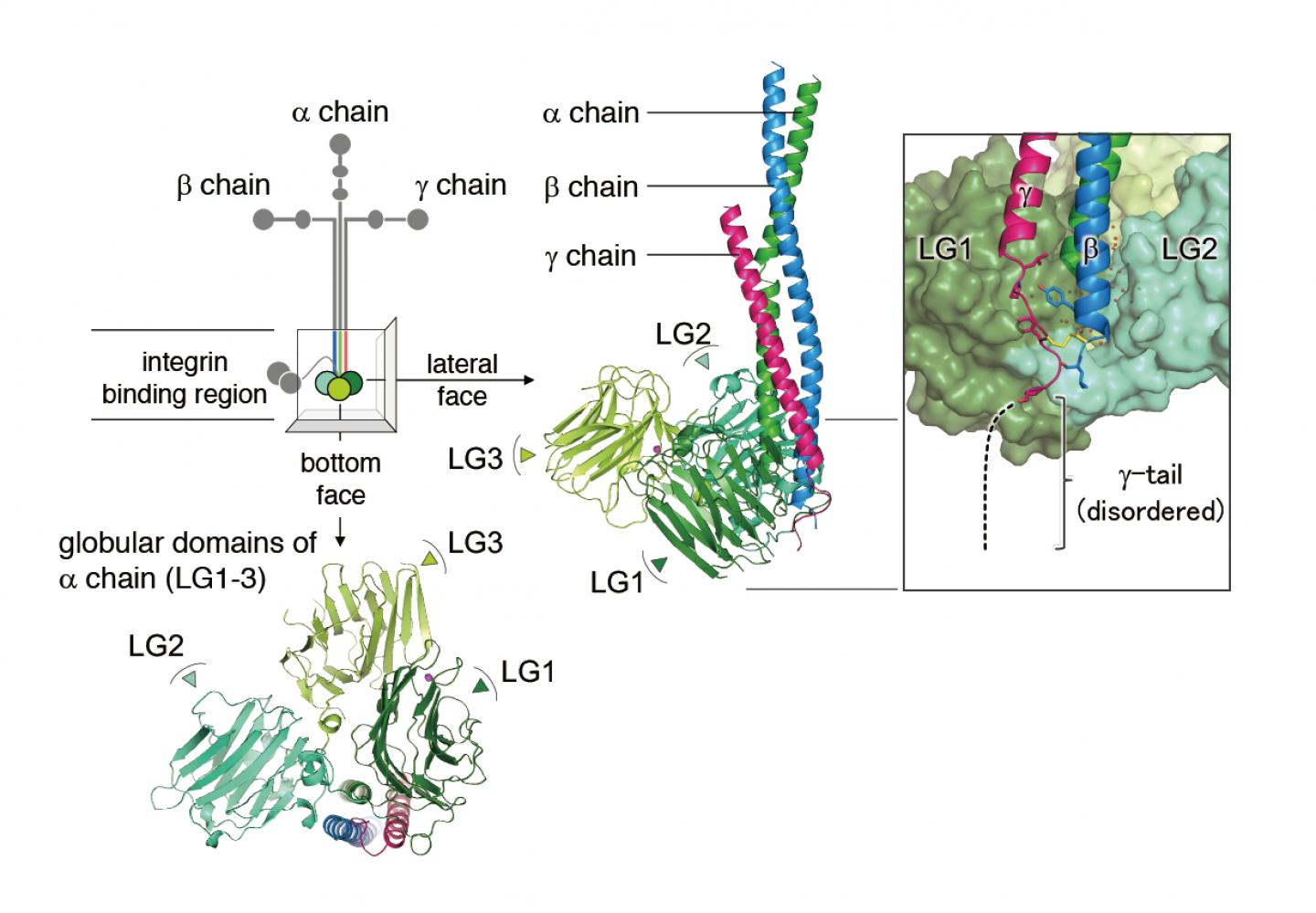
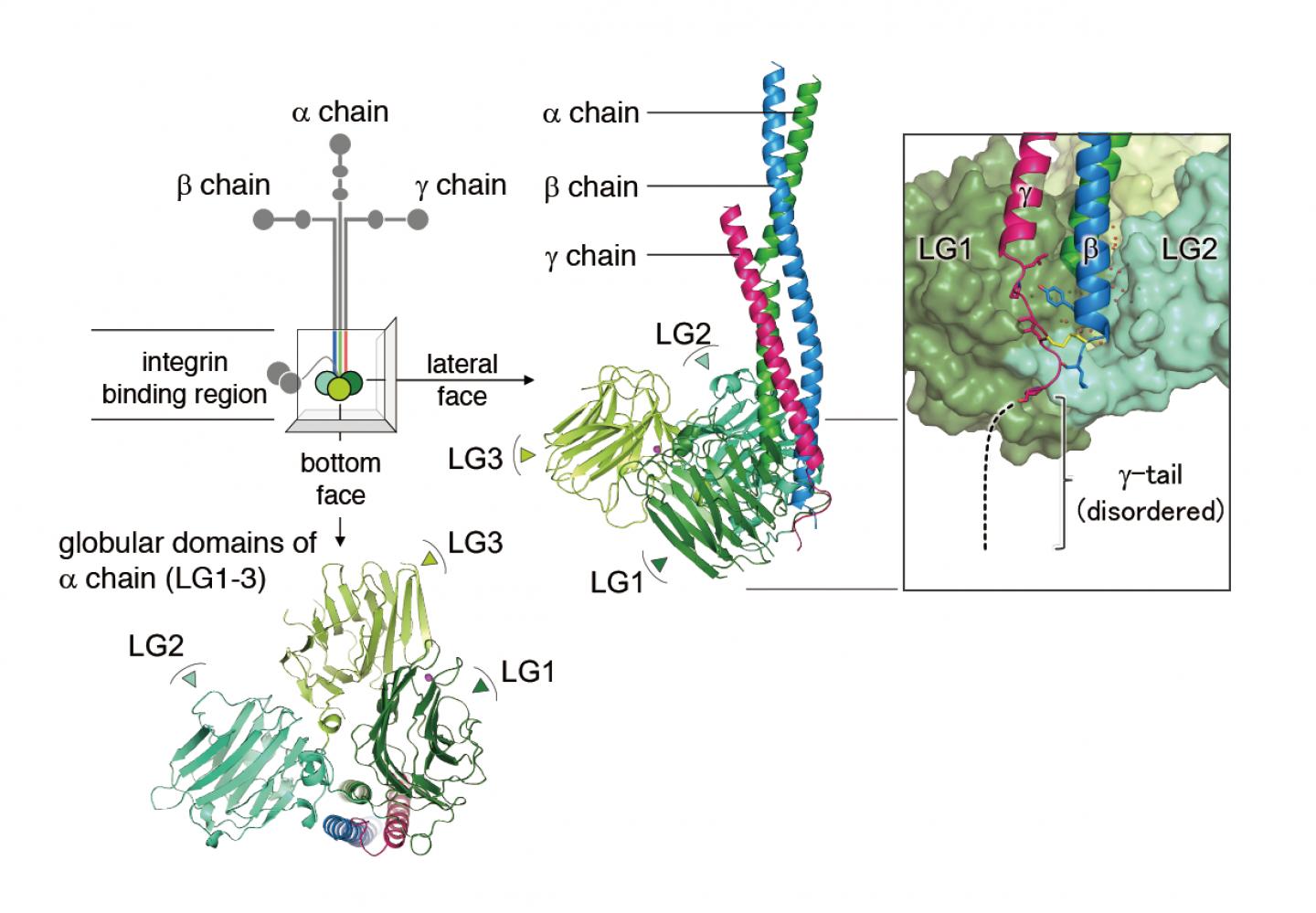
IMAGE

Credit: Osaka University

(Osaka, Japan) While you are what you eat, cells are what they touch. The cells with which it interacts will determine a cell's function, shape, and in some cases even identity. Crucial to these interactions are laminins, a family of adhesion molecules, and integrins, a family of molecules that lie on the cell surface and are receptors for laminins. Among the many laminins, Laminin 511 interests scientists because it is found from the time of the embryo and persists throughout life. Using advanced electron microscopy methods, researchers from the Institute for Protein Research, Osaka University, have uncovered precisely where laminin 511 interacts with integrins.

"Laminins consist of 3 chains, alpha, beta and gamma," explains Professor Kiyotoshi Sekiguchi, who led the study. "Each chain interacts differently with integrin."

It is known that the specific domains of the alpha chain (LG1-3) and the gamma chain are essential for binding to integrin, but scientists are unsure if the gamma chain directly interacts with integrin or facilitates interaction with LG1-3.

"Our previous work showed that the glutamic acid residue in the third position from the C-terminus of the gamma chain is crucial for integrin binding. We do not know if the residue promotes an active LG1-3 conformation or if it interacts directly with integrins," adds Sekiguchi.

For glutamic acid to directly interact, it would need to coordinate with a metal ion site in the integrin. To test this hypothesis, Sekiguchi's team observed the integrin-binding fragment of laminin 511 using electron microscopy. Mutations in the fragment confirmed that the glutamic acid coordinates with a metal ion-dependent adhesion site of integrin, arguing the gamma chain directly interacts with integrin.

The electron microscopy images indicate the gamma chain interaction stabilizes the laminin-integrin interaction.

"LG1-3 brings the gamma tail in close contact with the metal ion-dependent adhesion site. This interaction is important for cell function. Understanding how the interaction is stabilized helps us understand how function is sustained."

###

Media Contact

Saori Obayashi
[email protected]
81-661-055-886
@osaka_univ_e

http://www.osaka-u.ac.jp/en

Original Source

http://resou.osaka-u.ac.jp/en/research/2017/20170902_1 http://dx.doi.org/10.1126/sciadv.1701497

Share12Tweet8Share2ShareShareShare2

Related Posts

Scientists uncover how inflammatory molecules drive cancer progression

August 18, 2026
Five new Cyprus wasp species discovered, including one named after Aphrodite

Five new Cyprus wasp species discovered, including one named after Aphrodite

August 18, 2026

Dual-frequency photoacoustic imaging maps vessels and oxygenation across the mouse brain

August 18, 2026

Locus-Specific Analysis Reveals Genetic Risk Mechanisms Behind Complex Diseases

August 18, 2026
Please login to join discussion

POPULAR NEWS

  • Scientists uncover how inflammatory molecules drive cancer progression

    29 shares
    Share 12 Tweet 7
  • Five new Cyprus wasp species discovered, including one named after Aphrodite

    29 shares
    Share 12 Tweet 7
  • Dual-frequency photoacoustic imaging maps vessels and oxygenation across the mouse brain

    29 shares
    Share 12 Tweet 7
  • Locus-Specific Analysis Reveals Genetic Risk Mechanisms Behind Complex Diseases

    29 shares
    Share 12 Tweet 7

About

BIOENGINEER.ORG

We bring you the latest biotechnology news from best research centers and universities around the world. Check our website.

Follow us

Recent News

Scientists uncover how inflammatory molecules drive cancer progression

Five new Cyprus wasp species discovered, including one named after Aphrodite

Dual-frequency photoacoustic imaging maps vessels and oxygenation across the mouse brain

Subscribe to Blog via Email

Enter your email address to subscribe to this blog and receive notifications of new posts by email.

Join 85 other subscribers
  • Contact Us

Bioengineer.org © Copyright 2023 All Rights Reserved.

Welcome Back!

Login to your account below

Forgotten Password?

Retrieve your password

Please enter your username or email address to reset your password.

Log In
No Result
View All Result
  • Homepages
    • Home Page 1
    • Home Page 2
  • News
  • National
  • Business
  • Health
  • Lifestyle
  • Science

Bioengineer.org © Copyright 2023 All Rights Reserved.