

• HOME
  • NEWS
  • EXPLORE
    • CAREER
      • Companies
      • Jobs
    • EVENTS
    • iGEM
      • News
      • Team
    • PHOTOS
    • VIDEO
    • WIKI
  • BLOG
  • COMMUNITY
    • FACEBOOK
    • INSTAGRAM
    • TWITTER
Sunday, October 4, 2026
BIOENGINEER.ORG
No Result
View All Result
  • Login
  • HOME
  • NEWS
  • EXPLORE
    • CAREER
      • Companies
      • Jobs
        • Lecturer
        • PhD Studentship
        • Postdoc
        • Research Assistant
    • EVENTS
    • iGEM
      • News
      • Team
    • PHOTOS
    • VIDEO
    • WIKI
  • BLOG
  • COMMUNITY
    • FACEBOOK
    • INSTAGRAM
    • TWITTER
  • HOME
  • NEWS
  • EXPLORE
    • CAREER
      • Companies
      • Jobs
        • Lecturer
        • PhD Studentship
        • Postdoc
        • Research Assistant
    • EVENTS
    • iGEM
      • News
      • Team
    • PHOTOS
    • VIDEO
    • WIKI
  • BLOG
  • COMMUNITY
    • FACEBOOK
    • INSTAGRAM
    • TWITTER
No Result
View All Result
Bioengineer.org
No Result
View All Result
Home Headlines

Protein YAP in early life influences adult spinocerebellar ataxia pathology

Bioengineer.org by Bioengineer.org
January 25, 2018
in Headlines, Health, Science News
Reading Time: 2 mins read
0
Share on FacebookShare on TwitterShare on LinkedinShare on RedditShare on Telegram
IMAGE

Credit: Department of Neuropathology, TMDU

Study led by Tokyo Medical and Dental University (TMDU) identifies crucial protein that rescues progression of adult spinocerebellar ataxia

Tokyo – Spinocerebellar ataxia is a group of neurodegenerative diseases characterized by progressive incoordination of gait, and is often associated with poor coordination of hands, speech, and eye movements. There are different types of SCA, and these are classified based on the mutated (altered) gene. In spinocerebellar ataxia type 1 (SCA1), the causative gene ATXN1 and its interacting factors were determined over two decades ago. However, SCA1 remains intractable, and no disease-modifying therapy has reached the clinical bedside.

As with other neurodegenerative diseases, the understanding of spinocerebellar ataxias, including SCA1, has changed over time. The types of affected neurons are not as specific as initially believed, the effects of these disorders are not limited to single organs, and SCA might be a developmental disorder that affects cerebellar neurons during embryo formation or in early childhood.

These changes in the conception of neurodegenerative conditions have not deterred researchers at Tokyo Medical and Dental University (TMDU) to delve deep into the underlying mechanisms of these diseases. The researchers previously found the overexpression of YAPdeltaC, the neuronal isoform of the protein YAP which is involved in the regulation of gene expression, prevents transcriptional repression-induced atypical death (TRIAD) of neurons in Huntington's disease in vitro models. TRIAD is a distinct form of cell death; it is extremely slow in comparison with apoptosis, necrosis, or autophagy.

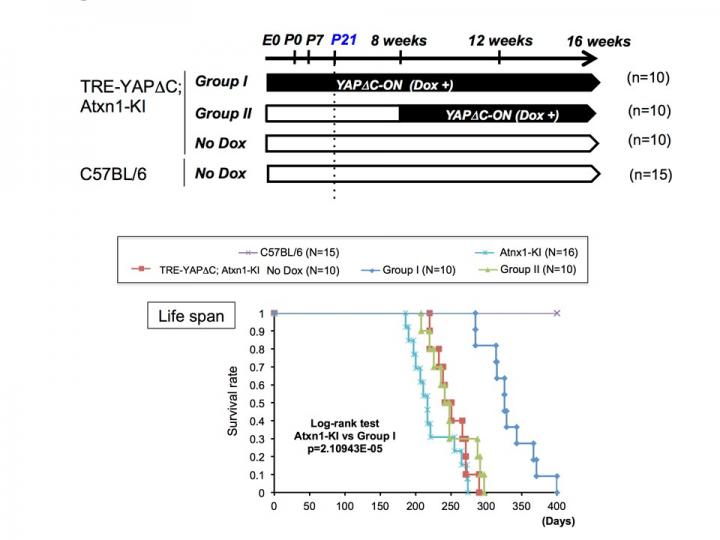
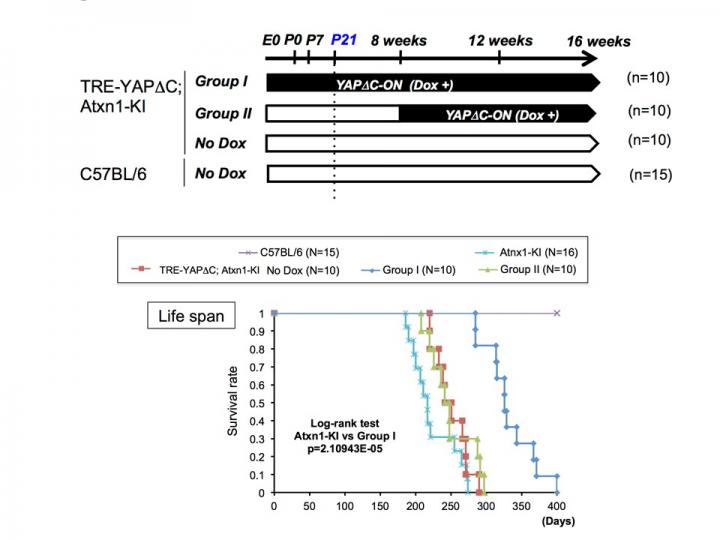
In a new study, the researchers further tested the therapeutic effect of YAPdeltaC – this time on SCA1 pathology in mice. They published their findings in Nature Communications.

"Unexpectedly, adulthood expression of YAPdeltaC did not ameliorate the pathology and symptoms of Atxn1-KI mice," study lead author Kyota Fujita explains. "Instead, YAPdeltaC expression during development markedly rescued the pathology and symptoms in adulthood."

The researchers also found that YAP/YAPdeltaC functioned as a transcriptional co-activator of RORα, a protein essential for development of cerebellum through direct regulation of genes expressed in Purkinje cells, a class of GABAergic neurons found in the mice cerebellum. The supplementation of YAP/YAPdeltaC successfully overcame the toxic effect of mutant Atxn1 protein and restored the transcriptional activity of RORα.

"Collectively, our results indicate that functional impairment of YAP/YAPdeltaC by mutant Atxn1 protein during development determines the adult pathology of SCA1," corresponding author Hitoshi Okazawa says. "We believe certain molecular signatures generated during development significantly influence late-onset phenotypes, and that these signatures act by restoring gene expression to optimal levels. Therefore, identification of these signature genes would enable us to manipulate the late-onset cell death of SCA1 – and even other neurodegenerative diseases – in the future."

###

The article, "Developmental YAPdeltaC determines adult pathology in a model of spinocerebellar ataxia type 1" was published in Nature Communications at DOI: 10.1038/s41467-017-01790-z.

Media Contact

Hitoshi OKAZAWA
[email protected]

http://www.tmd.ac.jp/english/

Original Source

http://www.tmd.ac.jp/english/press-release/20180112_1/index.html http://dx.doi.org/10.1038/s41467-017-01790-z


Share12Tweet8Share2ShareShareShare2

Related Posts

New Study Examines How Dedicated Dermatology Textbooks Represent Skin of Colour

New Study Examines How Dedicated Dermatology Textbooks Represent Skin of Colour

October 4, 2026
Adding Immunotherapy to Chemo and Bevacizumab Extends Survival in Recurrent Cervical Cancer

Adding Immunotherapy to Chemo and Bevacizumab Extends Survival in Recurrent Cervical Cancer

October 4, 2026

Forskolin Extract Boosts Gut Hormone GLP-1 and Strengthens Intestinal Barrier in Cell Study

October 4, 2026

Empathy, Not Mood, Drives Helping in Autistic Children, Study Finds

October 4, 2026
Please login to join discussion

POPULAR NEWS

  • Alloys That Shrink Their Own Grains: New PIX Mechanism Refines Metals With Heat Alone

    Alloys That Shrink Their Own Grains: New PIX Mechanism Refines Metals With Heat Alone

    29 shares
    Share 12 Tweet 7
  • Endurance Exercise Reshapes the Liver in Males and Females Through Distinct Molecular Routes

    29 shares
    Share 12 Tweet 7
  • Single Transcription Factor PU.1 Rapidly Converts Fibroblasts into Macrophage-Lineage Cells

    29 shares
    Share 12 Tweet 7
  • New Scale Measures How Ready Nurse Educators Really Are for the AI Era

    29 shares
    Share 12 Tweet 7

About

We bring you the latest biotechnology news from best research centers and universities around the world. Check our website.

Follow us

Recent News

Alloys That Shrink Their Own Grains: New PIX Mechanism Refines Metals With Heat Alone

Endurance Exercise Reshapes the Liver in Males and Females Through Distinct Molecular Routes

Single Transcription Factor PU.1 Rapidly Converts Fibroblasts into Macrophage-Lineage Cells

Subscribe to Blog via Email

Success! An email was just sent to confirm your subscription. Please find the email now and click 'Confirm' to start subscribing.

Join 85 other subscribers
  • Contact Us

Bioengineer.org © Copyright 2023 All Rights Reserved.

Welcome Back!

Login to your account below

Forgotten Password?

Retrieve your password

Please enter your username or email address to reset your password.

Log In
No Result
View All Result
  • Homepages
    • Home Page 1
    • Home Page 2
  • News
  • National
  • Business
  • Health
  • Lifestyle
  • Science

Bioengineer.org © Copyright 2023 All Rights Reserved.
