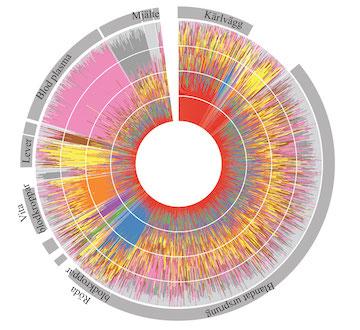
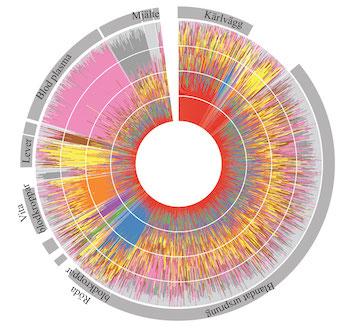
IMAGE: This is a graph from the study: Tissue-specific protein in blood plasma.
Credit: Research team/Study
Researchers from Lund University and the University of Zurich have developed a way to use mass spectrometry to measure hundreds of proteins in a single blood sample. With the help of protein patterns it is then possible to determine the severity of a patient's sepsis (blood poisoning) condition and which organs have been damaged. The method is presented in an article in Nature Communications.
"We use the blood as a mirror reflecting what happens in the body", says Johan Malmström. He is a biomedical scientist, while his brother and fellow researcher Erik, lead author of the article, is a medical intern. Both are affiliated with Lund University. The third brother Lars works in bioinformatics at the University of Zurich. The team has been able to map the majority of all proteins that can be found in vital organs such as the heart, lung, liver, spleen and blood vessels, and listed which proteins are specific to each specific organ.
"If you see in a blood sample that the amount of proteins from a specific organ increases, it indicates damage to this organ. The method provides an understanding of the molecular events that take place during the course of a disease, and the possibility, using the same analysis, to study how different organs are affected", explains Erik Malmström.
Sepsis (formerly called blood poisoning) is caused by a bacterial infection, and is a condition in which the immune system starts to react erroneously in different ways. However, it is often difficult to diagnose, because the symptoms of sepsis – including high breathing rate, fever, rapid pulse, pain and confusion – occur in milder conditions as well. Also, the progression of the disease can be very fast, and become fatal in just a few hours. Therefore, there is a great need for faster diagnosis and better understanding of the course of the disease.
Another researcher at Lund University, Adam Linder, has begun to develop a diagnostic method based on the protein HBP. This protein is emitted from the white blood cells and reflects the risk of hypotension.
The Malmström group's study of hundreds of different proteins could eventually be used to select other important proteins that can serve as biomarkers for different aspects of sepsis. First and foremost, however, the method is an important research tool.
"There is so much we don't know about sepsis. Why do not all patients react the same way – why do some organs suffer the most damage in some patients and not in others? Do different bacteria cause the disease to progress? Can you divide patients into different subgroups, or bacteria, or does each new combination of patients and bacteria lead to a specific form of sepsis?" asks Erik Malmström.
The researchers have conducted their studies on animals, but are now moving on to human tissue. Through a collaboration with surgeons at Skåne University Hospital they have obtained samples of healthy tissue from all organs concerned. Protein patterns of these samples can then be compared with the corresponding tissue in sepsis patients.
"Protein mapping like this has never been done before. The method can also be applied to other diseases for studying how pathological changes in various organs are reflected in a blood sample", says Johan Malmström.
###
Download study: Malmström, E., Kilsgård, O., Hauri, S., Smeds, E., Herwald, H., Malmström L., and Malmström, J (2016). Large-scale inference of protein tissue origin in gram-positive sepsis plasma using quantitative targeted proteomics. Nature Communications
LINK: http://www.nature.com/ncomms/2016/160106/ncomms10261/full/ncomms10261.html#f3
Media Contact
Cecilia Schubert
[email protected]
46-046-222-7646
@lunduniversity
http://www.lu.se