Aptamers, the nucleic acid-based biosensors with the ability to bind specific proteins or small molecules, offer a way to identify target molecules without the complexity of analytical apparatuses. While being increasingly used in diagnostic applications for various diseases, their potential as effective sensors for cancer is particularly noteworthy, because early detection of cancer can lead to an over 90% cure rate. However, aptamers face critical limitations as they are susceptible to degradation or aggregation by nucleases or charged proteins present in biological samples such as blood or saliva. This makes it challenging to utilize them directly in clinical samples without first removing those molecules. Recently, a team of researchers from Pohang University of Science and Technology (POSTECH) solved this problem using a protein-based microcapsule.
Credit: POSTECH
Aptamers, the nucleic acid-based biosensors with the ability to bind specific proteins or small molecules, offer a way to identify target molecules without the complexity of analytical apparatuses. While being increasingly used in diagnostic applications for various diseases, their potential as effective sensors for cancer is particularly noteworthy, because early detection of cancer can lead to an over 90% cure rate. However, aptamers face critical limitations as they are susceptible to degradation or aggregation by nucleases or charged proteins present in biological samples such as blood or saliva. This makes it challenging to utilize them directly in clinical samples without first removing those molecules. Recently, a team of researchers from Pohang University of Science and Technology (POSTECH) solved this problem using a protein-based microcapsule.
The research team led by professors Seung Soo Oh and Sungwook Woo, and PhD candidate Jinmin Kim from the Department of Materials Science and Engineering at POSTECH developed an aptamer sensor system that allows for the rapid detection of target molecules directly from biological samples, eliminating the need for pretreatment processes. This research has been published in ‘Biosensors and Bioelectronics’, an international journal dedicated to biosensors.
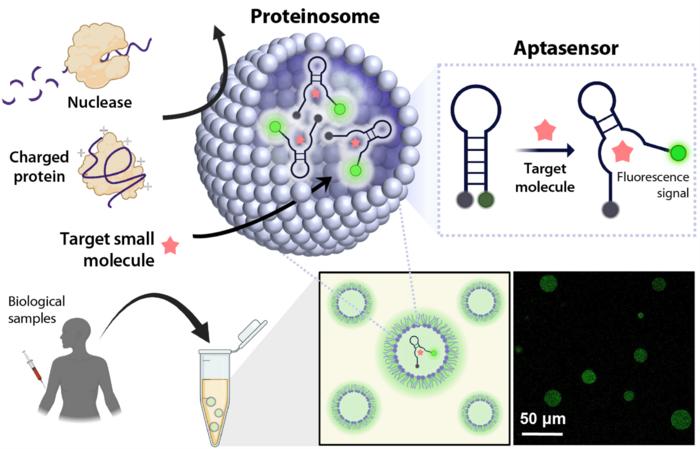
In this research, the team created spherical microcapsules called proteinosomes based on self-assembly of protein-polymer amphiphiles. The microcapsule was designed to contain an aptasensor based on a structure-switching aptamer that reacts with target molecules to produce a fluorescent signal instantaneously, and its surface is composed of a size-selective semi-permeable membrane that selectively permits only small target molecules to pass through while effectively blocking the entry of larger harmful proteins. The results demonstrated that the optimal performance of the aptasensor for target detection was fully preserved even in non-treated biofluids, enabling effective and rapid detection of target molecules such as estradiol, an important female hormone associated with cancer in reproductive organs, dopamine, a neurotransmitter that is indicative of Parkinson’s or Alzheimer’s diseases, and cocaine, a controlled substance that often requires rapid on-site detection.
The capsules developed by the researchers demonstrated robust protection against harmful proteins. For example, aptasensors housed within the microcapsules stayed undamaged for 18 hours in highly concentrated nuclease solutions, about 300,000 times the normal serum level. In addition, by leveraging the property that each capsule functions as an independent ‘reaction vessel,’ the researchers demonstrated independent operation of multiple aptasensors in the same mixture, enabling simultaneous real-time sensing of multiple target molecules and monitoring their respective concentration changes.
Professor Seung Soo Oh who led the research explained, “By integrating sample separation and target detection, we have pioneered a novel small molecule point-of-care biosensor technology that is directly applicable to biological samples such as serum.” He added, “This platform has the potential to revolutionize medicine, spanning early disease detection and personalized treatment.” PhD candidate Jinmin Kim remarked, “The proteinosome-based sensing platform is a versatile system because it can be extended to sensors for various target molecules by simply changing the aptasensor inside.”
The research was conducted with support from the STEAM Research Program and the Basic Research Projects of the Ministry of Science and ICT and the National Research Foundation of Korea, the R&D Programs of the Ministry of Trade, Industry and Energy and the Korea Planning & Evaluation Institute of Industrial Technology, the Dual-Use Technology Projects of the Institute of Civil Military Technology Cooperation under the Agency for Defense Development, and the Basic Science Research Capacity Enhancement Project of the Korea Basic Science Institute.
Journal
Biosensors and Bioelectronics
DOI
10.1016/j.bios.2024.116062
Article Title
Aptasensor-encapsulating semi-permeable proteinosomes for direct target detection in non-treated biofluids
Article Publication Date
12-Feb-2024