Secondary skin complications represent the most prevalent health condition among individuals with lower limb loss, affecting approximately sixty-three percent of amputees who rely on prosthetic devices for daily upright mobility. Writing in Biomedical Materials and Devices, a multidisciplinary research team led by Ming Liu examined the clinical realities governing the residual limb-socket interface, emphasizing that technological advancements in sensor development have largely failed to translate into improved patient outcomes. Traditional socket evaluation continues to depend almost exclusively on subjective feedback from patients, creating substantial risks of tissue breakdown for individuals who present with compromised sensation or peripheral neuropathy. Although prosthetic sockets remain the primary physical link transferring mechanical forces between residual bone and artificial limbs, existing clinical practices lack quantitative tools to measure force distributions accurately during real-world locomotion. Without reliable, real-time diagnostic data to support evidence-based decision-making, mechanical failures at this boundary frequently trigger deep tissue injury, chronic pain, and permanent abandonment of mobility devices.
Lower limb loss constitutes a profound clinical and financial challenge worldwide, with approximately one hundred and fifty thousand major lower limb amputations performed annually within the United States alone. The lifetime medical expenses for an individual undergoing lower limb amputation frequently exceed eight hundred thousand dollars when adjusting for inflation, reflecting the immense personal and institutional costs associated with continuous rehabilitation and hardware maintenance. Although direct skeletal fixation through osseointegration has emerged as an alternative in multiple countries, its clinical availability remains constrained and long-term biological outcomes are still undergoing active investigation. Consequently, external prosthetic sockets constructed from high-strength composites such as carbon fiber remain the dominant standard of care. Because successful ambulation correlates directly with employment rates and psychological wellbeing, sustaining a comfortable and secure connection between the limb and the prosthesis is paramount. When an interface fails to distribute cyclical mechanical forces properly, the resulting localized tissue trauma leads to recurrent clinical visits, costly revisions, and devastating interruptions in patient independence.
The engineering architecture connecting a residual limb to a prosthetic limb comprises an intricate assembly of interlocking structural and cushioning layers. At its foundation, a custom-molded rigid socket mimics the patient geometry, occasionally incorporating a softer inner socket layer to permit localized mechanical adjustments. Between the limb and the socket wall, clinical teams introduce suspension systems, flexible elastomeric liners, and variable layers of prosthetic socks that amputees don or doff to accommodate fluctuating tissue volume. Additional mechanical hardware, including pin-lock pins, external suspension sleeves, waist belts, and active or passive vacuum pumps located at the prosthetic foot, serves to counteract gravitational and centrifugal forces during leg swing. Despite this complexity, the fabrication and lifetime management of this interface proceed across two sequential stages, designated as the manufacturing stage and the long-term maintenance stage, both of which currently suffer from an absence of standardized quantitative performance metrics.
Fabricating a functional socket requires several weeks to months, beginning with physical casting, non-contact optical scanning, or manual anthropometric measurements collected by a certified prosthetist. Using these geometric profiles alongside clinical appraisals of scar tissue and bony prominences, prosthetists manufacture an initial transparent diagnostic test socket, commonly termed a check socket, out of thermoformable polymers such as polycarbonate or polyethylene terephthalate glycol. The clear walls permit clinicians to observe tissue blanching directly and perform rapid physical adjustments by applying localized heat during clinic trials. Nevertheless, reimbursement policies typically constrain practitioners to evaluate two or fewer test sockets before proceeding to permanent lamination. Furthermore, standard in-clinic evaluations fail to capture the extreme dynamic stress distributions that emerge during unconstrained community locomotion. While permitting patients to wear test sockets outside clinical settings has been explored, the limited structural durability of diagnostic thermoplastics introduces unacceptable risks of catastrophic mechanical fracture and falling.
Following patient acceptance, the interface enters a maintenance phase lasting approximately three years before complete socket replacement becomes medically necessary. During this extended interval, the rigid socket frame cannot undergo substantial structural redesign without documented changes in residual limb shape to satisfy health insurance reimbursement requirements. Amputees must independently monitor their skin integrity, managing daily volume fluctuations by adding prosthetic socks, inserting localized pads, or adjusting suspension straps. When routine self-management fails to resolve discomfort, prosthetists perform aggressive modifications by bonding permanent internal pads or drilling perforation windows through the rigid socket shell to relieve regional stiffness. If residual limb volume contracts significantly, practitioners insert spacer pads between the outer carbon frame and a flexible inner socket layer. However, the success of these iterative interventions depends entirely on the patient capacity to detect localized mechanical distress and articulate specific structural discomfort accurately before severe ulceration occurs.
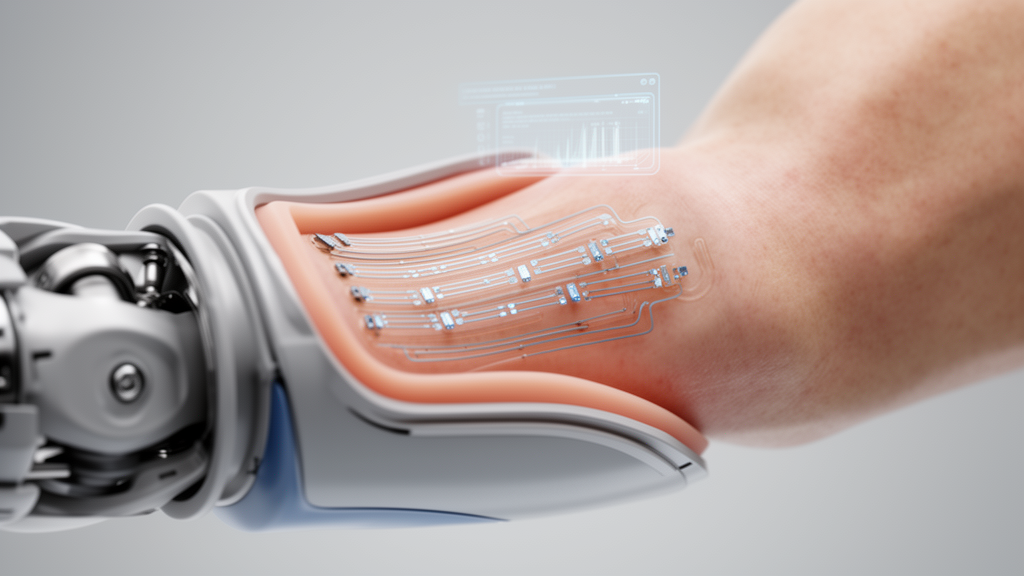
Current commercial sensing systems intended for residual limb assessment face severe practical constraints that limit their routine clinical adoption. Flexible force-sensing grids placed over regional limb surfaces provide localized pressure amplitudes, but they cover only a minor fraction of the total weight-bearing area. Because standard prosthetic design principles intentionally concentrate mechanical loads across pressure-tolerant anatomical structures, isolated numerical readings cannot distinguish intentional weight-bearing gradients from pathological force concentrations. Moreover, mechanical pressure represents only one contributing factor in ulcer etiology, which is heavily influenced by localized thermal accumulation, shear stress, tissue ischemia, and elevated humidity. Translating laboratory sensor pads into daily clinical practice is further obstructed by cumbersome physical wiring, tedious donning procedures, and software systems that fail to register sensor measurements intuitively against anatomical landmarks, leaving clinicians without actionable diagnostic guidance.
Physical and economic constraints within modern healthcare systems create additional friction against deploying complex electronic hardware at the residual limb boundary. Constructing an initial socket assembly costs between three thousand and twelve thousand dollars, leaving patients vulnerable to substantial out-of-pocket deductibles and copayments that deter elective technological additions. Sensor hardware integrated into daily prostheses must demonstrate the capacity to extend socket lifespan or prevent catastrophic tissue injury to justify reimbursement from institutional payors. From a clinical perspective, diagnostic tools must operate rapidly without encroaching upon limited appointment schedules, deliver instantly interpretable diagnostic displays, and withstand repeated clinical usage across diverse socket geometries.
The physical environment within an enclosed prosthetic socket presents extraordinary challenges for electronic and mechanical longevity. The established biomechanical doctrine of total surface contact dictates that no dead space should exist between the residual limb and the socket, maximizing the surface area available to distribute axial loads. Introducing bulky sensing inserts, protruding interconnects, or thick wire bundles into this tight boundary fundamentally alters local force distributions, paradoxically increasing the risk of pressure ulcers. Furthermore, routing electrical wiring through holes drilled directly in the socket shell degrades structural composite integrity, disrupts the hermetic vacuum seals essential for suction suspension, and produces dangerous stress risers. Conversely, passing long cables upward through the proximal socket opening exposes delicate wiring to severe cyclic bending, which precipitates frequent mechanical fatigue failures and generates micro-channels that compromise suspension suction during the swing phase of gait.
To overcome the operational limitations of traditional wired arrays during diagnostic evaluations, investigators are developing functional responsive materials that display mechanical stress through direct optical feedback. Transparent check sockets offer an ideal platform for materials that change optical properties under mechanical deformation, completely eliminating external cables and external data processing computers. For example, elastomeric photonic structures comprising alternating nanoscale layers of polydimethylsiloxane and polystyrene-polyisoprene triblock copolymers function as flexible optomechanical Bragg reflectors. When tensile strain stretches these layered fibers, their optical reflection peak shifts predictably from longer red wavelengths toward shorter blue wavelengths. Similarly, sandwich-structured sensors combining micro-pyramidal polymer electrolytes with tungsten oxide thin films undergo reversible redox reactions that alter optical transmission under compression. Other platforms employ embedded liquid metal microchannels within silicone to induce localized Joule heating and trigger thermochromic color shifts, although these thermal approaches reflect accumulated temporal averages rather than instantaneous dynamic peak pressures.
Assessing ischemic tissue damage at vulnerable residual limb regions requires monitoring physiological biomarkers that directly reflect microvascular health rather than mechanical forces alone. Because sustained external pressures induce capillary occlusion, tracking localized subcutaneous blood flow and tissue oxygen saturation provides a reliable indicator of impending tissue necrosis. Diagnostic modalities including transcutaneous oxygen measurement, metabolic positron emission tomography, near-infrared spectroscopy, and commercial subepidermal moisture scanners have demonstrated capabilities in identifying early-stage tissue injury under static experimental conditions. However, their physical performance under continuous cyclic loading cycles remains largely uncharacterized. Applying early detection technologies during the initial fabrication phase presents procedural complications, because if an incipient ulcer is detected, socket evaluation must be suspended until complete tissue recovery occurs, thereby preventing clinicians from determining whether structural modifications successfully mitigated localized mechanical trauma.
For daily patient monitoring outside hospital environments, tracking axial displacement between the residual limb and the prosthetic socket, known clinically as pistoning, serves as an intuitive mechanical marker of suspension efficacy. Although clinical conventions traditionally dictate that axial motion should remain below one-quarter of an inch, observational studies demonstrate that experienced prosthesis users routinely tolerate pistoning excursions exceeding one inch without developing dermatological breakdown. Contemporary monitoring platforms evaluate this dynamic displacement by tracking integrated liner pins, distal electromagnetic sensors, surface-mounted magnets, or optical displacement sensors similar to those used in computer mice. However, these systems rely on the unverified physiological assumption that elastomeric liners remain continuously locked against underlying cutaneous tissue without regional slippage. Because relative motion varies dramatically across different residual limb aspects, single-point displacement readings provide an incomplete appraisal that cannot reliably guide structural socket revisions.
Flexible textile electronics represent a compelling architecture for long-term physiological monitoring by embedding sensing elements directly into inexpensive, replaceable prosthetic socks. Integrating piezoresistive, capacitive, piezoelectric, or triboelectric sensing yarns into standard fabrics allows comprehensive surface monitoring across residual limb anatomy without adding prohibitive hardware costs. For example, multi-patch capacitive arrays utilizing woven conductive and insulating yarns encapsulated in copper-nickel coated polyester fabrics have successfully captured pressure dynamics over the patellar tendon and popliteal fossa during walking. Meanwhile, self-powered triboelectric nanogenerator arrays composed of electrospun polymer nanofibers have demonstrated real-time pressure sensitivity without external power supplies in simulated socket simulators. Nevertheless, transitioning these laboratory textile systems into clinical validation requires extensive home-based clinical trials, establishing definitive diagnostic guidelines that directly empower clinicians and amputees to preserve lifelong skin health.
Subject of Research: Clinical challenges and engineering requirements for prosthetic residual limb-socket interface monitoring
Article Title: Monitoring the Residual Limb-Socket Interface: A Perspective on Clinical Needs and Challenges
Article References: Liu, M., Evert, B., Kim, S., Dickey, M. D., Bozkurt, A., & Filer, W. (2025). Monitoring the Residual Limb-Socket Interface: A Perspective on Clinical Needs and Challenges. Biomedical Materials & Devices. https://doi.org/10.1007/s44174-025-00594-w
Image Credits: AI Generated
DOI: 10.1007/s44174-025-00594-w
Keywords: residual limb socket interface, prosthetic socket, lower limb amputation, prosthetic fitting, pressure ulcers, skin breakdown, pistoning monitoring, check socket, prosthetic liners, wearable sensors, textile sensing, biomedical engineering, triboelectric nanogenerators, optomechanical fibers, clinical translation, rehabilitation technology
News Source: Drew Townsend. (November 24, 2026). Prosthetic Socket Sensor Systems Require Clinical Integration to Prevent Amputee Skin Complications. Scienmag.