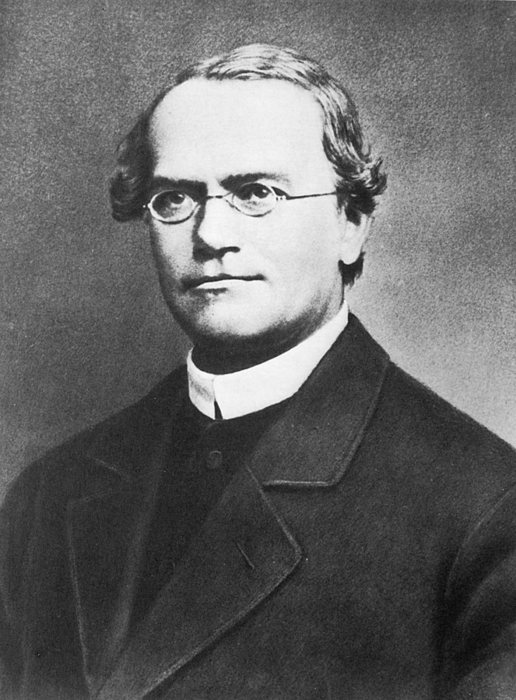
Gregor Mendel, the Moravian monk, was indeed “decades ahead of his time and truly deserves the title of ‘founder of genetics.’” So concludes an international team of scientists as the 200th birthday of Mendel approaches on 20 July.
Credit: N/A
Gregor Mendel, the Moravian monk, was indeed “decades ahead of his time and truly deserves the title of ‘founder of genetics.’” So concludes an international team of scientists as the 200th birthday of Mendel approaches on 20 July.
The team, from KeyGene in the Netherlands and the John Innes Centre in the UK, draw on newly-discovered historical information to conclude that, when his proposals are viewed in the light of what was known of cells in the mid-19th century, Mendel was decades ahead of his time.
“Uncovering hidden details about Mendel has helped to build a picture of the scientific and intellectual environment in which he worked. At the outset Mendel knew nothing about Genetics and had to deduce it all for himself. How he went about this is highly instructive,” said Dr Noel Ellis from the John Innes Centre, one of the contributors to the study.
The new information shows that Mendel began his work with the practical objectives of a plant breeder, before he became interested in the underlying biological processes that condition the heritable differences between organisms. It also shows that Mendel recognised the importance of understanding the formation of reproductive cells and the process of fertilisation.
A small but rich inheritance
Mendel’s work and ideas have been studied by many, even though material describing his work is limited. Where Darwin left thousands of letters, for Mendel only a few are known.
Mendel’s work started to receive significant recognition 34 years after its publication and 16 years after his death. No notes relating to this work have been found. All that was left was a pair of scientific papers, one of which is the famous ‘Experiments on Plant Hybrids’ published in German in 1866. This paper remains the basis of what children at school learn about genetics today.
Newspaper articles from Mendel’s time have been digitised
Thanks to modern technology, the authors were able to extract valuable information from 19th-century newspaper articles, proceedings, and yearbooks that have recently been digitised. These show how advanced the ideas and work of Mendel were as he used cell biological theory to come to conclusions on how traits of plants are transmitted from parents to their offspring.
Mendel’s Elemente: what we know as genes
Mendel noted that pea plants must maintain and transmit the ‘code’ for the appearance of a trait, we now call these coding instructions genes, Mendel called them ‘Elemente.’
For many traits, two different Elemente or ‘Elements’ are present, for example to code for flower colour in peas, one which conditions purple and an alternative for white flower colour.
Mendel proposed that in the male and female parts of the flower, reproductive cells are formed that only contain one type of Element, and these single Elements are transmitted to a daughter plant, one from the male and another from the female.
We now know that only half of the number of chromosomes is transmitted to egg cells in the female flower parts and pollen in the male flower parts, thanks to the division that occurs during meiosis at the formation of gametes.
Two centuries on from his birth this remarkable scientific life is still offering up new insights.
The article, How did Mendel arrive at his discoveries? appears in Nature Genetics
Journal
Nature Genetics
DOI
10.1038/s41588-022-01109-9
Method of Research
Data/statistical analysis
Subject of Research
Not applicable
Article Title
How did Mendel arrive at his discoveries?
Article Publication Date
11-Jul-2022