• HOME
  • NEWS
  • EXPLORE
    • CAREER
      • Companies
      • Jobs
    • EVENTS
    • iGEM
      • News
      • Team
    • PHOTOS
    • VIDEO
    • WIKI
  • BLOG
  • COMMUNITY
    • FACEBOOK
    • INSTAGRAM
    • TWITTER
Saturday, May 2, 2026
BIOENGINEER.ORG
No Result
View All Result
  • Login
  • HOME
  • NEWS
  • EXPLORE
    • CAREER
      • Companies
      • Jobs
        • Lecturer
        • PhD Studentship
        • Postdoc
        • Research Assistant
    • EVENTS
    • iGEM
      • News
      • Team
    • PHOTOS
    • VIDEO
    • WIKI
  • BLOG
  • COMMUNITY
    • FACEBOOK
    • INSTAGRAM
    • TWITTER
  • HOME
  • NEWS
  • EXPLORE
    • CAREER
      • Companies
      • Jobs
        • Lecturer
        • PhD Studentship
        • Postdoc
        • Research Assistant
    • EVENTS
    • iGEM
      • News
      • Team
    • PHOTOS
    • VIDEO
    • WIKI
  • BLOG
  • COMMUNITY
    • FACEBOOK
    • INSTAGRAM
    • TWITTER
No Result
View All Result
Bioengineer.org
No Result
View All Result
Home NEWS Science News Chemistry

Promoting the electrochemical hydrogenation of furfural by synergistic Cu0-Cu+ active sites

Bioengineer by Bioengineer
February 23, 2023
in Chemistry
Reading Time: 2 mins read
0
Stepwise synergistic electrochemical hydrogenation of furfural with mixed valence copper
Share on FacebookShare on TwitterShare on LinkedinShare on RedditShare on Telegram

This study is led by Prof. Yuqin Zou (College of Chemistry and Chemical Engineering, Hunan University). The experiments were performed by using a series of in situ characterization and the density functional theory (DFT) calculation.
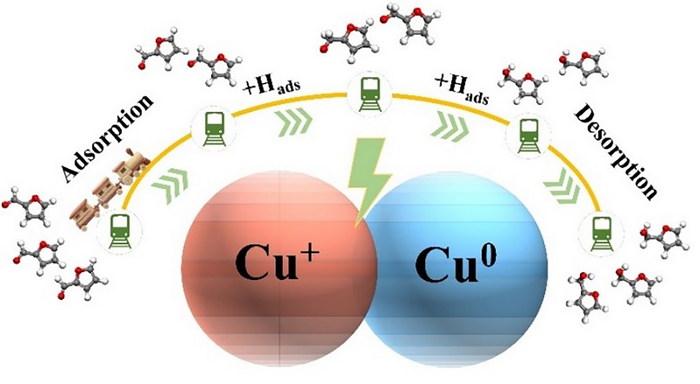
Stepwise synergistic electrochemical hydrogenation of furfural with mixed valence copper

Credit: ©Science China Press

This study is led by Prof. Yuqin Zou (College of Chemistry and Chemical Engineering, Hunan University). The experiments were performed by using a series of in situ characterization and the density functional theory (DFT) calculation.

It is noteworthy that the experimental findings show that Cu0 catalyzed furfural hydrogenation without Cu+ possesses a slow hydrogenation rate and poor selectivity. In contrast, the Cu0-Cu+ active sites possess excellent performance in the selective hydrogenation of furfural to produce furfuryl alcohol. Moreover, this catalytic advantage shows a clear potential dependence, with a regular decrease in furfural selective hydrogenation performance when a decrease in potential leads to a decrease in the proportion of Cu+.

“Cu-based catalysts have shown excellent catalytic performance for the electrochemical hydrogenation of furfural to produce furfuryl alcohol. However, the true reaction active site remains unclear. Mixed-valence Cu oxide catalysts demonstrate excellent furfuryl alcohol selectivity but are limited by the dynamic electrocatalyst surface during catalysis. In situ capture of the true reaction activity sites and thus insight into the origin of the cu-based catalyst furfural electrochemical hydrogenation activity is necessary. This work could inform the optimal design of all Cu based catalyst electrocatalytic hydrogenation processes for organics.” Zou says.

Herein, the oxidation state of the prepared CuO nanowire under the ECH of furfural was tracked by in situ X-ray absorption spectroscopy (XAS). The co-existence of Cu0 and Cu+ states during the electrohydrogenation was con-firmed. Moreover, the poisoning experiment proved the decisive role of Cu+ in the furfural ECH. Finally, the reac-tion energy barriers of the furfural ECH on Cu(111), Cu2O(111), and Cu0-Cu+ were analyzed by the density functional theory (DFT) calculation. It is concluded that Cu0-Cu+ active sites on the surface of CuO synergistically the conversion of furfural to furfuryl alcohol, and the re-spective roles of Cu0 and Cu+ have also been revealed: Cu+ accelerates the second-step hydrogenation process of furfural, and Cu0 reduces the energy barrier for desorption of furfuryl alcohol.

See the article:

Promoting the electrochemical hydrogenation of furfural by synergistic Cu0-Cu+ active sites

https://doi.org/10.1007/s11426-022-1407-0


Journal

Science China Chemistry

DOI

10.1007/s11426-022-1407-0

Share12Tweet8Share2ShareShareShare2

Related Posts

Using Epigenetics to Monitor Environmental Arsenic Exposure — Chemistry

Using Epigenetics to Monitor Environmental Arsenic Exposure

May 1, 2026
Innovative Nanoreactor Design Enhances Catalysis by Optimizing Transport and Reaction Kinetics — Chemistry

Innovative Nanoreactor Design Enhances Catalysis by Optimizing Transport and Reaction Kinetics

May 1, 2026

Swift Creation of Conductive Organic Compounds via Mechanochemistry

May 1, 2026

Scientists Reveal Atomic Mechanism Behind Water-Induced Hydroxylation in CoOx Nanostructures

May 1, 2026

POPULAR NEWS

  • Research Indicates Potential Connection Between Prenatal Medication Exposure and Elevated Autism Risk

    832 shares
    Share 333 Tweet 208
  • New Study Reveals Plants Can Detect the Sound of Rain

    714 shares
    Share 285 Tweet 178
  • Scientists Investigate Possible Connection Between COVID-19 and Increased Lung Cancer Risk

    67 shares
    Share 27 Tweet 17
  • Salmonella Haem Blocks Macrophages, Boosts Infection

    61 shares
    Share 24 Tweet 15

About

We bring you the latest biotechnology news from best research centers and universities around the world. Check our website.

Follow us

Recent News

Family Health Needs of Disabled Elders Explored

Mcu Controls Bone Growth Through Mitochondrial Calcium

Physical Disorders, ADLs, Cognition, Depression in Nursing Homes

Subscribe to Blog via Email

Enter your email address to subscribe to this blog and receive notifications of new posts by email.

Join 82 other subscribers
  • Contact Us

Bioengineer.org © Copyright 2023 All Rights Reserved.

Welcome Back!

Login to your account below

Forgotten Password?

Retrieve your password

Please enter your username or email address to reset your password.

Log In
No Result
View All Result
  • Homepages
    • Home Page 1
    • Home Page 2
  • News
  • National
  • Business
  • Health
  • Lifestyle
  • Science

Bioengineer.org © Copyright 2023 All Rights Reserved.