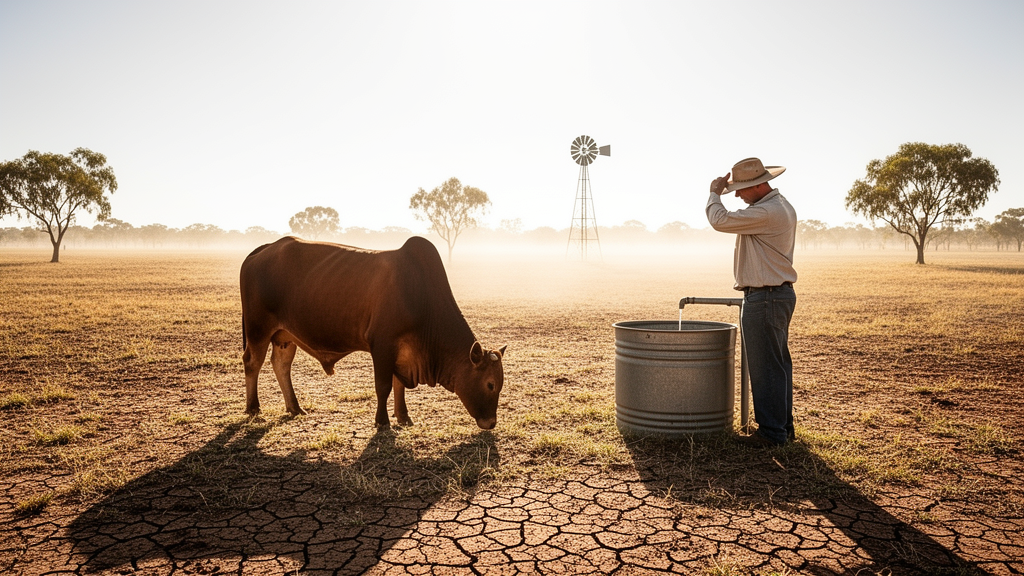
A seven-model ensemble of regionally downscaled climate projections indicates that dangerous heat for cattle and outdoor workers will intensify across northern Australia’s extensive grazing systems throughout this century, with the sharpest escalation under a higher-emission pathway. The study, published in npj Sustainable Agriculture, applies cattle heat-load indices and a physiology-based human workability model to two emissions scenarios, SSP1-2.6 and SSP3-7.0, at mid-century (2045–2055) and late century (2090–2099), against a historical baseline of 1990–2010. Its central conclusion is that integrated adaptation spanning livestock management and labour scheduling will likely be required to sustain the region’s red-meat sector.
The researchers used the Heat Load Index (HLI), which combines relative humidity, wind speed and black globe temperature derived from air temperature and solar radiation. Cattle begin accumulating heat when the HLI exceeds a breed-specific threshold: 86 for unshaded British Bos taurus breeds such as Angus, and 96 for the more heat-tolerant 100% Bos indicus genotypes such as Brahman. These thresholds derive from feedlot trials with an unshaded black Angus steer, and all headline exceedance counts in the study assume unshaded conditions, with shade treated separately as a sensitivity analysis.
The projected expansions are substantial. Heat-tolerant Bos indicus cattle at the Barkly Tableland are projected to experience 105.6 days per year above their threshold by the late century under SSP3-7.0, compared with 15.2 days per year historically, equivalent to heat-load accumulation conditions on roughly one day in three. Bos taurus exposure exceeds 300 days per year in parts of the semi-arid interior. Averaged across the northern Australian land area, exceedance of the Bos taurus threshold increases by 25.6 days per year under SSP1-2.6 by mid-century and by 78.0 days per year under SSP3-7.0 by late century, with a maximum local increase of 113.8 days per year; the corresponding Bos indicus increases are 15.0 and 66.6 days per year, peaking locally at 168.9 days per year.
Consecutive-day persistence compounds the risk. At the Barkly, the longest annual run of days above the Bos indicus threshold lengthens from 8 ± 1 days historically to 53 ± 17 days under SSP3-7.0 by late century, meaning cattle may face spells of roughly 53 consecutive days of daytime heat accumulation in which overnight physiological recovery becomes increasingly difficult. At Dalby, the longest Bos taurus spell rises from 19 ± 5 days historically to 49 ± 17 days under the same scenario. Supplementary analyses using the Temperature–Humidity Index and the comprehensive climate index reproduce the same spatial pattern, supporting the finding that the result is not specific to the HLI formulation.
Shade emerges as a powerful, though partial, buffer. Access to shade raises the heat-load threshold by three units for partial shade and by seven units for roughly 70% block-out, such as engineered shade structures. Applying the +7 adjustment to late-century SSP3-7.0 projections returns exposure to approximately present-day unshaded levels at five of the six site and genotype combinations: 40.3 against 45.4 days per year for Bos taurus at Dalby, 111.7 against 113.3 at Winton, and 13.8 against 15.2 for Bos indicus at the Barkly. The exception is Bos taurus at the Barkly, where historical exposure of 135.2 days per year becomes 142.6 under the shaded late-century case. Under the more realistic +3 partial-shade adjustment, however, exposure approximately doubles at every site. Shade also does not reduce humidity and provides no overnight benefit.
For humans, the study uses the maximum safe metabolic rate (MMAX), a heat-balance measure of the highest sustained physical activity level a person can maintain over a six-hour exposure without progressive heat storage. Mustering on horseback at walking pace was estimated at about 4.0 metabolic equivalents of task (METs) from field-trial physiological measurements, and a day was classified as unsafe for outdoor work where MMAX falls below 4.0 METs. Two exposure windows were compared: an early-morning window of 0400 to 1000, matching current mustering practice, and a daytime window of 0800 to 1800, matching a conventional working day.
Days unsafe for outdoor work increase by 31–60% over the late-century interval. In the daytime window, exposure exceeds 300 days per year across parts of the northern coastal tropics by mid-century under both scenarios, meaning sustained work at the reference intensity would rarely be thermally safe there across a conventional working day. At the Barkly, daytime unsafe days rise from 133.7 ± 3.8 per year historically to 217.0 ± 14.8 under late-century SSP3-7.0, while early-morning unsafe days climb from 66.0 ± 6.4 to 149.8 ± 14.9 at that site under the same scenario.
Rescheduling work into the pre-dawn and early-morning window is the principal scheduling adaptation available, and its adequacy depends strongly on the emissions pathway. Under SSP1-2.6, all three case-study sites show fewer early-morning unsafe days in the late century than in the historical daytime window, with all seven ensemble members agreeing on the sign of the change. Under SSP3-7.0, however, the ensemble-mean late-century early-morning count exceeds the present-day daytime count at all three sites, reaching 49.0, 134.2 and 149.8 days per year at Dalby, Winton and the Barkly respectively. The earlier window removes 61% of unsafe days at Dalby, 34% at Winton and 31% at the Barkly relative to the daytime window, but the residual still exceeds the historical daytime count at each site. The authors describe this contraction as a binding operational constraint, because mustering cannot be deferred indefinitely without consequences for animal welfare and market timing.
The study quantifies thermal exposure rather than mortality, and the authors note several limitations. Only two emissions pathways were analysed, representing optimistic and high-emission bounds; the seven CMIP6 models were all downscaled with the same CCAM framework, limiting structural diversity, and two members share substantial parent-model components, so the ensemble spread understates full projection uncertainty. The historical baseline precedes warming observed since 2010, likely underestimating current exposure, and annual averaging masks acute multi-day heatwaves. Human projections are unshaded throughout because no equivalent shade adjustment exists for MMAX, and the analysis does not incorporate socio-economic adaptation, meaning the projections represent potential climatic exposure rather than realised risk.
Even so, the asymmetry between the two halves of the grazing system is stark. Effective shade provision offsets approximately the entire projected late-century increase in cattle heat load at five of six site-genotype combinations, retaining adaptive headroom for livestock under the higher-emission pathway, whereas the principal scheduling adaptation for workers is sufficient only under strong mitigation. The authors argue that technological innovations such as AI-guided drones, automated herding, virtual fencing and on-animal sensing, alongside silvopastoral shade systems and adaptive scheduling, will be needed to reduce human exposure while maintaining low-stress livestock handling, and that integrating physiological, economic and behavioural dimensions into climate projections is a critical next step for climate-risk assessment in the red-meat sector.
Subject of Research: Projected cattle and human heat stress in northern Australia's extensive grazing systems under two emissions scenarios
Article Title: Heat extremes threaten cattle and outdoor workers across northern Australia’s extensive grazing systems
Article References: Taylor, R., Cowan, T., & Perkins-Kirkpatrick, S. (2026). Heat extremes threaten cattle and outdoor workers across northern Australia’s extensive grazing systems. npj Sustainable Agriculture, 4(1), Article 88. https://doi.org/10.1038/s44264-026-00200-6
Image Credits: AI Generated
DOI: 10.1038/s44264-026-00200-6
Keywords: heat stress, cattle, northern Australia, grazing systems, climate projections, Heat Load Index, outdoor workers, SSP3-7.0, shade provision, mustering, CMIP6, adaptation
News Source: William Thompson. (October 29, 2026). Projected heat extremes threaten cattle and outdoor workers across northern Australia. Scienmag.