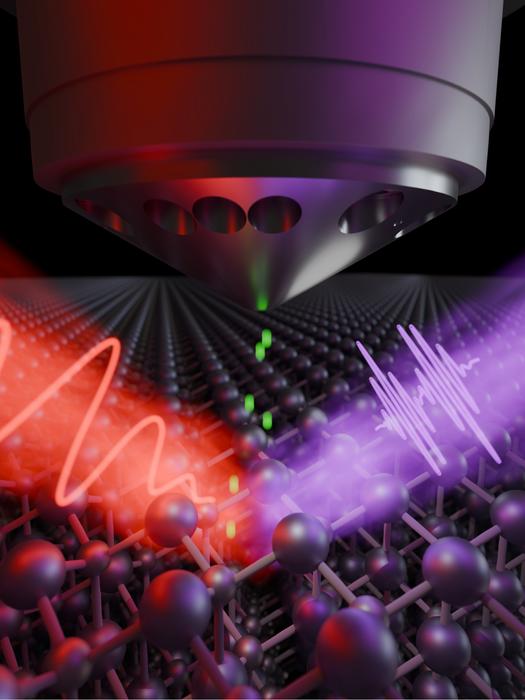
When electrons move within a molecule or semiconductor, this occurs on unimaginably short time scales. A Swedish-German including physicist Dr Jan Vogelsang from the University of Oldenburg has now made significant progress towards a better understanding of these ultrafast processes: The researchers were able to track the dynamics of electrons released from the surface of zinc oxide crystals using laser pulses with spatial resolution in the nanometre range and at previously unattained temporal resolution.
Credit: Image: Jan Vogelsang
When electrons move within a molecule or semiconductor, this occurs on unimaginably short time scales. A Swedish-German including physicist Dr Jan Vogelsang from the University of Oldenburg has now made significant progress towards a better understanding of these ultrafast processes: The researchers were able to track the dynamics of electrons released from the surface of zinc oxide crystals using laser pulses with spatial resolution in the nanometre range and at previously unattained temporal resolution.
With these experiments, the team demonstrated the applicability of a method that could be used to better understand the behaviour of electrons in nanomaterials and new types of solar cells, among other applications. Researchers from Lund University, including Professor Dr Anne L’Huillier, one of last year’s three Nobel laureates in physics, were involved in the study, which was published in the science journal Advanced Physics Research.
In their experiments, the research team combined a special type of electron microscopy known as photoemission electron microscopy (PEEM) with attosecond physics technology. The scientists use extremely short-duration light pulses to excite electrons and record their subsequent behaviour. “The process is much like a flash capturing a fast movement in photography,” Vogelsang explained. An attosecond is incredibly short – just a billionth of a billionth of a second.
Combining two technologically demanding techniques
As the team reports, similar experiments had so far failed to attain the temporal accuracy required to track the electrons’ motion. The tiny elementary particles whizz around much faster than the larger and heavier atomic nuclei. In the present study, however, the scientists were able to combine the two technologically demanding techniques, photoemission electron microscopy and attosecond microscopy, without compromising either the spatial or temporal resolution. “We have now finally reached the point where we can use attosecond pulses to investigate in detail the interaction of light and matter at the atomic level and in nanostructures,” said Vogelsang.
One factor which made this progress possible was the use of a light source that generates a particularly high quantity of attosecond flashes per second – in this case 200,000 light pulses per second. Each flash released on average one electron from the surface of the crystal, allowing the researchers to study their behaviour without them influencing each other. “The more pulses per second you generate, the easier it is to extract a small measurement signal from a dataset,” explained the physicist.
Anne L’Huillier’s laboratory at Lund University (Sweden), where the experiments for the present study were carried out, is one of the few research laboratories worldwide that has the technological equipment required for such experiments. Vogelsang, who was a postdoctoral researcher at Lund University from 2017 to 2020, is currently in the process of setting up a similar experimental laboratory at the University of Oldenburg. In the future, the two teams plan to continue their investigations and explore the behaviour of electrons in various materials and nanostructures.
Vogelsang has headed the Attosecond Microscopy research group at the University of Oldenburg since 2022. The group is funded by the German Research Foundation’s prestigious Emmy Noether Programme.
Journal
Advanced Physics Research
DOI
10.1002/apxr.202300122
Method of Research
Experimental study
Subject of Research
Not applicable
Article Title
Time-resolved photoemission electron microscopy on a ZnO surface using an extreme ultraviolet attosecond pulse pair
Article Publication Date
3-Dec-2023
COI Statement
The authors declare no conflict of interest.