• HOME
  • NEWS
  • EXPLORE
    • CAREER
      • Companies
      • Jobs
    • EVENTS
    • iGEM
      • News
      • Team
    • PHOTOS
    • VIDEO
    • WIKI
  • BLOG
  • COMMUNITY
    • FACEBOOK
    • INSTAGRAM
    • TWITTER
Monday, June 29, 2026
BIOENGINEER.ORG
No Result
View All Result
  • Login
  • HOME
  • NEWS
  • EXPLORE
    • CAREER
      • Companies
      • Jobs
        • Lecturer
        • PhD Studentship
        • Postdoc
        • Research Assistant
    • EVENTS
    • iGEM
      • News
      • Team
    • PHOTOS
    • VIDEO
    • WIKI
  • BLOG
  • COMMUNITY
    • FACEBOOK
    • INSTAGRAM
    • TWITTER
  • HOME
  • NEWS
  • EXPLORE
    • CAREER
      • Companies
      • Jobs
        • Lecturer
        • PhD Studentship
        • Postdoc
        • Research Assistant
    • EVENTS
    • iGEM
      • News
      • Team
    • PHOTOS
    • VIDEO
    • WIKI
  • BLOG
  • COMMUNITY
    • FACEBOOK
    • INSTAGRAM
    • TWITTER
No Result
View All Result
Bioengineer.org
No Result
View All Result
Home NEWS Science News Chemistry

Probing semiconductor crystals with a sphere of light

Bioengineer by Bioengineer
June 7, 2019
in Chemistry
Reading Time: 2 mins read
0
IMAGE
Share on FacebookShare on TwitterShare on LinkedinShare on RedditShare on Telegram

IMAGE

Credit: Kazunobu Kojima, Tohoku University

Tohoku University researchers have developed a technique using a hollow
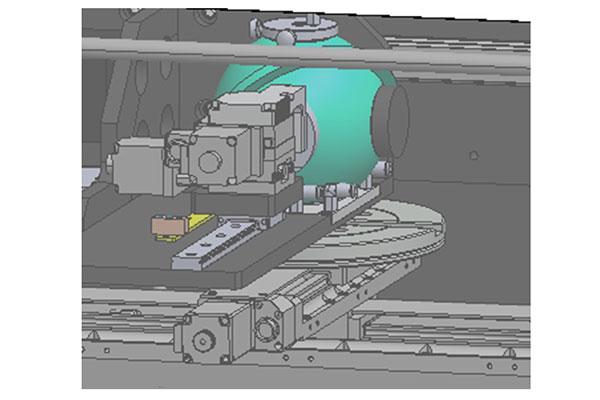
sphere to measure the electronic and optical properties of large semiconducting crystals. The approach, published in the journal Applied Physics Express, improves on current photoluminescence spectroscopy techniques and could lead to energy savings for mass producers, and thus consumers, of power devices.

Semiconducting crystals are used to make electronic devices like microprocessor chips and transistors. Manufacturers need to be able to detect crystal defects and test their energy conversion efficiency. One way to do this is to measure their ‘internal quantum efficiency’, or their ability to generate photons from electrons excited by an electric current or an excitation laser. Currently available methods limit the sample size that can be tested at a time.

Advanced materials scientist Kazunobu Kojima of Tohoku University and colleagues devised a modified approach to photoluminescence spectroscopy that can test larger samples.

Standard photoluminescence spectroscopy detects the relative amount of light emitted by a semiconductor crystal when an excitation laser is shone on it. Light energy is lost through these excitation and emission processes, so scientists have been experimenting with photoluminescence spectroscopy that uses an ‘integrating sphere’ to minimize the loss of photons, the elementary particles of light.

Integrating spheres collect both the excitation light and the light emitted from a sample lying inside it, where the light is diffusively reflected inside until it becomes uniformly dispersed. The uniform distribution of light improves the accuracy and repeatability of internal quantum efficiency testing. But this means that the size of the crystal being tested is ultimately limited by the size of the sphere.

Kojima and colleagues found they could still test the internal quantum efficiency of a crystal when it was placed directly outside the sphere, allowing larger samples to be used.

They conducted their tests on a semiconducting crystal called gallium nitride, which
is commonly used in LEDs and is expected to be used in electronic devices because of its superior properties.

“This ‘omnidirectional photoluminescence’ spectroscopy can be used to evaluate the quality of large-sized crystals or semiconductor wafers, which are essential for the mass production of power devices,” says Kojima, adding that this could lead to energy saving and reduce production costs.

###

Media Contact
Kazunobu Kojima
[email protected]

Original Source

https://www.tohoku.ac.jp/en/press/sphere_of_light.html

Related Journal Article

http://dx.doi.org/10.7567/1882-0786/ab2165

Tags: Chemistry/Physics/Materials SciencesMaterials
Share12Tweet8Share2ShareShareShare2

Related Posts

AI and Physics Collaborate to Design Advanced Hydrogen Storage Materials

June 25, 2026

International Team Including Dresden Scientists Develops Novel Designer Proteins for Advanced Study of Living Tissue

June 25, 2026

New Study Uncovers Key Factors Driving Water Chemistry in Nanoscale Environments

June 25, 2026

Plasma Technology Extends Catalyst Lifespan in Hydrogen Production

June 24, 2026
Please login to join discussion

POPULAR NEWS

  • Saying Goodbye to PGY-6: Pediatric Fellowship Realities

    103 shares
    Share 41 Tweet 26
  • Multi-Hospital Study Reveals Long Covid Burden Is Twice as High as Current Estimates

    92 shares
    Share 36 Tweet 23
  • Detection of EDCs in Breast Milk and Infant Urine Up to Six Months Highlights Early Exposure Risks

    77 shares
    Share 31 Tweet 19
  • New Drug Candidate Developed at McMaster Shows Potential for Treating Brain Cancer

    58 shares
    Share 23 Tweet 15

About

We bring you the latest biotechnology news from best research centers and universities around the world. Check our website.

Follow us

Recent News

Tracking Lanthanide-Labeled Microplastics in Plants

POSTECH Researchers Slash Cost of Reconstituted Cell-Free Systems by 95%

AI and Physics Collaborate to Design Advanced Hydrogen Storage Materials

Subscribe to Blog via Email

Success! An email was just sent to confirm your subscription. Please find the email now and click 'Confirm' to start subscribing.

Join 82 other subscribers
  • Contact Us

Bioengineer.org © Copyright 2023 All Rights Reserved.

Welcome Back!

Login to your account below

Forgotten Password?

Retrieve your password

Please enter your username or email address to reset your password.

Log In
No Result
View All Result
  • Homepages
    • Home Page 1
    • Home Page 2
  • News
  • National
  • Business
  • Health
  • Lifestyle
  • Science

Bioengineer.org © Copyright 2023 All Rights Reserved.