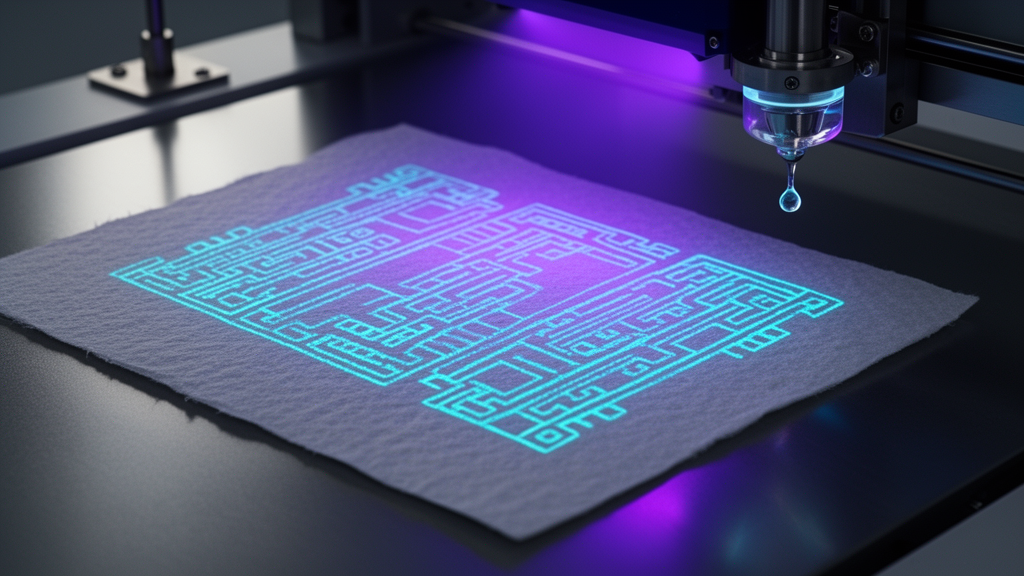
Researchers have developed a water-soluble printable security ink based on nitrogen-doped carbon quantum dots designed for covert document authentication and anti-counterfeiting, demonstrating vibrant blue-green fluorescence under ultraviolet excitation while remaining completely invisible under normal ambient lighting. The study, conducted using laboratory facilities across the Goa and Dharwad campuses of the National Forensic Sciences University alongside the Indian Institute of Technology Delhi, establishes an experimental pathway for deploying fluorescent nanomaterials directly into conventional desktop printing systems to encrypt covert information across common paper substrates.
Document security faces escalating threats from sophisticated forgery and counterfeiting techniques that increasingly bypass traditional physical safeguards such as watermarks, holograms, and standard digital signatures used on passports, national identity cards, legal certificates, and currency. While earlier research examined alternative nanomaterials like zinc oxide quantum dots to enhance print permanence or perovskite quantum dots for thermal and chemical durability in glass matrices, practical implementation on routine paper substrates has remained scarce. Many prior carbon quantum dot formulations were confined to proof-of-concept laboratory demonstrations on specialized surfaces, leaving a distinct gap in developing printer-compatible, water-soluble inks that offer robust fluorescence, thermal endurance, and long-term stability in routine forensic settings.
To fabricate the luminescent nanoparticles, the research team utilized a solvothermal chemical synthesis method combining specific precursors, namely 0.6 grams of citric acid, 40 milliliters of formamide, and 1.05 milliliters of ethylenediamine. The chemical mixture was homogenized using a magnetic stirrer, transferred into a Teflon-lined stainless-steel autoclave, and heated inside an oven at 180 degrees Celsius for a duration of 4 hours. Following the heating cycle and subsequent cooling, the solution was passed through a 0.22-micrometer polyvinylidene fluoride syringe filter to remove impurities.
The purified carbon dot solution served as the functional precursor for the printable ink, which was formulated by blending the synthesized nanoparticles with polyethylene glycol 400 and distilled water. The mixture was ultrasonicated for 10 minutes to produce the final nitrogen-doped carbon quantum dot-based ink. For physical deployment, the researchers loaded the resulting formulation into a standard PG-745 S ink cartridge fitted within a commercial Canon Pixma MG2570s inkjet printer equipped with 1,280 printing nozzles delivering precise 2-picolitre droplets, while also evaluating manual stamp application methods across varied document substrates.
Structural investigation of the synthesized nanomaterials confirmed the formation of nanoscale, quasi-amorphous particles with a low degree of crystallinity. Rigaku Ultima-IV X-ray diffractometer measurements using copper K-alpha radiation with a wavelength of 1.542 angstroms across a 2-theta range of 10 to 100 degrees revealed a characteristic broad diffraction peak centered at approximately 20 degrees corresponding to the (002) crystal plane. The interlayer d-spacing was calculated at approximately 0.44 nanometers, while the average crystallite size was determined to be approximately 1.27 nanometers, confirming that the synthesized dots operated within the quantum confinement regime necessary for distinctive optical behaviors.
Surface functionalization and elemental composition were verified through Fourier transform infrared spectroscopy and energy-dispersive X-ray spectroscopy. Bruker-Alpha II FTIR analysis using an attenuated total reflectance accessory between 600 and 4000 reciprocal centimeters detected distinct absorption bands at 3309 reciprocal centimeters for hydroxyl and amine groups, 2883 reciprocal centimeters for saturated hydrocarbons, 1665 reciprocal centimeters for carbonyl groups, 1387 reciprocal centimeters for carboxylic groups, and 1302 reciprocal centimeters for methyne carbon-nitrogen and carbon-oxygen bonds. These hydrophilic surface groups impart excellent water dispersibility to the particles, while energy-dispersive X-ray analysis confirmed successful nitrogen doping into the sp2-hybridized aromatic carbon lattice.
Optical assessments using ultraviolet-visible spectrophotometry between 190 and 650 nanometers identified three absorption peaks at 214, 274, and 342 nanometers, with the dominant 214-nanometer peak reflecting pi-to-pi-star electron transitions within the aromatic carbon core and secondary peaks arising from n-to-pi-star transitions in surface functional groups. Bandgap calculations derived from Tauc plot analysis yielded an energy range of approximately 2.43 to 2.85 electron volts, aligning with blue-green visible emission. Fluorescence spectroscopy confirmed that intense emission occurred exclusively under ultraviolet excitation at 3.34 electron volts, whereas red illumination at 1.97 electron volts, green at 2.47 electron volts, and blue at 2.63 electron volts yielded no genuine photoluminescence, establishing an energy threshold essential for anti-counterfeiting security.
Practical durability and interaction with paper substrates demonstrated notable resilience under variable operating conditions. Thermal testing across a temperature span from 25 to 115 degrees Celsius revealed that printed clarity and fluorescence intensity improved notably at elevated temperatures between 45 and 115 degrees Celsius compared to lower baseline temperatures between 25 and 35 degrees Celsius, an effect attributed to enhanced solvent evaporation and tighter adhesion to cellulose fibers without inducing distortion. When printed on porous substrates such as standard A4 office paper, pure cellulose paper, and bond paper, the ink exhibited excellent permanence and clarity; however, application on ruled paper resulted in degraded definition, which the authors attributed to commercial surface sizing agents restricting fiber absorption.
Aging assessments conducted over a 30-day monitoring timeline revealed no observable photobleaching or material degradation, with fresh prints showing comparable fluorescence to specimens evaluated at 8, 15, 20, and 30 days under ultraviolet illumination. Under ambient room light, the printed markings remained completely invisible, preventing visual detection while offering covert verification when exposed to ultraviolet lamps. The authors noted that this provides multi-level authentication potential, combining primary Level 1 visual fluorescence upon inspection with higher Level 2 spectral signatures embedded in the discrete emission profile, creating multidimensional barriers that resist replication and cloning by unauthorized parties.
Despite these promising proof-of-concept results, the researchers outlined several technical limitations that require further experimental exploration before widespread commercial deployment. The current investigation focused predominantly on Level 1 ultraviolet-visible fluorescence without evaluating advanced photoluminescence metrics such as fluorescence lifetimes, multi-stimulus responsive triggers, or control baseline samples. Critical fluid dynamics properties—including ink viscosity, surface tension, contact angle, and jetting mechanics to suppress the coffee-ring effect—were not quantified, and morphological verification was restricted to diffraction and spectroscopy without high-resolution transmission electron microscopy or dynamic light scattering. Addressing these rheological parameters and investigating programmable multi-dimensional encoding systems represent necessary next steps for integrating quantum dot formulations into high-resolution legal and forensic document workflows.
Subject of Research: Water-soluble nitrogen-doped carbon quantum dot ink for secure inkjet printing and document authentication
Article Title: Nitrogen doped carbon quantum dot printable ink for document authentication and anticounterfeiting
Article References: Baidoo, Z., Ablateye, D. N. O., & Munjal, S. (2026). Nitrogen doped carbon quantum dot printable ink for document authentication and anticounterfeiting. Discover Chemistry, 3(1), Article 608. https://doi.org/10.1007/s44371-026-01052-2
Image Credits: AI Generated
DOI: 10.1007/s44371-026-01052-2
Keywords: nitrogen-doped carbon quantum dots, document authentication, anti-counterfeiting, security ink, inkjet printing, solvothermal synthesis, photoluminescence, ultraviolet fluorescence, bandgap energy, X-ray diffraction, Fourier transform infrared spectroscopy, energy dispersive X-ray spectroscopy, polyethylene glycol, thermal stability, information encryption, paper substrates, quantum dots, forensic document analysis
News Source: Katie Riggs. (November 11, 2026). Printable Nitrogen-Doped Carbon Quantum Dot Inks Provide Covert Document Authentication. Scienmag.