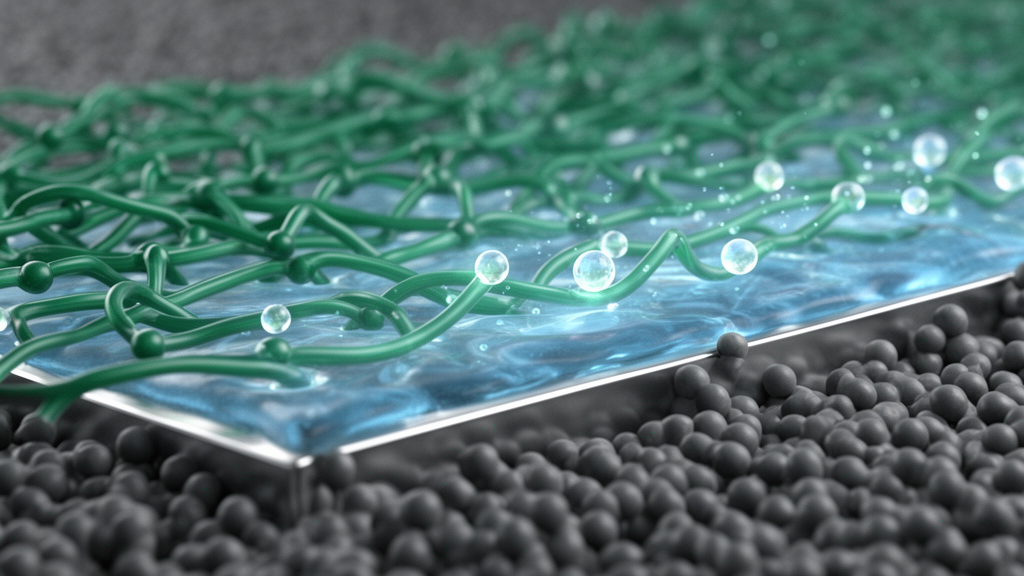
A review published in Frontiers in Batteries and Electrochemistry by researchers Jibrin Muhammad Yelwa and Haruna Musa demonstrates that device kinetics and cycling durability in polyaniline hybrid supercapacitors are governed fundamentally by interfacial properties rather than bulk composition. Polyaniline, widely recognized as an attractive prototypical pseudocapacitive conducting polymer, features an exceptionally high theoretical capacitance of 356 microfarads per square centimeter, intrinsic conductivity, and cost-effective synthesis routes. Despite these favorable intrinsic characteristics, practical device implementation has repeatedly encountered performance ceilings resulting from severe kinetic losses, large interfacial charge-transfer resistance, dopant instability, pore obstruction, and substantial volumetric fluctuations that trigger rapid capacity fade. Addressing these degradation pathways requires moving beyond simple physical mixtures of active components toward deliberately engineered heterojunctions. Yelwa and Musa establish a functional classification of recent advances over the past five years, focusing directly on charge-transfer functions across polyaniline-host and polyaniline-electrolyte boundaries rather than categorizing composites strictly by their constituent host materials.
The fundamental charge-storage mechanism in these hybrid electrodes operates via two complementary, parallel processes taking place at specifically engineered interfaces. The first mechanism is electrostatic electrical double-layer capacitance, wherein electrolyte ions reversibly adsorb at the surfaces of conductive scaffolds such as carbons or MXenes as well as at the polyaniline-electrolyte interface without involving faradaic reactions. The second process is faradaic pseudocapacitance, which relies on rapid, reversible redox transitions along the polyaniline polymer backbone across three distinct oxidation states: fully reduced leucoemeraldine, half-oxidized conductive emeraldine salt, and fully oxidized pernigraniline. During charging, electrons are extracted from the polyaniline backbone through the conductive current-collecting scaffold while charge neutrality is balanced by proton expulsion or anion insertion from the electrolyte; the reverse sequence occurs during discharge. Because these redox transitions occur near the polymer surface with a near-linear dependence of stored charge on potential, the electrochemical signature manifests as pseudocapacitance rather than discrete battery-like voltage plateaus.
Interface-related failure modes routinely suppress practical electrode performance below theoretical limits whenever composite morphology and surface chemistry remain unoptimized. In dense or overgrown coatings, tightly packed polymer chains physically obstruct electrolyte ingress into interior redox domains, leaving substantial fractions of polyaniline electrochemically inactive and severely increasing diffusion limitations. In flexible solid-state devices incorporating polymer gel electrolytes, inadequate surface wetting produces interfacial microvoids and promotes severe mechanical delamination under cyclic deformation. Furthermore, unmodified interfaces frequently suffer from weak physical adhesion, which causes progressive debonding as polyaniline undergoes repeated swelling and shrinking during dopant insertion and de-insertion cycles. Chemomechanical stress accumulation leads directly to microscopic cracking, the formation of highly resistive interfacial junctions, and continuous increases in charge-transfer resistance over extended cycling. Yelwa and Musa emphasize that overcoming these interrelated failure modes demands simultaneous optimization across five distinct design levers: chemical anchoring, electronic coupling, morphology-controlled ion transport, mechanical strain buffering, and coordinated electrolyte-electrode coupling.
Chemical anchoring strategies stabilize polymer chains against mechanical detachment while minimizing interfacial contact resistance through targeted functional groups and in situ synthesis techniques. Modifying carbon cloth or porous carbon scaffolds with catechol-rich polydopamine introduces abundant hydroxyl and amine functionalities that form robust hydrogen and covalent bonds with aniline monomers and propagating polyaniline chains. This surface functionalization dramatically enhances substrate wettability, yielding uniform polymer deposition and markedly lower charge-transfer resistance compared to bare substrates. Natural biopolymer scaffolds, such as lignin-free wood possessing dense hydroxyl networks, similarly enable in situ oxidative polymerization that secures high areal capacitance while preserving open macroporous channels. In complementary designs, sulfonated lignin functions simultaneously as a binding matrix and a polyanionic dopant, establishing an electrostatic and hydrogen-bonded interpenetrating network with polyaniline. Direct in situ polymerization onto titanium carbide MXene sheets produces significantly more intimate contact, lower charge-transfer resistance, and superior capacitance retention compared to simple physical blending.
Electronic percolation architectures provide continuous, low-resistance conduction pathways that eliminate isolated polymer domains and maintain rapid electron transport throughout thick electrode assemblies. Integrating two-dimensional chemical vapor deposition graphene directly beneath conformal polyaniline coatings creates uninterrupted conductive pathways that minimize equivalent series resistance and charge-transfer resistance across wide operating frequencies. Similarly, introducing small fractions of graphene, such as approximately eight weight percent, into polyaniline matrices elevates specific capacitance by nearly an order of magnitude and yields approximately 89 percent capacitance retention after 10,000 cycles. Conducting polymer interlayers, such as poly(3,4-ethylenedioxythiophene) doped with poly(styrenesulfonate), act as compliant electronic bridges capable of wetting both graphene and polyaniline phases in flexible planar configurations. Within titanium carbide MXene systems, intercalating chain-like polyaniline or discrete nanoscale polyaniline dots preserves electronic continuity across adjacent lamellar sheets, establishing interconnected three-dimensional percolation networks that simultaneously deliver high volumetric capacitance and outstanding high-rate power capability.
Morphological engineering governs the active interfacial surface area accessible to electrolyte ions and prevents the collapse of necessary transport nanochannels. Uncontrolled deposition frequently causes two-dimensional nanomaterials to restack into dense laminates, inducing severe ion starvation and sluggish diffusion at high current densities. Introducing polyaniline nanodots or nanoscale polymer pillars between titanium carbide MXene sheets acts as a nanoscale spacer, expanding interlayer nanochannels to facilitate rapid ion migration without interrupting continuous electron paths. In three-dimensional porous carbon frameworks, growing vertically aligned polyaniline nanowire or nanofiber arrays creates hierarchical pore networks where macropores supply bulk electrolyte access, mesopores permit unhindered local ion diffusion, and ultrathin polymer walls ensure brief solid-state diffusion paths. Conformal, ultrathin polyaniline shells deposited onto conductive carbon cloths similarly maintain the macroporous void spaces inherent to woven textiles, ensuring rapid liquid penetration and high electrochemical utilization of active material even during rapid charge and discharge sweeps.
Accommodating the substantial volumetric expansion and contraction that accompanies repeated protonation and deprotonation requires robust mechanical buffering at the junction. Flexible, porous current collectors, such as carbon nanotube mats, aerogels, and woven textiles, disperse local strain concentrations and prevent structural pulverization during extended redox cycling. Systematic evaluations of carbon nanotube mats demonstrate that excessively thick polyaniline coatings become rigid and susceptible to mechanical fracture, whereas optimized, thin coatings preserve compliance and sustain structural integrity. Superelastic hybrid hydrogels synthesized via cryopolymerization distribute mechanical deformation throughout their viscoelastic network, maintaining uninterrupted mixed ionic-electronic transport pathways under large mechanical strains. Furthermore, controlling polymer crystallographic ordering, as demonstrated in semi-polycrystalline polyaniline-graphene composites, actively suppresses crack propagation at heterointerfaces. This structural stabilization enables electrodes to maintain stable equivalent series resistance and charge-transfer resistance while retaining approximately 97 percent of their initial capacitance across 10,000 consecutive charge-discharge cycles.
Electrolyte selection and dopant chemistry exert profound control over polyaniline redox kinetics, operational potential windows, and long-term chemical durability. Because polyaniline requires protonation of imine nitrogens to transition from the non-conductive emeraldine base to the highly conductive emeraldine salt, electrolyte acidity and counter-ion identity directly dictate charge-storage efficiency. Utilizing superacid dopants or incorporating polyanionic dopants like lignosulfonate creates localized reservoirs of mobile counter-ions that stabilize the conductive emeraldine salt state and suppress irreversible over-oxidation during prolonged potential cycling. In aqueous media, introducing transition metal cations such as manganese ions into acidic sulfuric acid solutions enhances both redox kinetics and cycling durability on carbon cloth substrates. Solid-state and flexible devices benefit from compatible polymer gel electrolytes, including sulfuric acid-polyvinyl alcohol mixtures, which ensure intimate interfacial contact with porous electrodes, prevent interfacial void formation, and preserve low internal series resistance during mechanical bending and folding operations.
To establish rigorous scientific comparisons, Yelwa and Musa outline a comprehensive diagnostic framework that links specific electrochemical signatures to interfacial quality while warning against common analytical misinterpretations. Ideal electrochemical impedance spectroscopy Nyquist plots must exhibit a minimal high-frequency intercept for equivalent series resistance, a tightly contracted high-to-mid-frequency semicircle reflecting low charge-transfer resistance, and a near-vertical low-frequency line indicating capacitive ion storage rather than a 45-degree Warburg diffusion tail. However, the authors caution that steep low-frequency lines alone do not prove high-rate capability; researchers must corroborate impedance data with scan-rate-dependent cyclic voltammetry kinetic analysis, where power-law b-values approaching 1.0 confirm surface-controlled kinetics. Furthermore, complex-capacitance relaxation time constants, symmetric galvanostatic charge-discharge profiles exhibiting minimal internal resistance drop, and area-normalized charge-transfer resistance values must be evaluated alongside transmission-line modeling to isolate genuine interfacial enhancements from superficial gains caused by differences in mass loading, surface area, or intrinsic scaffold conductance.
Translating these sophisticated interfacial concepts into practical energy storage technology requires extending design rules to realistic commercial mass loadings exceeding five milligrams per square centimeter. Most published laboratory demonstrations operate at low mass loadings below two milligrams per square centimeter, where mass-transport limitations remain negligible; at practical loadings, thick electrode coatings are prone to pore clogging, poor internal wetting, and severe diffusion bottlenecks. Inherently scalable fabrication techniques, such as continuous roll-to-roll in situ oxidative polymerization, water-based benign priming with polydopamine or lignin, and scalable viscous-ink printing of polyaniline-MXene formulations, offer viable pathways toward manufacturing flexible, high-loading electrodes. Looking forward, the review emphasizes three strategic research priorities: adopting multimodal operando characterization combining impedance spectroscopy with in situ Raman, X-ray photoelectron spectroscopy, and spectroelectrochemistry; enforcing standardized reporting of electrode mass loadings, active areas, and normalized resistance metrics; and developing environmentally sustainable, mechanically resilient composites for real-world wearable electronics.
Subject of Research: Interface engineering strategies and quantitative diagnostic frameworks for polyaniline hybrid supercapacitor electrodes
Article Title: Interface engineering for efficient charge transfer in polyaniline hybrid supercapacitors: a mini review
Article References: Yelwa, J. M., & Musa, H. (2026). Interface engineering for efficient charge transfer in polyaniline hybrid supercapacitors: a mini review. Frontiers in Batteries and Electrochemistry, 5, 1994869. https://doi.org/10.3389/fbael.2026.1994869
Image Credits: AI Generated
DOI: 10.3389/fbael.2026.1994869
Keywords: Polyaniline, Supercapacitors, Interface Engineering, Charge Transfer Resistance, Electrochemical Impedance Spectroscopy, Pseudocapacitance, MXene Hybrids, Graphene Composites, Mechanical Buffering, Percolation Networks, Electrolyte Coupling, Rate Capability, Transmission Line Modeling, Cyclic Voltammetry, Equivalent Series Resistance, Carbon Cloth Scaffolds, Molybdenum Disulfide
News Source: Bethany Barker. (November 11, 2026). Engineered Interfaces Dictate Charge Transfer Dynamics in Polyaniline Hybrid Supercapacitors. Scienmag.