• HOME
  • NEWS
  • EXPLORE
    • CAREER
      • Companies
      • Jobs
    • EVENTS
    • iGEM
      • News
      • Team
    • PHOTOS
    • VIDEO
    • WIKI
  • BLOG
  • COMMUNITY
    • FACEBOOK
    • INSTAGRAM
    • TWITTER
Monday, July 6, 2026
BIOENGINEER.ORG
No Result
View All Result
  • Login
  • HOME
  • NEWS
  • EXPLORE
    • CAREER
      • Companies
      • Jobs
        • Lecturer
        • PhD Studentship
        • Postdoc
        • Research Assistant
    • EVENTS
    • iGEM
      • News
      • Team
    • PHOTOS
    • VIDEO
    • WIKI
  • BLOG
  • COMMUNITY
    • FACEBOOK
    • INSTAGRAM
    • TWITTER
  • HOME
  • NEWS
  • EXPLORE
    • CAREER
      • Companies
      • Jobs
        • Lecturer
        • PhD Studentship
        • Postdoc
        • Research Assistant
    • EVENTS
    • iGEM
      • News
      • Team
    • PHOTOS
    • VIDEO
    • WIKI
  • BLOG
  • COMMUNITY
    • FACEBOOK
    • INSTAGRAM
    • TWITTER
No Result
View All Result
Bioengineer.org
No Result
View All Result
Home NEWS Science News

Preventing oxygen release leads to safer high-energy-density batteries

Bioengineer by Bioengineer
July 13, 2021
in Science News
Reading Time: 2 mins read
0
IMAGE
Share on FacebookShare on TwitterShare on LinkedinShare on RedditShare on Telegram

IMAGE

Credit: Takashi Nakamura

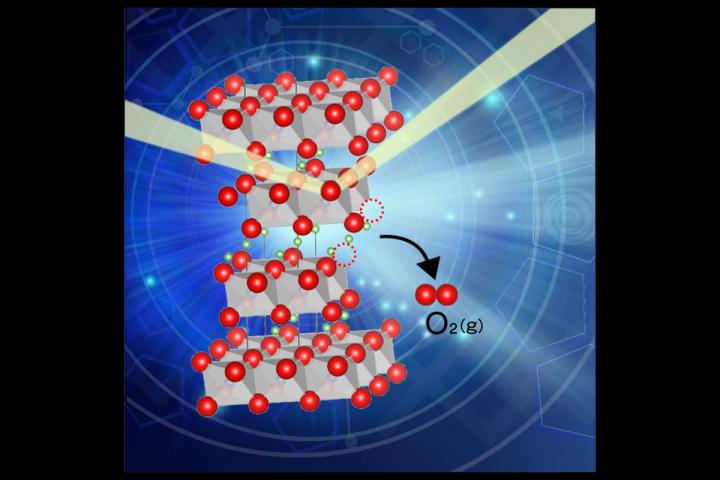
A research group has produced fresh insights about the release of oxygen in lithium-ion batteries, paving the way for more robust and safer high-energy-density batteries.

Next-generation batteries that store more energy are critical if society is to achieve the UN’s Sustainable Development Goals and realize carbon neutrality. However, the higher the energy density, the higher the likelihood of thermal runaway – the overheating of batteries that can sometimes result in a battery exploding.

Oxygen released from cathode active material is a trigger for thermal runaway, yet our knowledge of this process is insufficient.

Researchers from Tohoku University and the Japan Synchrotron Radiation Research Institute (JASRI) investigated the oxygen release behavior and relating structural changes of cathode material for lithium-ion batteries LiNi1/3Co1/3Mn1/3O2 (NCM111). NCM111 acted as a model oxide-based battery material through coulometric titration and X-ray diffractions.

The researchers discovered NCM111 accepts 5 mol% of oxygen release without decomposing and that oxygen release induced structural disordering, the exchange of Li and Ni.

When oxygen is released, it reduces the transition metals (Ni, Co and Mn in NCM111), lessening their ability to keep a balanced charge in the materials.

To evaluate this, the research group utilized soft-Xray absorption spectroscopy at BL27SU SPring-8 – a JASRI operated large-scale synchrotron radiation facility in Japan.

They observed selective Ni3+ reduction in NCM111 at the beginning stage of oxygen release. After the Ni reduction finished, Co3+ decreased, while Mn4+ remained invariant during 5 mol% of oxygen release.

“The reduction behaviors strongly suggest that high valent NI (Ni3+) enhances oxygen release significantly,” said Takashi Nakamura, coauthor of the paper.
To test this hypothesis, Nakamura and his colleagues prepared modified NCM111 containing more Ni3+ than the original NCM111. To their surprise, they discovered the NCM111 exhibited much severer oxygen release than expected.

Based on this, the research group proposed that the high valent transition metals destabilize lattice oxygen in oxide-based battery materials.

“Our findings will contribute to the further development of high energy density and robust next-generation batteries composed of transition metal oxides,” said Nakamura.

###

Media Contact
Takashi Nakamura
[email protected]

Original Source

https://www.tohoku.ac.jp/en/press/preventing_oxygen_release_safer_high_energy_density_batteries.html

Related Journal Article

http://dx.doi.org/10.1002/aenm.202101005

Tags: Technology/Engineering/Computer Science
Share12Tweet8Share2ShareShareShare2

Related Posts

Massive antibody profiling now possible with scalable serolomics platform

July 6, 2026
Optoelectronic tweezers may revolutionize single-cell research

Optoelectronic tweezers may revolutionize single-cell research

July 6, 2026

Men in the US more often diagnosed with late-stage cancers than women

July 6, 2026

Salt adaptation linked to higher disease risk, Mizzou study finds

July 6, 2026
Please login to join discussion

POPULAR NEWS

  • Detection of EDCs in Breast Milk and Infant Urine Up to Six Months Highlights Early Exposure Risks

    77 shares
    Share 31 Tweet 19
  • New Drug Candidate Developed at McMaster Shows Potential for Treating Brain Cancer

    58 shares
    Share 23 Tweet 15
  • Saying Goodbye to PGY-6: Pediatric Fellowship Realities

    103 shares
    Share 41 Tweet 26
  • KTU Researchers Explore Ultrasound’s Role in Enhancing Blood Flow Beyond Diagnostics

    53 shares
    Share 21 Tweet 13

About

We bring you the latest biotechnology news from best research centers and universities around the world. Check our website.

Follow us

Recent News

Massive antibody profiling now possible with scalable serolomics platform

Optoelectronic tweezers may revolutionize single-cell research

Men in the US more often diagnosed with late-stage cancers than women

Subscribe to Blog via Email

Enter your email address to subscribe to this blog and receive notifications of new posts by email.

Join 83 other subscribers
  • Contact Us

Bioengineer.org © Copyright 2023 All Rights Reserved.

Welcome Back!

Login to your account below

Forgotten Password?

Retrieve your password

Please enter your username or email address to reset your password.

Log In
No Result
View All Result
  • Homepages
    • Home Page 1
    • Home Page 2
  • News
  • National
  • Business
  • Health
  • Lifestyle
  • Science

Bioengineer.org © Copyright 2023 All Rights Reserved.