In the landscape of global aging populations, the issue of falls among older adults has emerged as a critical public health challenge. Recent research by Nonsa-ard, Khodseewong, Wongprachum, and colleagues shines a spotlight on preventive behaviors that correlate with fall incidence among elderly individuals residing in rural communities of Thailand. This study, published in BMC Geriatrics in 2026, advances our understanding of fall risk factors and the multifaceted strategies that can mitigate such risks in resource-limited settings.
Falls among older adults frequently result in severe physical injuries, psychological distress, and subsequent functional decline, often culminating in reduced independence and quality of life. The rural Thai context presents unique socio-economic and environmental variables that influence fall risks, distinct from urban or high-income country settings. The researchers undertook a meticulous cross-sectional analysis to unravel how specific preventive behaviors contribute to the complex epidemiology of falls in these communities, offering insights that could shape tailored public health interventions.
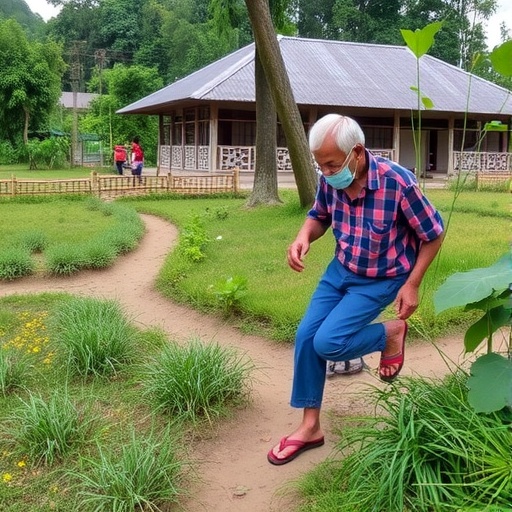
The study strategically sampled older adults living in rural villages, recognizing that rurality often entails limited access to healthcare, lower socioeconomic status, and environmental hazards such as uneven terrain, inadequate lighting, and traditional housing structures that may elevate fall risks. By utilizing structured interviews and observational assessments, the authors collected comprehensive data on participants’ living conditions, health status, mobility patterns, and engagement in preventative behaviors.
One core focus was the identification of modifiable behaviors linked to fall incidence. These behaviors encompassed physical activity levels, medication adherence, home environment modifications, and community engagement. The study found that older adults who maintained regular physical activity and performed balance-strengthening exercises were significantly less likely to experience falls. This aligns with biomechanical theories emphasizing muscular strength and proprioceptive function as pivotal in maintaining postural stability.
Medication management emerged as another critical factor. Polypharmacy, or the use of multiple medications, is common among elderly populations and can exacerbate fall risk due to side effects such as dizziness or orthostatic hypotension. The research highlighted that older adults who actively managed their medication regimens, often through caregiver support or routine medical consultations, exhibited reduced fall incidence. This points to the necessity of coordinated healthcare approaches that prioritize medication review and patient education.
Environmental modifications within the home and immediate surroundings were also integral to fall prevention. Participants who implemented simple adjustments, such as installing handrails, improving floor surface grip, and decluttering pathways, demonstrated a notable decline in fall rates. These findings underscore the importance of ergonomic interventions tailored to rural settings, where structural home improvements can be constrained by financial and material limitations.
Community-based preventive behaviors, including participation in health education sessions and social support networks, were positively correlated with lower fall incidence. Social engagement not only contributes to mental well-being but also facilitates the dissemination of fall prevention knowledge and promotes adherence to safety practices. The interplay between social determinants of health and behavior adoption is particularly salient in rural communities, where traditional norms and collective values shape health behaviors.
The researchers employed advanced statistical modeling to control for confounding variables such as age, gender, comorbidities, and functional status. Their rigorous analysis validated that the identified preventive behaviors independently predicted fall outcomes, enhancing the robustness of the conclusions. Such methodological precision is crucial to distinguish causal pathways from mere associations in epidemiological research.
Importantly, the cross-sectional design affords a snapshot of behaviors and fall incidents but also imposes limitations regarding temporal causality. The authors acknowledged this constraint, advocating for future longitudinal studies to unravel how preventive behaviors evolve over time and their sustained impact on fall risk. Nonetheless, their findings establish an empirical foundation for immediate community health interventions aimed at fall prevention.
This research contributes to the burgeoning discourse on healthy aging by contextualizing fall prevention within the socio-cultural and environmental realities of rural Thailand. It advocates for integrative strategies that encompass physical conditioning, medication management, environmental safety, and social empowerment. Such comprehensive approaches resonate with World Health Organization guidelines that emphasize multifactorial fall prevention programs tailored to local contexts.
Moreover, the study’s implications extend beyond Thailand, offering valuable lessons for global rural health initiatives. As many low- and middle-income countries grapple with similar demographic shifts and infrastructural challenges, the insights into culturally and economically feasible preventive behaviors are universally relevant. This alignment bolsters the potential for international knowledge exchange and collaborative policy formulation.
The research also spotlights the critical role of primary healthcare providers and community health workers in identifying at-risk individuals and facilitating behavior change. Training these frontline actors to deliver personalized fall risk assessments and education can amplify the reach and effectiveness of prevention programs. In addition, leveraging local community organizations to foster peer support and collective action emerges as a promising avenue.
Technological innovation may further augment fall prevention efforts in rural settings. Emerging tools such as wearable sensors and mobile health applications could provide real-time monitoring and feedback to older adults, enhancing adherence to physical exercises and environmental safety practices. However, such technological interventions must be designed with sensitivity to literacy levels, cultural preferences, and access constraints prevalent in rural communities.
In sum, the study by Nonsa-ard and colleagues delineates a nuanced portrait of preventive behaviors that significantly reduce fall incidence among older adults in rural Thailand. By integrating behavioral science, epidemiology, and gerontology, the research charts a path towards sustainable, community-centered fall prevention frameworks. As populations age globally, embracing such evidence-based strategies is essential to safeguard the independence and dignity of older adults.
As the global demographic shift towards older populations continues unabated, integrating multifaceted preventive behaviors into rural health systems will be paramount to curbing the cascading impacts of falls. This work not only enriches the scientific literature but also galvanizes actionable public health efforts, underscoring that even in resource-limited settings, informed behavioral modifications hold transformative potential.
Subject of Research: Preventive behaviors and fall incidence among older adults in rural Thailand
Article Title: Preventive behaviors associated with fall incidence among older adults living in rural communities of Thailand: a cross-sectional study
Article References:
Nonsa-ard, R., Khodseewong, S., Wongprachum, K. et al. Preventive behaviors associated with fall incidence among older adults living in rural communities of Thailand: a cross-sectional study. BMC Geriatr (2026). https://doi.org/10.1186/s12877-026-07830-y
Image Credits: AI Generated
DOI: 10.1186/s12877-026-07830-y
Keywords: fall prevention, older adults, rural health, Thailand, preventive behaviors, gerontology, public health
Tags: cross-sectional studies on elderly fallselderly fall prevention strategiesenvironmental hazards in rural elderly carefall risk factors in rural Thailandfall-related injuries in older adultspreventing falls among older adultspsychological effects of falls in elderlypublic health interventions for fall preventionresource-limited settings and elderly carerural health challenges in aging populationssocio-economic impact on elderly fallstraditional housing and fall risks