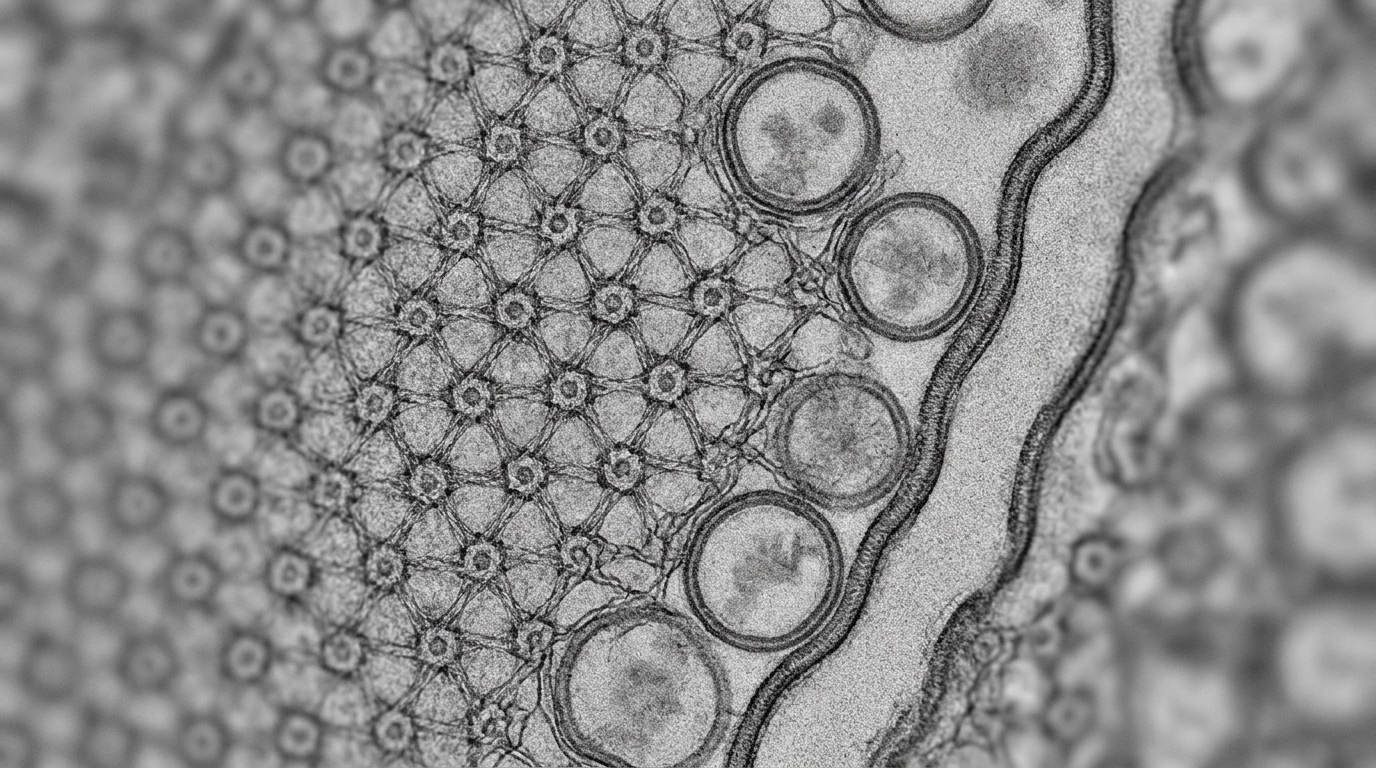
Presynaptic active-zone scaffold proteins ELKS and RIM assemble into periodic nanoscale lattices when reconstituted in non-neuronal cells, establishing that these components form a minimal functional module for synaptic architecture. In reconstituted cellular assemblies, ELKS proteins organize into discrete nanodots with diameters of approximately 60 nanometres, arranged within a regular spatial pattern characterized by a typical lattice spacing of around 130 nanometres. Active zones in presynaptic nerve terminals naturally serve as architectural models for nanotechnology because their native scaffold assemblies spatially organize the complex biological machinery required for neurotransmitter release.
To determine the governing principles behind this spatial organization, researchers analyzed reconstituted protein assemblies alongside native neuronal synapses using super-resolution nanoscopy and quantitative spatial analysis. The investigation integrated these imaging measurements directly with block-copolymer theory to evaluate assembly behaviour. Through this combined approach, the study identified ELKS and RIM as a minimal scaffold module that is fully sufficient to generate ordered hexagonal lattices. The self-assembly process is driven by orthogonal self-association between individual scaffold proteins coupled directly with specific binding interactions between ELKS and RIM.
Accordingly, classical block-copolymer physics provides an explanatory framework capable of describing the nanostructure organization formed by ELKS2 and RIM1.
The researchers further demonstrated that the geometry of the reconstituted nanolattices is systematically tunable through changes in molecular composition. Adjusting the relative stoichiometry of the core scaffold proteins directly alters both the lattice spacing and the overall morphology of the arrays. Furthermore, the structural modularity of the ELKS2–RIM1 system accommodates the recruitment of additional client proteins. The targeted incorporation of regulatory synaptic clients, specifically including RIMBP2 and Liprin-α3, systematically modifies both the spacing between nanodots and the structural morphology of the assembled lattice.
By defining how orthogonal self-association, specific inter-protein binding, and scaffold stoichiometry control lattice parameters, the research elucidates key molecular principles underlying presynaptic active-zone architecture. Designing biological nanomaterials with programmable geometry and function has remained a central challenge across nanotechnology.
Subject of Research: Self-assembly of presynaptic active-zone scaffold proteins into nanoscale lattices
Article Title: Supramolecular protein block copolymers encode presynaptic active-zone nanolattices
Article References: Sakamoto, H., & Shimobayashi, S. F. (2026). Supramolecular protein block copolymers encode presynaptic active-zone nanolattices. Nature Nanotechnology. https://doi.org/10.1038/s41565-026-02340-9
Image Credits: AI Generated
DOI: 10.1038/s41565-026-02340-9
Keywords: presynaptic active zones, scaffold proteins, ELKS, RIM, ELKS2, RIM1, nanolattices, block-copolymer theory, microphase separation, super-resolution nanoscopy, RIMBP2, Liprin-α3, supramolecular assembly, protein condensates, hexagonal lattices, nanotechnology, neurotransmitter release, spatial organization
News Source: Denise Maddox. (November 27, 2026). Presynaptic Active-Zone Scaffold Proteins Self-Assemble Into Ordered Hexagonal Nanolattices. Scienmag.