


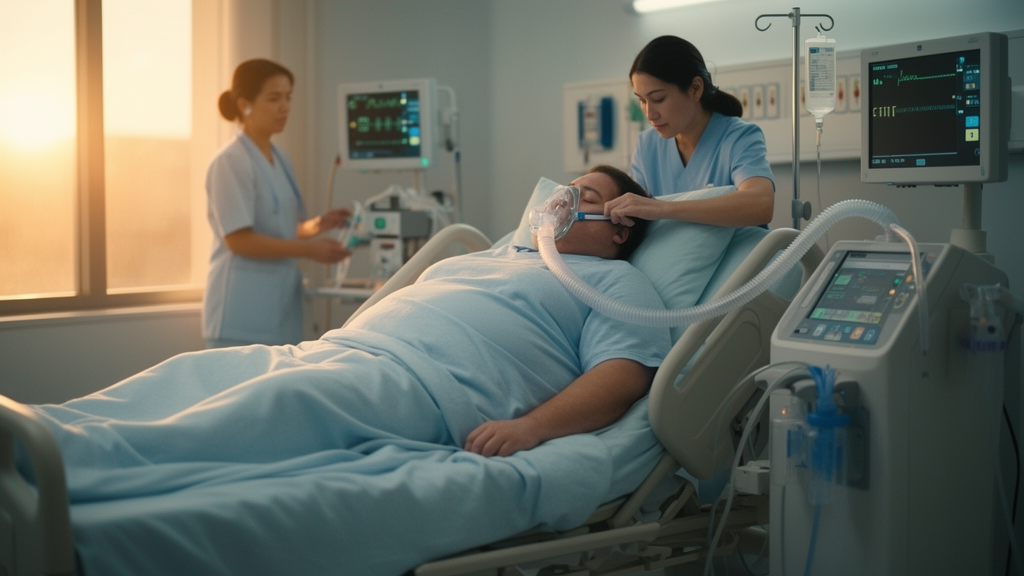
For critically ill patients with morbid obesity, the moments immediately after a breathing tube is removed are among the most precarious of an intensive care unit stay. A new physiological analysis published in Annals of Intensive Care reports that both noninvasive ventilation with pressure support over positive end-expiratory pressure, known as PSV-PEEP, and continuous positive airway pressure, or CPAP, reduced the work of breathing after extubation, but pressure support did so far more dramatically. In the fifteen patients studied, inspiratory work of breathing fell to a median of 5.3 joules per minute under PSV-PEEP, compared with 8.4 joules per minute under CPAP and 14.9 joules per minute while breathing standard oxygen through a face mask. The differences were statistically robust, with p values below 0.001 across the comparisons.
The study, a post-hoc analysis of data from a prospective crossover physiological trial conducted in Montpellier, France, is the first to directly measure inspiratory effort in patients with obesity during the immediate post-extubation period under these three conditions. Rather than tracking clinical outcomes such as reintubation or survival, the researchers focused on the mechanical burden placed on the respiratory muscles, capturing it with invasive measurements of esophageal, gastric and airway pressures. Their central question was simple: does adding pressure support on top of PEEP unload the diaphragm more effectively than CPAP alone, which delivers positive pressure without inspiratory assistance?
The answer, according to the data, is a clear physiological yes. Transdiaphragmatic pressure swing, a direct index of how hard the diaphragm contracts with each breath, averaged 5.9 centimeters of water under PSV-PEEP, 11.4 under CPAP and 19.6 under standard oxygen. Every inspiratory effort index the team measured, including esophageal pressure swings and esophageal and diaphragmatic pressure-time products, showed the same hierarchy: spontaneous breathing demanded the most effort, CPAP unloaded the muscles substantially, and PSV-PEEP unloaded them further still. The authors interpret this gradient as evidence of a progressively greater unloading of the inspiratory muscles as ventilatory support intensifies.
Respiratory pattern measurements reinforced the picture. The respiratory rate dropped from a median of 29.0 breaths per minute on standard oxygen to 24.6 on CPAP and 24.4 on PSV-PEEP, while the ratio of respiratory rate to tidal volume, a marker of rapid shallow breathing, fell from 81.1 to 75.3 and then 65.7 minutes per milliliter respectively, with p values below 0.05. Tidal volume and minute ventilation stayed essentially identical across the three conditions, meaning the drop in rate reflected more efficient breathing rather than reduced ventilation. Applying positive pressure, whether through CPAP or PSV-PEEP, was also associated with a significant reduction in intrinsic PEEP, the trapped pressure that forces patients to suck open their own airways at the start of each breath, and with a longer expiratory time.
The physiology behind these findings is rooted in how obesity reshapes the respiratory system. Excess body mass decreases the compliance of the respiratory system, compresses lung volumes and lowers functional residual capacity, the reservoir of air remaining in the lungs at the end of a normal exhale. Obesity is also associated with impaired upper airway function and reduced neuromuscular strength, and it raises resting oxygen uptake, which translates into a higher baseline work of breathing. In the intensive care unit, where work of breathing is often already elevated during weaning, this added load is considered a potential contributor to extubation failure, which occurs in roughly 15 to 20 percent of high-risk patients and carries higher morbidity.
Positive airway pressure addresses several of these mechanisms at once. Applying PEEP has been shown to improve functional residual capacity and gas exchange, and in patients with morbid obesity, tidal expiratory flow limitation is common and can promote dynamic hyperinflation that inflates the work of breathing. By splinting the airways open, CPAP and PSV-PEEP reduce intrinsic PEEP and the inspiratory threshold load it imposes. Pressure support then goes a step further, actively assisting each inspiratory effort rather than merely changing the pressure environment. The authors note that the difference in intrinsic PEEP between standard oxygen and the positive-pressure modes in their study was small, one to two centimeters of water, and unlikely to be clinically significant on its own, suggesting the additional benefit of PSV-PEEP comes chiefly from the pressure support itself.
The experimental design was meticulous but modest in scale. Fifteen patients, twelve women and three men, with a mean body mass index of 45 kilograms per square meter were analyzed from an original cohort of seventeen, with exclusions due to accidental removal of the esophageal catheter. All had been mechanically ventilated for at least 24 hours, with a mean duration of six days, and were considered ready for extubation. After the tube was removed, each patient moved through three consecutive 20-minute phases: standard oxygen at 5 liters per minute, CPAP at 7 centimeters of water, and PSV-PEEP with the same settings prescribed before extubation, whose mean PEEP level of 7 plus or minus 2 centimeters of water matched the CPAP phase. This matching allowed the team to isolate the specific contribution of pressure support over an identical level of PEEP.
The measurements themselves relied on a double balloon-tipped catheter positioned in the mid-esophagus and stomach, with transdiaphragmatic pressure obtained by subtracting esophageal from gastric pressure. Work of breathing was calculated from esophageal pressure-tidal volume loops using the Campbell diagram, with corrections applied for mask leaks, and balloon positioning was verified with occlusion testing and abdominal palpation. For analysis, only the last ten interpretable respiratory cycles of each phase were retained. Non-parametric statistics appropriate for the small sample, including the Friedman test with Holm-adjusted pairwise comparisons, were used throughout by an independent statistician.
The authors are candid about the study’s boundaries. It measured effort indexes for a single 20-minute window shortly after extubation and was not designed to test whether reduced inspiratory effort translates into fewer reintubations or better long-term outcomes, nor did it examine the duration of ventilation support patients actually needed. The fixed ordering of the three phases, without randomization or a washout period, could bias results if an earlier condition partially unloaded the muscles and carried over into the next, a concern the researchers tried to mitigate by analyzing only late cycles. Pressure support levels also varied between patients because settings were maintained as prescribed before extubation, and the facial mask used for measurements may itself have influenced effort, although the same mask was used across all three conditions.
Those caveats matter for interpretation, but they do not diminish the study’s central physiological message. Earlier clinical trials have found that prophylactic noninvasive ventilation started immediately after extubation reduces acute respiratory failure and reintubation in patients with obesity, and the new data offer a plausible mechanical explanation for that benefit: the support genuinely takes load off overworked inspiratory muscles, with pressure support doing so more completely than CPAP. Prior work in healthy volunteers with obesity had shown CPAP reducing diaphragm electromyogram and inspiratory pressure swings, and the current results extend that unloading principle to the post-extubation intensive care setting while demonstrating that adding pressure support provides a greater reduction in effort than CPAP alone. For clinicians weighing which noninvasive mode to apply after removing a breathing tube from a patient with morbid obesity, the findings suggest that where tolerance permits, pressure support over PEEP may unload the diaphragm more effectively, though the authors frame this as guidance for prophylactic use in this high-risk population rather than a prescription, and they note that high-flow nasal oxygen remains an unsettled alternative in need of further research.
Subject of Research: Physiological comparison of noninvasive ventilation with pressure support and CPAP on inspiratory effort after extubation in critically ill patients with morbid obesity
Article Title: Physiological comparison of noninvasive ventilation and CPAP on inspiratory efforts after extubation in critically ill patients with morbid obesity: a post-hoc analysis
Article References: Mahul, M., Capdevila, M., Galia, F., De Jong, A., & Jaber, S. (2025). Physiological comparison of noninvasive ventilation and CPAP on inspiratory efforts after extubation in critically ill patients with morbid obesity: a post-hoc analysis. Annals of Intensive Care, 15(1), Article 180. https://doi.org/10.1186/s13613-025-01603-3
Image Credits: AI Generated
DOI: 10.1186/s13613-025-01603-3
Keywords: noninvasive ventilation, CPAP, PSV-PEEP, extubation, morbid obesity, work of breathing, transdiaphragmatic pressure, intensive care, weaning, intrinsic PEEP, respiratory mechanics, pressure support
News Source: Daisy Hatcher. (October 30, 2026). Pressure Support Beats CPAP at Easing Breathing Effort After Extubation in Obesity. Scienmag.



