In the noisy ecosystem of a preschool classroom, where blocks topple, pretend kitchens bubble over, and children narrate their every move, talk is the currency of development. A new study published in the Journal of Autism and Developmental Disorders suggests that some children are being shortchanged in that economy. Using wearable sensing technology to capture thousands of hours of naturalistic classroom audio, researchers found that preschoolers with language difficulties both produce and receive significantly fewer words from their peers than their typically developing classmates, a gap that accumulates to roughly 260,000 missing words over a single academic year.
The research team, led by Laura M. Justice of the Crane Center for Early Childhood Research and Policy at The Ohio State University, set out to answer a deceptively simple question: do children with language difficulties experience peer talk differently from their classmates? Language difficulties are among the most common neurodevelopmental concerns of early childhood. Late language emergence, marked by delays in vocabulary and word combinations, affects about 13 percent of two-year-olds, while developmental language disorder, a condition impairing language comprehension and production, affects an estimated 7 to 10 percent of four- and five-year-olds. The causes remain unknown, though the condition is highly heritable, pointing to a genetic etiology.
Why does peer talk matter so much? Decades of developmental science show that adverse peer relations in childhood predict internalizing and externalizing behavior problems, conduct difficulties, and risk behaviors extending into adolescence and adulthood. For young children specifically, exposure to talk from others provides the linguistic stimuli that shape the neural pathways supporting language ability. Research in inclusive preschool classrooms has even shown that language growth over an academic year accelerates for children with language difficulties when they interact frequently with peers who have advanced language skills, a phenomenon known as the peer effect. If children with language difficulties are talking less with peers, they may be missing a critical developmental engine.
Previous work had already hinted at trouble. A study of 56 inclusive preschool classrooms using teacher reports found that children with language difficulties had significantly fewer ties in the classroom social network and were substantially more likely to be isolated from their peers. But teacher ratings and brief observations carry well-known biases. The new study took a different route: objective, continuous measurement using the Interaction Detection in Early Academic Settings, or IDEAS, sensing system, which combines voice recorders with Bluetooth proximity beacons worn by teachers and children throughout the school day.
The technology is technically sophisticated. Each participant wore a pouch or vest housing a voice recorder and a location-tracking beacon, with an accelerometer triggering data capture once the wearer was moving around the classroom. Wall-mounted antennae communicated with the beacons via radio frequency signals, classifying participants as being in proximity when they were within 1.5 meters of one another and oriented within 45 degrees. A MATLAB-based pipeline then applied automatic speech recognition to the audio, counting the words exchanged between people who were simultaneously in proximity. A support vector machine filtered out idle periods, and all interaction measures were standardized to words per minute of wear time. Validation work shows the word counts correlate with ground truth at r = .99 for teacher talk and r = .93 for child talk.
The study spanned 29 preschool classrooms in two mid-western states, followed across two consecutive academic years, with up to eight daylong observations per classroom between December and June. Of 181 children in the analytic sample, 36, or 20 percent, were identified as having language difficulties using multiple criteria: a standard score at or below 81 on the expressive communication subscale of the Preschool Language Scale Fifth Edition, an Individualized Education Program, and/or teacher-reported concern about language development. The researchers deliberately avoided relying solely on IEP status, since many children with language needs are never formally identified during the preschool years.
The headline finding is stark. Across all children, peer talk dwarfed teacher talk: children received an average of 31.33 words per minute from peers but only 6.75 from teachers, and produced 21.93 words per minute to peers versus just 2.55 to teachers, effects so large they correspond to standardized differences of 1.61 and 2.23 respectively. Against this backdrop, children with language difficulties received 3.66 fewer peer words per minute and produced 2.50 fewer peer words per minute than their classmates, differences that were statistically significant in multilevel models accounting for observations nested within children and classrooms. Scaled up, the researchers calculate, that gap amounts to about 7,200 fewer words from peers per week, or roughly 260,000 words across an academic year.
Just as striking was what the study did not find. Verbal interactions with teachers occurred at nearly identical rates for children with and without language difficulties, with no significant differences in either incoming or outgoing teacher talk. This surprised the team, given prior evidence that teachers interact more frequently with children with disabilities in inclusive settings. The authors suggest the null result may reflect the more objective and sustained nature of sensing-based observation compared with earlier methods, or the broader, less clinically defined way language difficulties were identified in this sample. Either way, the finding underscores that the distinctive experience of these children lies squarely in the peer domain, not the adult one.
Why do children with language difficulties talk less with peers? The study cannot establish causes, but the authors offer two leading interpretations. The first is homophily, the well-documented tendency of children to prefer playmates who share characteristics such as gender, age, or skill level. Recent research across 28 preschool classrooms found that children receiving special education were 11 percent more likely to play with other special-education children than with those outside that designation. Since children with language difficulties made up only 20 percent of each classroom, such preferences would sharply restrict the pool of available conversational partners. The second interpretation involves pragmatic language, the social use of language. Skills such as taking conversational turns, entering ongoing play, asking questions, and resolving conflicts verbally are often underdeveloped in children with language difficulties, and weak pragmatics has been specifically linked to social exclusion in preschool settings.
The developmental stakes are considerable, though the authors are careful about directionality. Less incoming peer talk could deprive children of linguistic input that fuels vocabulary and grammar growth, compounding their initial difficulties in a feedback loop. Less outgoing talk could further marginalize them from classroom social networks, with downstream consequences for behavior and learning that peer-rejection research has documented for decades. Alternatively, the authors note, the consequences could be neutral or even positive in some respects, and determining which is the case requires future classroom-based research. The study also has limits the authors acknowledge: 29 classrooms limit generalizability, the language-difficulty group may not map neatly onto clinical diagnoses, and the sensors capture frequency but not quality, missing gestures, facial expressions, perspective-taking, and real-time repair of communication breakdowns. Out-of-classroom settings such as playgrounds, where social networks may form differently, were also not observed. Still, the findings mark a technical milestone, demonstrating that wearable sensing can quantify, with unprecedented granularity, the everyday verbal lives of young children, and they signal an urgent need for interventions, such as peer-mediated approaches, that promote peer-to-peer talk for the children who need it most.
Subject of Research: Peer verbal interactions of preschool children with language difficulties measured with wearable sensing technology
Article Title: Peer Talk in the Preschool Classroom: Are the Experiences of Children With Language Difficulties Distinctive?
Article References: Justice, L. M., Pelfrey, G. L., Jiang, H., Foster, T. J., Irwin, D., & Villasanti, H. G. (2026). Peer Talk in the Preschool Classroom: Are the Experiences of Children With Language Difficulties Distinctive?. Journal of Autism and Developmental Disorders. https://doi.org/10.1007/s10803-026-07436-8
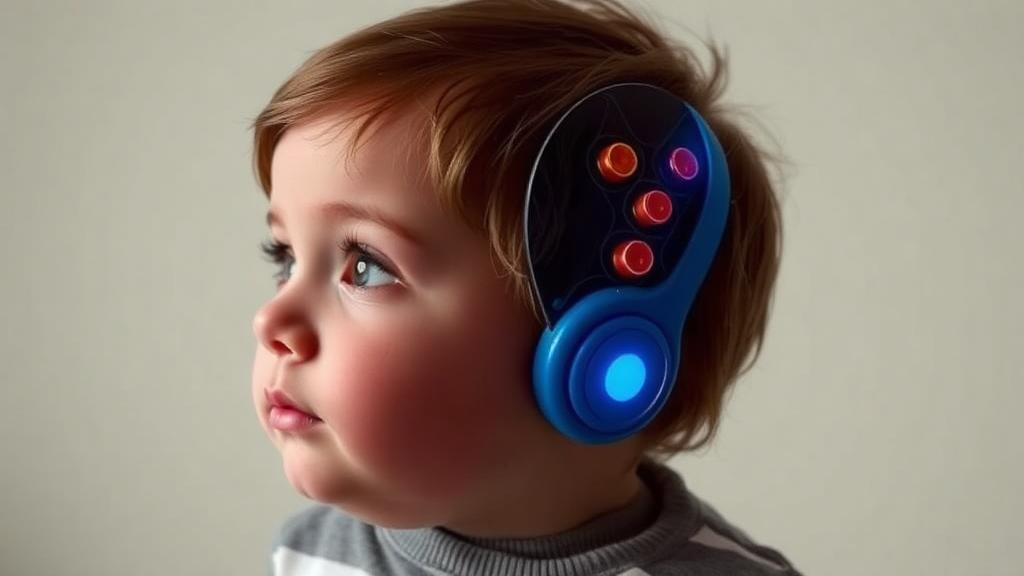
Image Credits: AI Generated
DOI: 10.1007/s10803-026-07436-8
Keywords: developmental language disorder, preschool, peer interactions, peer talk, wearable sensors, early childhood education, language development, social exclusion, pragmatic language, teacher-child interaction, inclusive classrooms, child development
Ophelia Keating. (October 4, 2026). Preschoolers With Language Difficulties Hear Thousands Fewer Words From Classmates, Wearable Sensors Reveal. Scienmag.