• HOME
  • NEWS
  • EXPLORE
    • CAREER
      • Companies
      • Jobs
    • EVENTS
    • iGEM
      • News
      • Team
    • PHOTOS
    • VIDEO
    • WIKI
  • BLOG
  • COMMUNITY
    • FACEBOOK
    • INSTAGRAM
    • TWITTER
Thursday, February 5, 2026
BIOENGINEER.ORG
No Result
View All Result
  • Login
  • HOME
  • NEWS
  • EXPLORE
    • CAREER
      • Companies
      • Jobs
        • Lecturer
        • PhD Studentship
        • Postdoc
        • Research Assistant
    • EVENTS
    • iGEM
      • News
      • Team
    • PHOTOS
    • VIDEO
    • WIKI
  • BLOG
  • COMMUNITY
    • FACEBOOK
    • INSTAGRAM
    • TWITTER
  • HOME
  • NEWS
  • EXPLORE
    • CAREER
      • Companies
      • Jobs
        • Lecturer
        • PhD Studentship
        • Postdoc
        • Research Assistant
    • EVENTS
    • iGEM
      • News
      • Team
    • PHOTOS
    • VIDEO
    • WIKI
  • BLOG
  • COMMUNITY
    • FACEBOOK
    • INSTAGRAM
    • TWITTER
No Result
View All Result
Bioengineer.org
No Result
View All Result
Home NEWS Science News Health

Prenatal BPA exposure may contribute to the male bias of autism spectrum disorder

Bioengineer by Bioengineer
January 19, 2021
in Health
Reading Time: 2 mins read
0
IMAGE
Share on FacebookShare on TwitterShare on LinkedinShare on RedditShare on Telegram

IMAGE

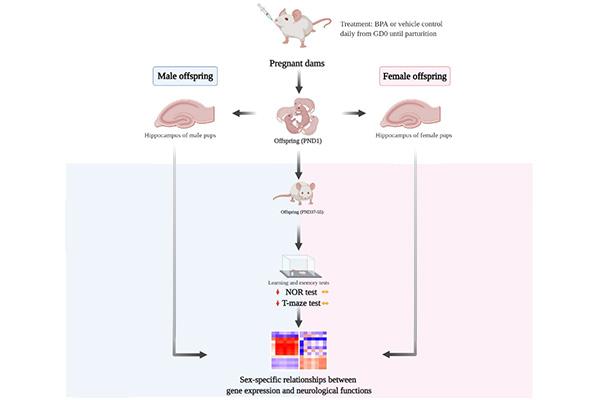
Credit: Surangrat Thongkorn et all

A new study by researchers from Chulalongkorn University, Tohoku University, and The George Washington University is the first to identify autism candidate genes that may be responsible for the sex-specific effects of bisphenol A (BPA) on the brain. It suggests BPA may serve as an environmental factor that contributes to the prevalence of male bias in autism spectrum disorder (ASD).

The research was published in the journal Scientific Reports.

BPA is widely used in many products in our daily life and abundant in micro/nanoplastics found in the environment, food, or the human placenta. It is thought to be an environmental influence on ASD – a neurodevelopmental disorder characterized by impaired social communication, restricted interests and repetitive behaviors. ASD is a major public health challenge around the world, with roughly 1 in 54 children in the United States being diagnosed.

“Many studies have shown BPA impairs neurological functions known to be disrupted in ASD, making scientists believe that BPA may be one of the key environmental risk factors for ASD. However, we still do not know how BPA can cause or increase the susceptibility of ASD and whether it also plays a role in the male bias of the disorder,” said assistant professor Dr.Tewarit Sarachana, head of the SYstems Neuroscience of Autism and PSychiatric disorders (SYNAPS) Research Unit at the Faculty of Allied Health Sciences, Chulalongkorn University.

“In fact, one of our recent studies has demonstrated that prenatal exposure to BPA altered the expression of several ASD candidate genes in the hippocampus in a sex-dependent pattern, but the link between the dysregulation of ASD candidate genes and impaired neurological functions is still lacking.”

“In this study, we showed exposure to BPA during the gestational period decreased neuronal viability and neuronal density in the hippocampus and impaired learning/memory in only the male offspring. Interestingly, the expression of several ASD-related genes in the hippocampus was dysregulated and showed sex-specific correlations with neuronal viability, neuritogenesis, and/or learning/memory. Under prenatal BPA exposure, these genes may play important roles in determining the risk of ASD and its higher prevalence in males,” said Surangrat Thongkorn, a Ph.D. candidate and first author of the study.

“The sex differences in the effects of BPA found in our study strongly suggest that BPA negatively impacts the male and female offspring brain through different molecular mechanisms. We are progressively working on these issues to identify the sex-specific molecular mechanism of BPA in the brain. Understanding the effects of BPA and its molecular mechanisms in ASD may lead to changes in the policy regarding the use of BPA or even the discovery of molecular targets for ASD treatment in the future,” concluded Dr.Sarachana.

###

Media Contact
Noriko Osumi
[email protected]

Original Source

https://www.tohoku.ac.jp/en/press/prenatal_bpa_exposure_male_bias_asd.html

Related Journal Article

http://dx.doi.org/10.1038/s41598-020-80390-2

Tags: Medicine/Healthneurobiology
Share12Tweet8Share2ShareShareShare2

Related Posts

Geriatric In-Home Deaths: Insights from Autopsy Findings

February 5, 2026

Leadership’s Impact on Allied Health Professional Identity

February 5, 2026

Regular Family Dinners May Lower Substance Use Risk in Adolescents, Study Finds

February 5, 2026

Two-Step Voltage Sensor Activation in KV7.4 Channel

February 5, 2026
Please login to join discussion

POPULAR NEWS

  • Robotic Ureteral Reconstruction: A Novel Approach

    Robotic Ureteral Reconstruction: A Novel Approach

    81 shares
    Share 32 Tweet 20
  • Digital Privacy: Health Data Control in Incarceration

    63 shares
    Share 25 Tweet 16
  • Study Reveals Lipid Accumulation in ME/CFS Cells

    57 shares
    Share 23 Tweet 14
  • Breakthrough in RNA Research Accelerates Medical Innovations Timeline

    53 shares
    Share 21 Tweet 13

About

We bring you the latest biotechnology news from best research centers and universities around the world. Check our website.

Follow us

Recent News

Sudanese Copts Evolve Rapid Resistance to Malaria Through Accelerated Evolutionary Process

IRF5’s Role in Emphysema via NLRP3 and Ly6C Cells

Free Halide Ions Enable Switchable Photoluminescence

Subscribe to Blog via Email

Enter your email address to subscribe to this blog and receive notifications of new posts by email.

Join 73 other subscribers
  • Contact Us

Bioengineer.org © Copyright 2023 All Rights Reserved.

Welcome Back!

Login to your account below

Forgotten Password?

Retrieve your password

Please enter your username or email address to reset your password.

Log In
No Result
View All Result
  • Homepages
    • Home Page 1
    • Home Page 2
  • News
  • National
  • Business
  • Health
  • Lifestyle
  • Science

Bioengineer.org © Copyright 2023 All Rights Reserved.