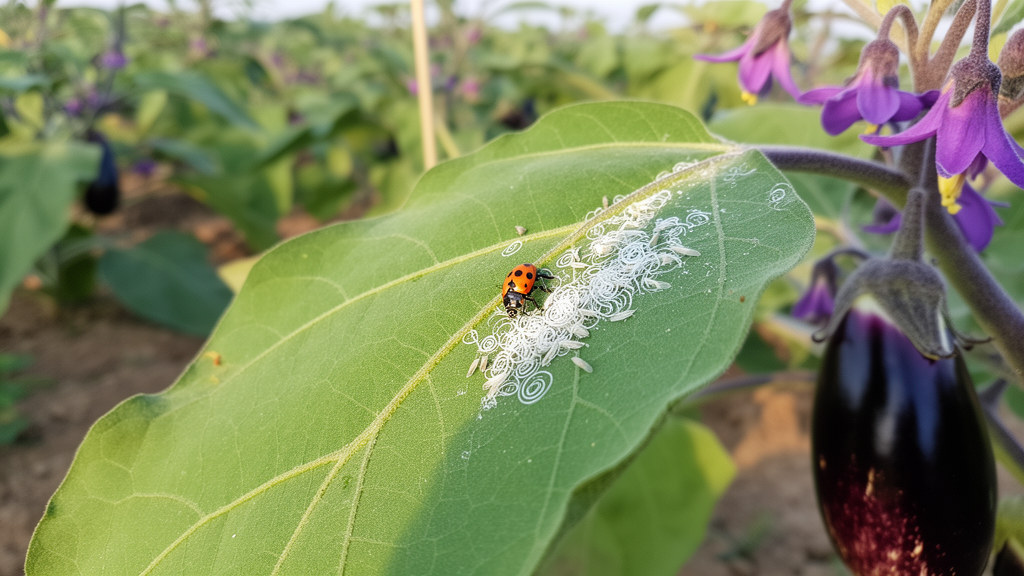
Targeted field releases and laboratory evaluations of five predatory insect species demonstrated that strategic biological control can suppress invasive spiralling whitefly populations on eggplant by more than ninety percent, presenting a practical non-chemical alternative for commercial horticulture. The extensive multi-phase investigation, conducted in Tamil Nadu, India, evaluated the green lacewings Mallada astur and Chrysoperla zastrowi sillemi, the cybocephalid beetle Cybocephalus species, and the predatory ladybird beetles Cryptolaemus montrouzieri and Axinoscymnus puttarudriahi against various life stages of the spiralling whitefly, Aleurodicus dispersus Russell. While synthetic chemical sprays have historically provided inconsistent control due to the pest’s heavy protective wax and cryptic habits, the biological assays revealed that specific predatory insects actively consume whitefly eggs, nymphs, and adults across development. In controlled field plot trials conducted over two distinct Kharif growing seasons, dual releases of these predators achieved sharp declines in pest density within twenty to twenty-five days, demonstrating that conservation and augmentative release of specialized predators can provide durable crop protection.
The target pest, Aleurodicus dispersus, is an exotic invasive insect native to the Neotropics that has expanded across tropical and subtropical agricultural zones, emerging as an economically devastating constraint since its initial documentation in India during the late 1990s. The polyphagous insect inflicts severe direct and indirect injury across an extensive range of valuable horticultural and plantation crops, including eggplant, cassava, guava, papaya, and hibiscus. Concurrently, feeding colonies excrete voluminous quantities of sugary honeydew alongside loose flocculent white wax, fostering the rampant proliferation of black sooty mold fungi across leaf surfaces. This fungal accumulation severely impedes foliar photosynthesis and fouls marketable produce, inflicting heavy economic losses on farmers while conventional synthetic chemical insecticides rapidly lose effectiveness due to insecticide resistance, secondary pest outbreaks, and natural enemy destruction.
To establish an effective predator-driven integrated pest management framework, researchers gathered wild populations of the five candidate predators directly from infested agricultural fields in Coimbatore, Tamil Nadu, and established parallel rearing colonies under standardized screenhouse conditions. The screenhouse environment was strictly regulated at twenty-five degrees Celsius give or take two degrees, seventy-five percent relative humidity give or take two percent, and an equal twelve-hour light and twelve-hour dark photoperiod, utilizing potted eggplants of the Pusa Purple Round variety. Aleurodicus dispersus host colonies were propagated and maintained within an experimental plot measuring ten meters by ten meters at Tamil Nadu Agricultural University.
Field-collected adults and larvae of Cybocephalus species were maintained in mesh-covered tubs supplied continuously with spiralling whitefly life stages. For the coccinellid predators Cryptolaemus montrouzieri and Axinoscymnus puttarudriahi, colonies were established within spacious wooden cages measuring thirty by thirty by thirty centimeters, stocking fifty fifteen-day-old adults per cage at an equal one-to-one sex ratio. These beetle colonies received daily provisioning of a fifty percent honey solution alongside whitefly-infested eggplant foliage, with pupation occurring naturally upon leaf surfaces and internal cage walls. Emerging adult cohorts across all five species were systematically harvested to support developmental biology trials, laboratory consumption bioassays, and subsequent open-field augmentative release experiments.
Laboratory life history assays revealed distinct developmental timelines across the five predator species when reared exclusively upon spiralling whitefly prey. One hundred individual insects per species were monitored individually from egg deposition to adult emergence within nylon-meshed containers measuring ten by five centimeters across two complete experimental replicates. Pre-adult developmental periods ranged from a rapid twenty point two days in Axinoscymnus puttarudriahi and twenty-two point three days in Mallada astur to an extended twenty-seven point five days in Cybocephalus species. The larval feeding period exhibited corresponding variation, spanning from eight point nine days in Axinoscymnus puttarudriahi to twelve point zero days in Cryptolaemus montrouzieri.
Reproductive output and adult longevity evaluations further differentiated the potential ecological roles of each predatory insect within crop canopies. Female reproductive fecundity peaked dramatically in Chrysoperla zastrowi sillemi, which produced an average of three hundred forty-five point six eggs per female, closely followed by Mallada astur at three hundred three point seven eggs per female. Conversely, Cybocephalus species and Axinoscymnus puttarudriahi exhibited comparatively modest lifetime egg production, yielding one hundred ten point six and one hundred eighteen point four eggs per female, respectively. However, Cybocephalus species compensated for lower oviposition through extraordinary adult longevity, with adult females surviving an average of sixty-three point three days under laboratory conditions, compared to thirty-eight point five days for Cryptolaemus montrouzieri and thirty-eight point three days for Axinoscymnus puttarudriahi. The prolonged adult lifespan of Cybocephalus ensures an enduring predatory presence capable of exerting sustained background suppression across successive whitefly generations.
Laboratory prey consumption assays demonstrated substantial variations in feeding capacity across predator instars when individuals were offered fifty to one hundred whitefly prey items daily at twenty-three degrees Celsius and seventy percent relative humidity. Mallada astur exhibited the highest overall voracity among all tested species, displaying statistically significant stage-dependent consumption rates across whitefly eggs, four nymphal instars, pupae, and winged adults. Third-instar Mallada astur larvae proved exceptionally aggressive, consuming an average of one hundred thirty-three point eight second-instar whitefly nymphs, far surpassing feeding levels recorded on older pupae or adult whiteflies. Similarly, third-instar larvae of Chrysoperla zastrowi sillemi exhibited pronounced predation against juvenile whiteflies, with analysis of variance confirming that consumption of second-instar nymphs generated the most pronounced statistical response. Both lacewing species functioned primarily as voracious juvenile specialists, attacking early and intermediate nymphal aggregations with high efficiency while consuming minimal numbers of heavily chitinized pupae or mobile adults.
Feeding assays with the predatory beetles revealed complementary stage preferences, indicating that multi-species assemblages could exploit different ecological niches within the same crop canopy. Cybocephalus species demonstrated significant predatory activity against whitefly eggs and early-stage nymphs, with larvae and long-lived adults consistently devouring large numbers of eggs, first instars, and second instars while exhibiting comparatively low feeding rates against pupae and adults. Cryptolaemus montrouzieri displayed a pronounced dual-stage feeding pattern wherein second-instar beetle larvae concentrated their feeding primarily upon whitefly egg clusters, whereas mature adult beetles actively attacked first-instar crawlers. In contrast, the indigenous ladybird Axinoscymnus puttarudriahi maintained a balanced and steady consumption profile across all whitefly developmental stages, consuming moderate numbers of eggs, young nymphs, and pupae without showing extreme preference for any single prey stage, underscoring its utility as a reliable background predator.
Field trials conducted over two full Kharif growing seasons in Pollachi, Coimbatore, rigorously tested predator efficacy under natural open-field agricultural conditions. One-month-old eggplants were established in randomized block design plots measuring one hundred square meters per replicate, separated by twenty-five-meter buffer zones to eliminate cross-treatment movement, with three independent replications per treatment and zero synthetic insecticide applications. Predator releases occurred twice at thirty-day intervals, delivering recommended field rates of one hundred thousand eggs per hectare for the neuropterans Mallada astur and Chrysoperla zastrowi sillemi, and fifteen hundred adult beetles per hectare for Cybocephalus species, Cryptolaemus montrouzieri, and Axinoscymnus puttarudriahi. Sampling protocols entailed inspecting thirty leaves per plot across upper, middle, and lower plant canopy tiers using fifteen-power optical magnifiers twenty-four hours before releases and fortnightly thereafter, with overall population reduction percentages calculated through the Henderson-Tilton equation.
Baseline whitefly densities prior to treatment introduction did not differ significantly among experimental plots, averaging between three hundred seven and three hundred twenty insects per leaf in the first Kharif season, and between one hundred fifty-five point seven and one hundred sixty-four point three insects per leaf in the second season. Following the initial predator release in season one, Mallada astur generated an eighty-four point zero percent population reduction, reducing pest counts to fifty-one point three insects per leaf, while Cybocephalus achieved seventy-nine point nine percent suppression. Following the second release, suppression intensified dramatically: Mallada astur achieved a ninety-seven point zero percent reduction, lowering pest density to eleven point seven insects per leaf, closely followed by Cybocephalus at ninety-five point five percent, Axinoscymnus puttarudriahi at ninety-two point eight percent, and Cryptolaemus montrouzieri at ninety-one point three percent, while untreated control plots swelled to three hundred ninety-one point seven whiteflies per leaf.
Consistent suppressive trends recurred throughout the second Kharif field trial, confirming the reliability of predator augmentation across varying initial pest densities and seasonal microclimates. Following the second release of season two, Mallada astur achieved ninety-eight point four percent pest suppression, leaving a negligible population of only three point seven whiteflies per leaf, while Cybocephalus species, Axinoscymnus puttarudriahi, and Cryptolaemus montrouzieri attained ninety-seven point zero, ninety-five point one, and ninety-four point two percent reduction, respectively. Statistical analysis of variance confirmed that season, release frequency, and predator species, as well as all two-way and three-way interaction terms, exerted highly significant effects on pest mortality. Even Chrysoperla zastrowi sillemi, which registered the lowest suppression among treatments, achieved eighty-eight point two percent population reduction, contrasting starkly with untreated control plots where whitefly numbers climbed unchecked to two hundred thirty-one insects per leaf.
These experimental outcomes demonstrate that predator-driven biological control offers an effective, ecologically sound replacement for synthetic insecticides in managing spiralling whiteflies within subtropical horticultural systems. The complementary functional roles of fast-acting, voracious larval predators like Mallada astur and long-lived, egg-specialist adult beetles like Cybocephalus species create a continuous suppressive barrier that strikes both reproductive recruitment and active nymphal feeding. Furthermore, because both candidate species accept standard laboratory rearing regimes and exhibit high reproductive capacities, commercial insectaries can mass-produce and deploy them at scale.
Subject of Research: Biological control of spiralling whitefly Aleurodicus dispersus on eggplant using five insect predators
Article Title: Predator-driven IPM approach: integrating predatory insect species for sustainable management of the whitefly, Aleurodicus dispersus russell (Hemiptera: Aleyrodidae) in eggplant
Article References: Boopathi, T., Anusha, N., & Prasuna, J. G. (2025). Predator-driven IPM approach: integrating predatory insect species for sustainable management of the whitefly, Aleurodicus dispersus russell (Hemiptera: Aleyrodidae) in eggplant. Egyptian Journal of Biological Pest Control, 35(1), Article 34. https://doi.org/10.1186/s41938-025-00868-x
Image Credits: AI Generated
DOI: 10.1186/s41938-025-00868-x
Keywords: Aleurodicus dispersus, spiralling whitefly, Mallada astur, Cybocephalus, Chrysoperla zastrowi sillemi, Cryptolaemus montrouzieri, Axinoscymnus puttarudriahi, biological control, integrated pest management, Solanum melongena, eggplant, predation rate, augmentative release, Tamil Nadu, Kharif season, horticultural entomology, green lacewings
News Source: Gavin Prescott. (November 11, 2026). Predatory Insects Slash Invasive Spiralling Whitefly Infestations in Eggplant Fields. Scienmag.