


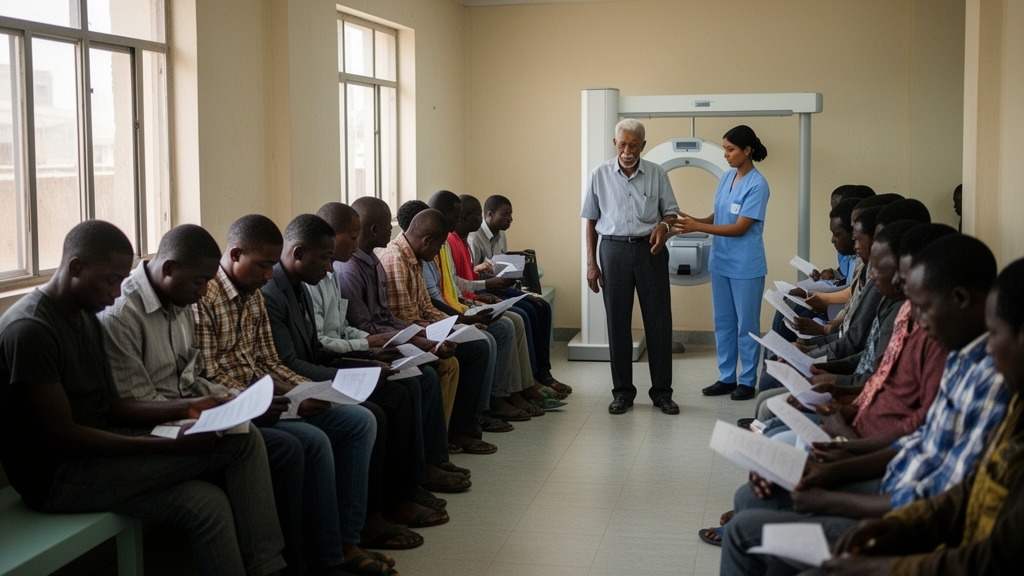
Ethiopian migrants screened for tuberculosis before leaving their home country developed active disease at a low but measurable rate during up to ten years of follow-up in Israel, according to a cohort study published in BMC Infectious Diseases. Of 6,919 migrants who underwent pre-departure screening and were followed between 2015 and 2024, 40 people, or 0.6 percent, developed tuberculosis after arriving in Israel, with most diagnoses occurring within the first two to three years after migration. The findings, drawn from cross-matching pre-departure screening records with the Israeli national tuberculosis registry, suggest that while certain screening measures flag higher-risk individuals, no single pre-departure test reliably predicts who will later develop active disease.
Tuberculosis incidence in Ethiopia is roughly 50 times higher than in Israel, which is why Ethiopian migrants undergo pre-departure screening that includes a medical questionnaire, physical examination, tuberculin skin test, and chest X-ray. The study aimed to characterize which migrants developed tuberculosis after arrival and to evaluate how well pre-departure screening measures predicted subsequent active disease in Israel. Researchers used sensitivity, specificity, and negative and positive predictive values to assess the association between screening results and later tuberculosis diagnosis.
Among the full cohort, 98 migrants, or 1.8 percent, showed a pre-departure chest X-ray suggestive of pulmonary tuberculosis. In multivariable analysis, three factors were associated with post-migration tuberculosis diagnosis: HIV infection, a pre-departure chest X-ray suggestive of pulmonary tuberculosis, and a greater tuberculin skin test induration.
The tuberculin skin test, measured at a cutoff of 10 millimeters or more, showed a descriptive sensitivity of 75.0 percent, with a 95 percent confidence interval of 58.8 to 87.3 percent, meaning it flagged about three-quarters of those who later developed tuberculosis. However, its positive predictive value was only 2.1 percent, with a confidence interval of 1.4 to 3.0 percent. That low predictive value reflects the fact that tuberculosis remained rare in the cohort: even among people with a positive skin test, the vast majority never developed active disease during follow-up.
Among migrants with a tuberculin skin test induration of 10 millimeters or more, the researchers examined how well other pre-departure findings performed. A chest X-ray suggestive of pulmonary tuberculosis showed a sensitivity of 85.7 percent and a positive predictive value of 15.4 percent. A history of previous tuberculosis showed a sensitivity of 80.0 percent and a positive predictive value of 5.6 percent. HIV infection showed a sensitivity of 50.0 percent and a positive predictive value of 7.1 percent. Chronic disease showed a sensitivity of 66.7 percent and a positive predictive value of 3.3 percent. All confidence intervals were wide, reflecting the small number of tuberculosis cases within this subgroup.
The study’s conclusions emphasize that migrants infected with HIV, those with a pre-departure chest X-ray suggestive of pulmonary tuberculosis, and those with greater tuberculin skin test indurations were at high risk of developing tuberculosis after arrival. The authors note that tuberculin skin test screening showed relatively high sensitivity but low positive predictive value in association with subsequent tuberculosis in Israel. This combination means the test is useful for ruling out disease in many people but generates many false positives when applied to a population where active tuberculosis is uncommon.
The timing of diagnoses is a notable finding. Most tuberculosis cases appeared within the first two to three years after migration, suggesting that the period immediately following arrival represents the highest-risk window for disease progression.
The cohort design followed all migrants who underwent pre-departure screening and were subsequently followed up in Israel over a nine-year window, from 2015 through 2024.
Several limitations shape how these results should be interpreted. The confidence intervals around the sensitivity and predictive value estimates are broad, particularly for the subgroup analyses among people with positive skin tests, where the number of tuberculosis cases was small. The descriptive nature of the sensitivity and predictive value calculations means they characterize this specific cohort rather than establishing universal screening performance.
For public health programs managing tuberculosis among migrant populations, the findings suggest that pre-departure screening identifies a higher-risk subgroup but cannot precisely predict individual outcomes. The concentration of cases in the first few years after arrival may help programs target follow-up resources toward the period when risk is greatest.
Subject of Research: Long-term follow-up of Ethiopian migrants in Israel who underwent pre-departure tuberculosis screening, examining associations between screening measures and subsequent active tuberculosis.
Article Title: Long-term follow-up in Israel on Ethiopian migrants who underwent pre-arrival tuberculosis screening
Article References: Bayebegn, F. Y., Singer, S. R., Perl, S. H., & Mor, Z. (2026). Long-term follow-up in Israel on Ethiopian migrants who underwent pre-arrival tuberculosis screening. BMC Infectious Diseases. https://doi.org/10.1186/s12879-026-14382-4
Image Credits: AI Generated
DOI: 10.1186/s12879-026-14382-4
Keywords: tuberculosis, Ethiopian migrants, Israel, pre-departure screening, tuberculin skin test, chest X-ray, HIV, cohort study, post-migration TB, predictive value, public health, BMC Infectious Diseases
News Source: Ophelia Keating. (October 28, 2026). Pre-Departure Tuberculosis Screening Offers Limited Predictive Value for Ethiopian Migrants in Israel. Scienmag.



