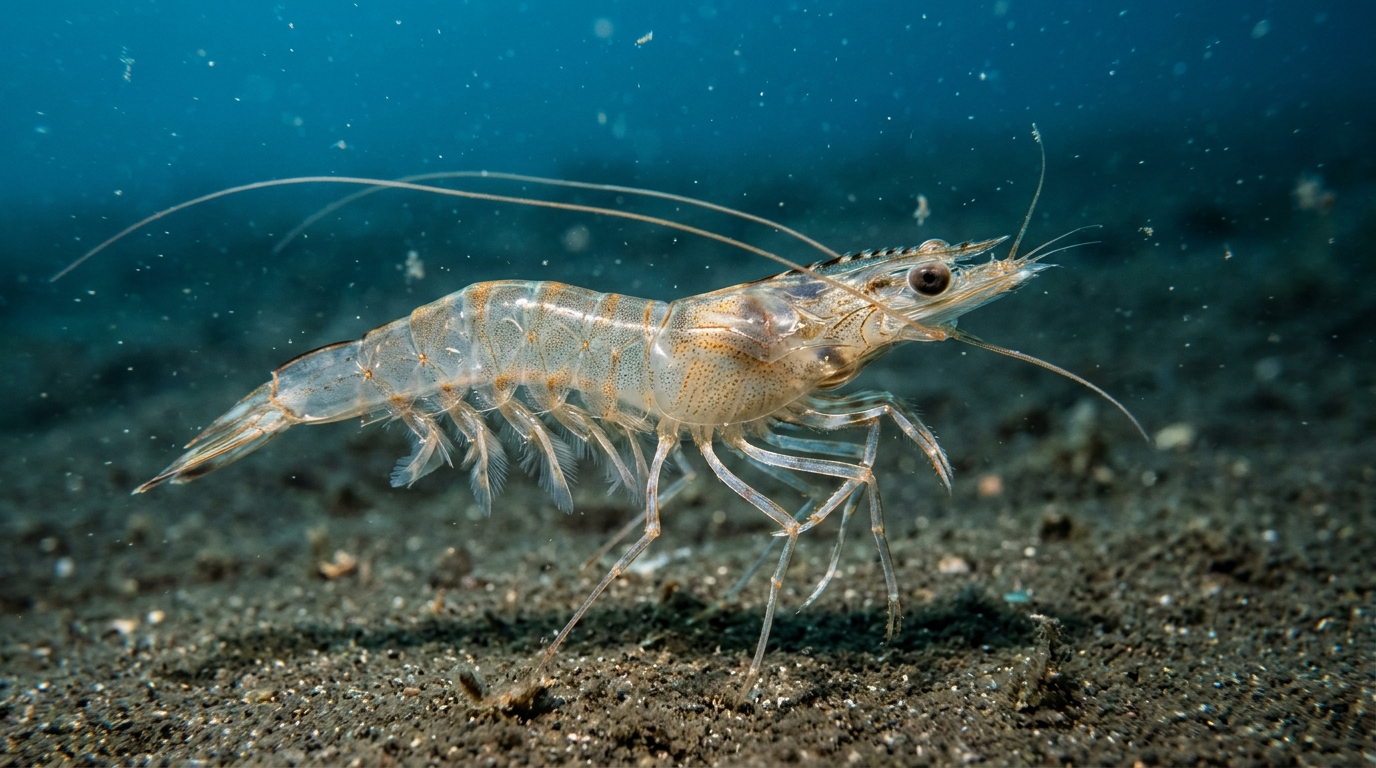
The giant freshwater prawn Macrobrachium rosenbergii is one of the most economically important aquaculture species in the world, yet it tolerates cold poorly. When water temperatures drop, survival, growth and productivity all suffer. A new whole-transcriptome study has now mapped, for the first time in this species, how the prawn’s hepatopancreas — a organ that combines digestive and metabolic functions — responds at the RNA level to acute low-temperature stress, capturing not only protein-coding messenger RNAs but also the non-coding RNAs that help regulate them.
Researchers exposed prawns to a controlled cooling regime, lowering water temperature from 26.0 ± 0.5 °C to 13.5 ± 0.5 °C at a rate of 1.5 °C per hour, then holding the animals at 13.5 ± 0.5 °C for 12 hours. A control group was kept at a constant 26.0 ± 0.5 °C for 36 hours. Sampling took place 36 hours after fasting onset in the control group and 44.3 hours after fasting onset in the cold-treated group, an 8.3-hour difference. Each condition included three biological replicates drawn from independent culture tanks.
Whole-transcriptome sequencing of the hepatopancreas profiled coding and non-coding RNA expression under the cold challenge. Using a false-discovery-rate-controlled analysis, the team identified 439 differentially expressed mRNAs, 23 long non-coding RNAs (lncRNAs) and 13 microRNAs (miRNAs); no circular RNAs (circRNAs) reached significance. A separate exploratory analysis using a relaxed threshold flagged 2,250 mRNAs, 80 lncRNAs, 2 circRNAs and 23 miRNAs, but these exploratory results were used only for hypothesis generation and not treated as confirmed findings.
Functional enrichment analysis showed that the differentially expressed mRNAs were substantially enriched in immune-related pathways and metabolic pathways, suggesting that the prawn’s response to cold involves broad reprogramming of both defence and energy-handling machinery. Correlation analysis between the differentially expressed lncRNAs and mRNAs identified 1,436 mRNAs that were potentially targeted by the 80 lncRNAs, forming a total of 8,729 lncRNA–mRNA interaction pairs.
By integrating miRNA–mRNA and lncRNA–mRNA interactions, the researchers constructed a putative mRNA-bridged lncRNA–miRNA–mRNA association network consisting of 2 miRNAs, 2 mRNAs and 8 lncRNAs, comprising 8 lncRNA–mRNA pairs and 4 miRNA–mRNA pairs. The authors stress that this network, generated purely from bioinformatic algorithms, remains to be experimentally verified. Within it, candidate genes were predicted, including Acat2, Alg-2, Atg18a, eIF3i, Kpc2, Larp4B, maf-S, Megf8, mRpL21, Nmnat, Ptpmeg, Pus10, Rab7, Slmap, spartin, Tim23, Srrm1, Usp7 and Wee1, all flagged as potentially associated with acute low-temperature adaptation in M. rosenbergii.
To check the reliability of the sequencing data, the team performed RT-qPCR on the same RNA-seq samples, confirming technical concordance with correlation coefficients of R² = 0.8046 for mRNAs, R² = 0.953 for lncRNAs and R² = 0.9124 for miRNAs. These high correlations indicate that the sequencing measurements track well with an independent quantification method on the same samples.
An important caveat shapes how these results should be read. Because survival under the cold challenge was low — roughly 13% — the expression profiles mainly represent acute low-temperature-tolerant survivors rather than the general population response. In other words, the molecular picture captured here reflects the biology of the animals that endured the stress, not necessarily what happens in the average prawn.
The study’s conclusions suggest that acute low-temperature stress not only alters mRNA expression but also profoundly reshapes the expression patterns and interaction networks of lncRNAs, circRNAs and miRNAs in the hepatopancreas. The authors propose that the stress may orchestrate coordinated reprogramming of immune, apoptotic and metabolic pathways through integrated ncRNA-mediated regulatory networks, unveiling a complex molecular framework for acute low-temperature adaptation. These remain plausible interpretations drawn from the transcriptomic data rather than experimentally demonstrated mechanisms.
Beyond its immediate findings, the work provides a resource for future functional studies of the candidate genes and regulatory networks identified. The authors also suggest the results may guide selective breeding programmes aimed at enhancing acute low-temperature tolerance in this economically important species, though such applications would depend on validating the predicted interactions and gene functions experimentally.
Subject of Research: Transcriptome-wide RNA changes in the hepatopancreas of giant freshwater prawns under acute low-temperature stress
Article Title: Comprehensive transcriptome-wide characterisation of hepatopancreas in response to acute low-temperature stress in Macrobrachium rosenbergii
Article References: Zhao, Y., Chen, M., Li, Z., Shen, X., Xia, Y., & Li, S. (2026). Comprehensive transcriptome-wide characterisation of hepatopancreas in response to acute low-temperature stress in Macrobrachium rosenbergii. BMC Genomics. https://doi.org/10.1186/s12864-026-13497-x
Image Credits: AI Generated
DOI: 10.1186/s12864-026-13497-x
Keywords: Macrobrachium rosenbergii, giant freshwater prawn, hepatopancreas, low-temperature stress, transcriptomics, lncRNA, miRNA, circRNA, aquaculture, cold tolerance, gene expression, selective breeding
News Source: Juliet Wilcox. (November 8, 2026). Prawn genome study maps RNA responses to cold shock. Scienmag.