

• HOME
  • NEWS
  • EXPLORE
    • CAREER
      • Companies
      • Jobs
    • EVENTS
    • iGEM
      • News
      • Team
    • PHOTOS
    • VIDEO
    • WIKI
  • BLOG
  • COMMUNITY
    • FACEBOOK
    • INSTAGRAM
    • TWITTER
Sunday, June 14, 2026
BIOENGINEER.ORG
No Result
View All Result
  • Login
  • HOME
  • NEWS
  • EXPLORE
    • CAREER
      • Companies
      • Jobs
        • Lecturer
        • PhD Studentship
        • Postdoc
        • Research Assistant
    • EVENTS
    • iGEM
      • News
      • Team
    • PHOTOS
    • VIDEO
    • WIKI
  • BLOG
  • COMMUNITY
    • FACEBOOK
    • INSTAGRAM
    • TWITTER
  • HOME
  • NEWS
  • EXPLORE
    • CAREER
      • Companies
      • Jobs
        • Lecturer
        • PhD Studentship
        • Postdoc
        • Research Assistant
    • EVENTS
    • iGEM
      • News
      • Team
    • PHOTOS
    • VIDEO
    • WIKI
  • BLOG
  • COMMUNITY
    • FACEBOOK
    • INSTAGRAM
    • TWITTER
No Result
View All Result
Bioengineer.org
No Result
View All Result
Home NEWS Science News Biology

Practices leverage telehealth to enhance access to abortion services

Bioengineer by Bioengineer
July 26, 2022
in Biology
Reading Time: 2 mins read
0
Visual Abstract
Share on FacebookShare on TwitterShare on LinkedinShare on RedditShare on Telegram

The COVID-19 pandemic disrupted the delivery of many health services, including abortion, prompting researchers in Seattle to examine the feasibility of telehealth to improve access to this important care. Researchers conducted 21 interviews with clinical staff from four practice settings: independent primary care practices; specialized family planning clinics; online medical services; and primary care clinics within multispecialty health systems. Across all practice settings, the researchers found similar operational procedures for remote medication abortion services, with each site following five basic steps for care provision: patient engagement, care consultations, payment, medication dispensing and follow-up communication.
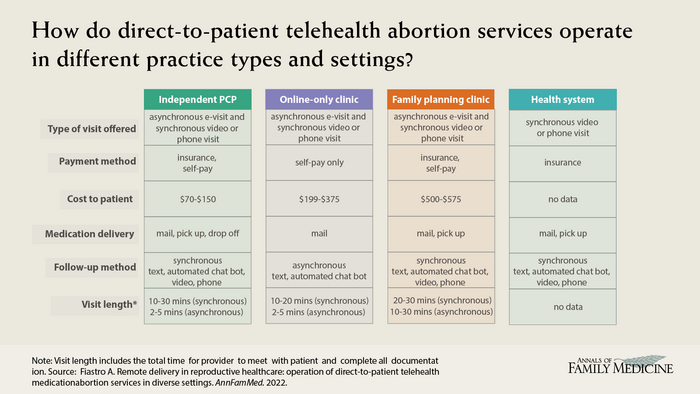
Visual Abstract

Credit: Annals of Family Medicine

The COVID-19 pandemic disrupted the delivery of many health services, including abortion, prompting researchers in Seattle to examine the feasibility of telehealth to improve access to this important care. Researchers conducted 21 interviews with clinical staff from four practice settings: independent primary care practices; specialized family planning clinics; online medical services; and primary care clinics within multispecialty health systems. Across all practice settings, the researchers found similar operational procedures for remote medication abortion services, with each site following five basic steps for care provision: patient engagement, care consultations, payment, medication dispensing and follow-up communication.

Though the overarching structure of services remained consistent across clinics, each site adapted services to their specific setting, local laws and regulations, and the needs of their patient populations. Service sites used multiple methods of medication delivery, including on-site pharmacies, medication dispensing protocols, and partner pharmacies. Family planning and health system clinics mailed medications from clinic stock or internal pharmacies, while independent clinics and online services often used mail-order pharmacies. The authors assert that these findings demonstrate the feasibility of offering abortion services in a variety of medical settings and highlight the potential variations that can be made to adapt the service to patient needs.


Journal

The Annals of Family Medicine

DOI

10.1370/afm.2821

Article Title

Remote delivery in reproductive health care: Operation of direct-to-patient telehealth medication abortion services in diverse settings

Share12Tweet8Share2ShareShareShare2

Related Posts

Breakthrough Non-Invasive Prenatal Test Matches Invasive Methods in Accuracy, Offering Enhanced Safety and Reduced Costs — Biology

Breakthrough Non-Invasive Prenatal Test Matches Invasive Methods in Accuracy, Offering Enhanced Safety and Reduced Costs

June 12, 2026
Identifying Retinal Cell Subgroups May Boost Success of Cell Transplants — Biology

Identifying Retinal Cell Subgroups May Boost Success of Cell Transplants

June 12, 2026

New Study Uncovers How the Brain Revises Its Predictions

June 12, 2026

Decoding Ebola Persistence in Human Brain Organoids

June 12, 2026

POPULAR NEWS

  • ESMO 2025: mRNA COVID Vaccines Enhance Efficacy of Cancer Immunotherapy

    325 shares
    Share 130 Tweet 81
  • Saying Goodbye to PGY-6: Pediatric Fellowship Realities

    99 shares
    Share 40 Tweet 25
  • Multi-Hospital Study Reveals Long Covid Burden Is Twice as High as Current Estimates

    91 shares
    Share 36 Tweet 23
  • Common Food Preservatives Associated with Elevated Blood Pressure and Increased Heart Disease Risk

    59 shares
    Share 24 Tweet 15

About

We bring you the latest biotechnology news from best research centers and universities around the world. Check our website.

Follow us

Recent News

Drosophila Nucleostemin 1 Loss Triggers Apoptosis Mechanism

Turkish Pharmacists’ Insights on Elderly Medication Management

Digit-Tracking Uncovers Macaque Curiosity in Visual Attention

Subscribe to Blog via Email

Enter your email address to subscribe to this blog and receive notifications of new posts by email.

Join 82 other subscribers
  • Contact Us

Bioengineer.org © Copyright 2023 All Rights Reserved.

Welcome Back!

Login to your account below

Forgotten Password?

Retrieve your password

Please enter your username or email address to reset your password.

Log In
No Result
View All Result
  • Homepages
    • Home Page 1
    • Home Page 2
  • News
  • National
  • Business
  • Health
  • Lifestyle
  • Science

Bioengineer.org © Copyright 2023 All Rights Reserved.