• HOME
  • NEWS
  • EXPLORE
    • CAREER
      • Companies
      • Jobs
    • EVENTS
    • iGEM
      • News
      • Team
    • PHOTOS
    • VIDEO
    • WIKI
  • BLOG
  • COMMUNITY
    • FACEBOOK
    • INSTAGRAM
    • TWITTER
Tuesday, September 1, 2026
BIOENGINEER.ORG
No Result
View All Result
  • Login
  • HOME
  • NEWS
  • EXPLORE
    • CAREER
      • Companies
      • Jobs
        • Lecturer
        • PhD Studentship
        • Postdoc
        • Research Assistant
    • EVENTS
    • iGEM
      • News
      • Team
    • PHOTOS
    • VIDEO
    • WIKI
  • BLOG
  • COMMUNITY
    • FACEBOOK
    • INSTAGRAM
    • TWITTER
  • HOME
  • NEWS
  • EXPLORE
    • CAREER
      • Companies
      • Jobs
        • Lecturer
        • PhD Studentship
        • Postdoc
        • Research Assistant
    • EVENTS
    • iGEM
      • News
      • Team
    • PHOTOS
    • VIDEO
    • WIKI
  • BLOG
  • COMMUNITY
    • FACEBOOK
    • INSTAGRAM
    • TWITTER
No Result
View All Result
Bioengineer.org
No Result
View All Result
Home NEWS Science News Chemistry

Powering devices goes skin deep

Bioengineer by Bioengineer
March 9, 2020
in Chemistry
Reading Time: 2 mins read
0
IMAGE
Share on FacebookShare on TwitterShare on LinkedinShare on RedditShare on Telegram

IMAGE

Credit: 2020 KAUST


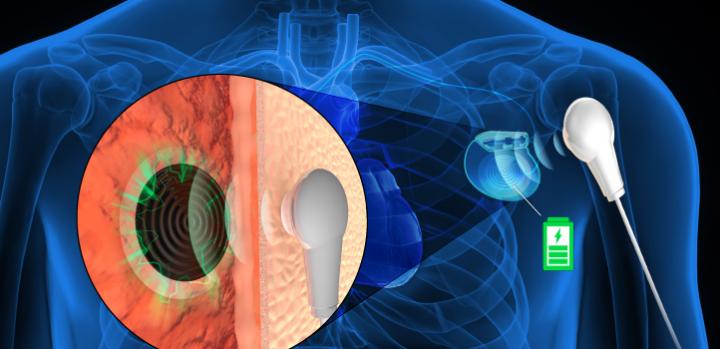
Soft and flexible materials can be used to ultrasonically charge bioelectronic implants, which could help to reduce the need for surgical treatment.

Electronic devices are increasingly used to remedy serious and long-term health problems, such as pacemakers to regulate heartbeat, electronic pumps that release insulin, and implantable hearing aids. Key design considerations for these components aim to minimize size and weight for patient comfort, and they ensure that the device is not toxic to the body.

Another stumbling block is how to power the devices. Batteries keep them working for a while, but changing the batteries demands invasive surgery. Ideally, the power source needs to be recharged wirelessly.

A collaborative study between the groups of materials scientist Husam Alshareef at KAUST and medical imaging expert Abdulkader A. Alkenawi at King Saud bin Abdulaziz University for Health Sciences reveals a way to remotely charge a battery using a soft, biocompatible material that absorbs sound waves passed through the body.

Hydrogels are made of long polymer molecules cross-linked to form a three-dimensional network that can hold a great deal of water. This gives hydrogels a flexible and stretchable texture, but it also means they are both electrical conductors and biocompatible, making them ideal for bioelectronic applications.

Kanghyuck Lee, lead author of the study, explains how the team combined polyvinyl alcohol with nanosheets of MXene, a transition-metal carbide, nitride or carbonitride. “Just as dissolving salt in water makes it conductive, we used MXene nanoflakes to create the hydrogel,” says Lee. “We were surprised to find that the resulting material can generate electric power under the influence of ultrasound waves.”

Their hydrogel, which they refer to as M-gel, generates a current when an applied pressure forces the flow of electrical ions in the water, filling the hydrogel. When this pressure is the result of ultrasound, the effect is called streaming vibration potential.

The KAUST team proved the concept by using a range of ultrasonic sources, including ultrasound tips found in many labs and the ultrasound probes used in hospitals for imaging. They were able to quickly charge an electrical device buried within several centimeters of beef.

“This is another example of the impressive potential of MXene hydrogels we’ve been developing in our laboratory for sensing and energy applications,” said Alshareef.

###

Media Contact
Carolyn Unck
[email protected]

Original Source

https://discovery.kaust.edu.sa/en/article/931/powering-devices-goes-skin-deep

Related Journal Article

http://dx.doi.org/10.1021/acsnano.9b08462

Tags: Biomechanics/BiophysicsChemistry/Physics/Materials SciencesEnergy/Fuel (non-petroleum)
Share12Tweet8Share2ShareShareShare2

Related Posts

β-Sitosterol from Ipomoea carnea Jacq. As a promising anti-inflammatory agent: Evidence from in silico modeling and in vitro validation

β-Sitosterol from Ipomoea carnea Jacq. As a promising anti-inflammatory agent: Evidence from in silico modeling and in vitro validation

August 31, 2026
Graded membranes point to a sustainable route for refining complex petroleum

Graded membranes point to a sustainable route for refining complex petroleum

August 31, 2026

Round-robin tests quantify catalyst activity and deactivation in CO2 hydrogenation modelling

August 30, 2026

Researchers reveal guiding principles for electrochemical synthesis of multimetallic nanocrystals

August 30, 2026
Please login to join discussion

POPULAR NEWS

  • β-Sitosterol from Ipomoea carnea Jacq. As a promising anti-inflammatory agent: Evidence from in silico modeling and in vitro validation

    29 shares
    Share 12 Tweet 7
  • Design, fabrication and characterization of a wearable Fiber Bragg grating sensor for cardiorespiratory monitoring using finger plethysmography

    29 shares
    Share 12 Tweet 7
  • KAIST opens the era of industrial-scale microbial foods, proposing growth strategies for the next-generation protein market

    29 shares
    Share 12 Tweet 7
  • Virologist awarded $2 million NIH grant to investigate how virus-infected cells live and die

    29 shares
    Share 12 Tweet 7

About

We bring you the latest biotechnology news from best research centers and universities around the world. Check our website.

Follow us

Recent News

β-Sitosterol from Ipomoea carnea Jacq. As a promising anti-inflammatory agent: Evidence from in silico modeling and in vitro validation

Design, fabrication and characterization of a wearable Fiber Bragg grating sensor for cardiorespiratory monitoring using finger plethysmography

KAIST opens the era of industrial-scale microbial foods, proposing growth strategies for the next-generation protein market

Subscribe to Blog via Email

Enter your email address to subscribe to this blog and receive notifications of new posts by email.

Join 85 other subscribers
  • Contact Us

Bioengineer.org © Copyright 2023 All Rights Reserved.

Welcome Back!

Login to your account below

Forgotten Password?

Retrieve your password

Please enter your username or email address to reset your password.

Log In
No Result
View All Result
  • Homepages
    • Home Page 1
    • Home Page 2
  • News
  • National
  • Business
  • Health
  • Lifestyle
  • Science

Bioengineer.org © Copyright 2023 All Rights Reserved.