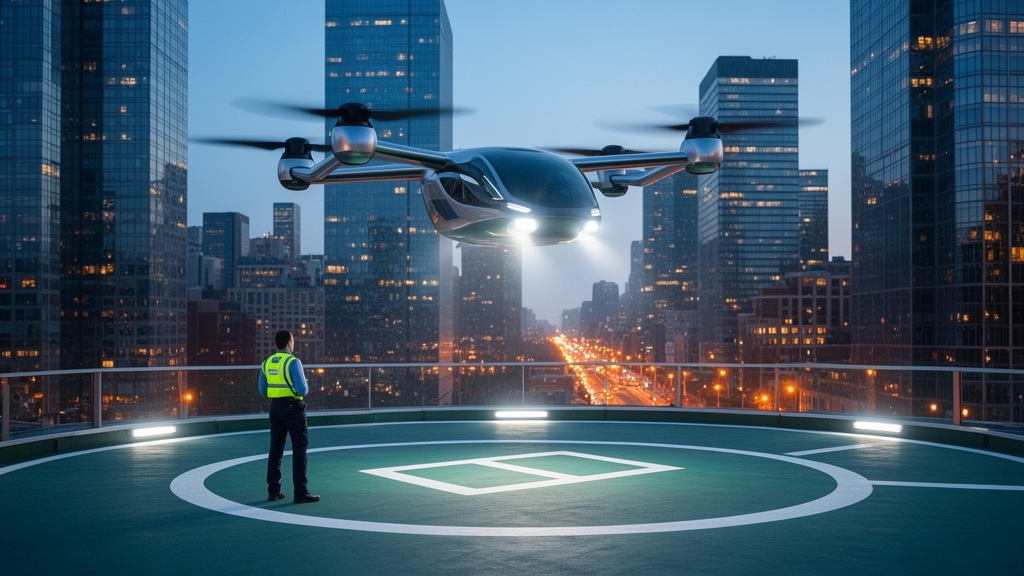
The dream of hailing an air taxi to soar above gridlocked city streets is edging closer to reality, but a quieter revolution is underway in the software that will keep those flying vehicles from colliding. A NASA researcher has unveiled a new method for generating flight trajectories for electric vertical takeoff and landing aircraft, known as eVTOLs, that is simpler and more direct than traditional approaches. The technique, developed by Russell A. Paielli of NASA Ames Research Center and published in the journal Frontiers in Aerospace Engineering, sidesteps the need for detailed aircraft models or flight control systems, potentially accelerating the simulation studies that must precede the deployment of thousands of urban air taxis in metropolitan skies.
The vision of Urban Air Mobility, or UAM, conjures images of swarms of electric aircraft ferrying commuters during rush hours in major cities. Many airframe developers, both startups and established manufacturers, are racing to build eVTOL vehicles capable of vertical takeoff and landing. None have yet been certified by the Federal Aviation Administration, and the challenges are daunting. The most critical pertain to safety, because public acceptance will demand that catastrophic accidents be extremely rare. In the early stages of development, traffic densities will be low, and the main safety concerns will involve airworthiness of individual vehicles and keeping them away from static obstacles. As traffic density increases, however, the safety concerns will shift toward the potential for mid-air collisions, and developing an air traffic control system for UAM will require extensive simulation studies built on flight modeling.
Aircraft flight modeling exists on a spectrum of fidelity. Vehicle engineering and control system design typically require detailed models with six or more degrees of freedom, including controls and actuators. Traffic modeling for air traffic control development, simulation testing, and actual operations such as conflict detection and resolution usually requires only a simpler point-mass model. Paielli’s method goes even further, constructing realistic trajectories without any simulation model of the aircraft or its flight controls. Instead, the user directly specifies the route, the static longitudinal profile describing altitude as a function of distance, and a power model that determines progress in time along that profile. Remarkably, the power model can be derived from a recorded or simulated trajectory of the same aircraft type, allowing a trajectory to be bent into any desired shape while retaining the same basic flight performance characteristics. According to the author, this capability has not been proposed in previous literature on trajectory generation.
The method builds on the concept of net or excess power, defined as the rate of change of mechanical energy, which combines kinetic energy from speed and potential energy from altitude. For any aircraft type, steady flight at a given altitude and airspeed requires a certain amount of power to maintain. Any power beyond what is needed for steady state goes into mechanical energy. That net power integrates over time to determine the vehicle’s speed and altitude. For most aircraft types, the maximum available net power increases with airspeed to some maximum, then decreases as drag rises at higher speeds. Data from the NASA Design and Analysis of Rotorcraft program for a six-passenger quadrotor air taxi at 6,000 feet pressure altitude shows the maximum rate of climb reaching slightly less than 2,000 feet per minute at an airspeed between 50 and 60 knots, with a maximum airspeed of approximately 120 knots.
The trajectory generation algorithm unfolds in four main parts: generating the static longitudinal profile, converting it to a dynamic longitudinal profile by applying a power model, superimposing that profile onto a specified route, and adjusting for the effects of winds. The first step is purely geometric, specifying the shape of the trajectory in three-dimensional space independent of time. The second step is kinetic, filling in the times to yield a specified power profile as a function of calibrated airspeed. For eVTOL air taxis, which can climb and descend at any angle, a typical profile might involve taking off and climbing vertically for 20 feet, transitioning to a flightpath angle of 10 degrees, and climbing to cruise altitude before reversing the pattern for descent and landing.
As the main example, Paielli employed an elliptical profile consisting of a quarter of an ellipse that is vertical at takeoff and transitions smoothly to horizontal at cruise altitude. This shape provides a smooth transition from vertical takeoff to level flight, which should result in a smooth ride for passengers. In an example with a vertipad elevation of 200 feet, a cruise altitude of 1,000 feet, and a horizontal climb distance of 2.0 nautical miles, the actual ellipse is heavily distorted, with a semi-major to semi-minor axis ratio of 15.2. Because no closed-form equation exists to map arc distance along the ellipse to along-track and altitude coordinates, a precise numerical mapping was constructed by sweeping the angle through its full range from zero to 90 degrees in small increments, stepping through arc distance to build the profile point by point.
The mathematical heart of the method lies in determining the time steps between discrete points in space along the trajectory that yield a specified power as a function of airspeed. Total mechanical energy is the sum of potential and kinetic energy. The average power over a single time step is the change in total energy divided by that time step. Substituting expressions for speed and distance and rearranging yields a cubic polynomial in the time increment. Solving this cubic at each point, using a formula drawn from the general cubic equation, determines the required time difference between points to achieve a given level of net power. There should be only one positive real root, which is the correct solution. The approach was verified using the QEP1, a single-seat quadrotor electric aircraft with a rotor diameter of 12.62 feet and an operating gross weight of 1,428 pounds. The resulting net power function matched the model target derived from simulated trajectory data with a uniform time step of 1.0 seconds almost perfectly, with slight discrepancies attributable to discretization error. The net power at takeoff was approximately 300 feet per minute, and maximum power reached approximately 1,300 feet per minute at a calibrated airspeed of about 85 knots.
Once the interpolated points with equal time steps are computed, any relevant flight variable can be precomputed as an array for fast lookup by simple array indexing, followed by linear interpolation between the two bounding points for better accuracy. This makes the trajectory model effectively continuous in time and space. The method also accommodates altitude change maneuvers crucial for conflict resolution, where an aircraft transitions from flying level at one altitude to flying level at another. The flightpath angle is incremented at a constant rate from zero to a specified maximum magnitude, typically in the range of 5 to 20 degrees. In an example maneuver from 1,000 to 1,500 feet, a rate of 10 degrees per nautical mile produced a total maneuver length of 1.33 nautical miles and a normal acceleration of 0.043 g, which is mild and acceptable for passenger comfort. The threshold for comfort is approximately 0.1 g, though a lower value of about 0.05 g is preferable when the traffic situation allows.
The analysis of trip flight time dependence on various parameters reveals findings with significant implications for the economic viability of UAM as an alternative to driving. For a route of 20 nautical miles, flight time increased by 13.6 minutes as cruise altitude rose from 1,000 to 4,000 feet with a climb distance of 2 nautical miles, with the increases growing larger at each successive altitude step. The time advantage of staying at lower altitudes is clear, and the economic disincentive of flying in the upper regions of UAM airspace is evident for this particular aircraft model, which may be somewhat underpowered. Shallower climbs reduce flight time, and the shortest flights would have climb and descent segments meeting in the middle with no level cruise segment, though that could reduce airspace capacity by blocking altitudes other flights need. Flight time also proved sensitive to power level, perhaps even more sensitive than to speed for shorter flights. Because power per unit mass depends on weight, more passengers can mean significantly longer flight times, particularly for smaller aircraft at higher cruise altitudes. Underpowered aircraft could hamper the UAM business model with flight times offering no significant time savings over driving.
The new method can generate candidate trajectories for conflict resolution, which can then be checked to find the candidate with the shortest flight time that is free of conflicts. Using advanced feedforward and feedback control methods, aircraft should be able to fly the resulting deconflicted trajectories to within specified tolerances in the field. The method also preserves basic performance characteristics when reshaping trajectories, because the power model derived from one trajectory of an aircraft type can be applied to generate or bend new trajectories while keeping the same flight performance. As urban air taxis edge toward certification and eventual deployment, tools like this power-based trajectory generator may prove essential for the simulation studies, airspace design, and traffic management systems that will determine whether the promise of flying over traffic becomes a safe and economically viable daily reality.
Subject of Research: Trajectory generation based on power for urban air mobility
Article Title: Trajectory generation based on power for urban air mobility
Article References: Paielli, R. A. (2023). Trajectory generation based on power for urban air mobility. Frontiers in Aerospace Engineering, 2, Article 1278726. https://doi.org/10.3389/fpace.2023.1278726
Image Credits: AI Generated
DOI: 10.3389/fpace.2023.1278726
Keywords: Trajectory, generation, based, power, urban, mobility, scientific research
News Source: Denise Maddox. (October 17, 2026). Power-Based Trajectory Method Could Shape the Future of Urban Air Taxis. Scienmag.