• HOME
  • NEWS
  • EXPLORE
    • CAREER
      • Companies
      • Jobs
    • EVENTS
    • iGEM
      • News
      • Team
    • PHOTOS
    • VIDEO
    • WIKI
  • BLOG
  • COMMUNITY
    • FACEBOOK
    • INSTAGRAM
    • TWITTER
Sunday, May 31, 2026
BIOENGINEER.ORG
No Result
View All Result
  • Login
  • HOME
  • NEWS
  • EXPLORE
    • CAREER
      • Companies
      • Jobs
        • Lecturer
        • PhD Studentship
        • Postdoc
        • Research Assistant
    • EVENTS
    • iGEM
      • News
      • Team
    • PHOTOS
    • VIDEO
    • WIKI
  • BLOG
  • COMMUNITY
    • FACEBOOK
    • INSTAGRAM
    • TWITTER
  • HOME
  • NEWS
  • EXPLORE
    • CAREER
      • Companies
      • Jobs
        • Lecturer
        • PhD Studentship
        • Postdoc
        • Research Assistant
    • EVENTS
    • iGEM
      • News
      • Team
    • PHOTOS
    • VIDEO
    • WIKI
  • BLOG
  • COMMUNITY
    • FACEBOOK
    • INSTAGRAM
    • TWITTER
No Result
View All Result
Bioengineer.org
No Result
View All Result
Home NEWS Science News Chemistry

Powder engineering adds AI to the mix

Bioengineer by Bioengineer
October 30, 2023
in Chemistry
Reading Time: 3 mins read
0
New simulation method that accurately predicts powder mixing using AI
Share on FacebookShare on TwitterShare on LinkedinShare on RedditShare on Telegram

Imagine a world without powders. It may sound exaggerated, but our daily lives are intricately connected to powders in various ways from foods, pharmaceuticals, cosmetics to batteries, ceramics, etc. In all these industries, powder mixing is an important unit operation where different types of powders are mixed to achieve uniformity. However, it can be difficult to predict what conditions are optimal to achieve the desired uniformity as the process often relies on trial and error as well as engineers’ expertise.
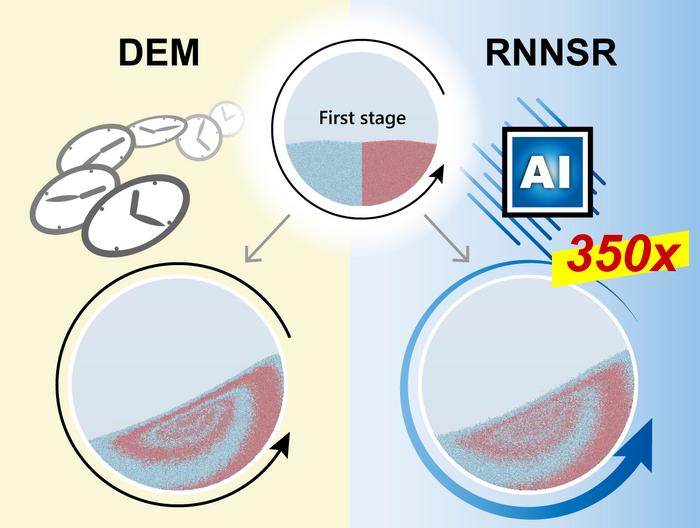
New simulation method that accurately predicts powder mixing using AI

Credit: Hideya Nakamura, Osaka Metropolitan University

Imagine a world without powders. It may sound exaggerated, but our daily lives are intricately connected to powders in various ways from foods, pharmaceuticals, cosmetics to batteries, ceramics, etc. In all these industries, powder mixing is an important unit operation where different types of powders are mixed to achieve uniformity. However, it can be difficult to predict what conditions are optimal to achieve the desired uniformity as the process often relies on trial and error as well as engineers’ expertise.

Numerical simulations using the discrete element method (DEM) have been used widely as an approach that can accurately predict powder mixing. This is achieved by calculating the motion of all particles in a very short time range (1/1,000,000 of a second), calculating the motion of the entire powder using the calculated values, and then repeating the process over and over again to calculate the motion of each particle a short time ahead. Therefore, the substantial amount of time it takes to predict powder mixing significantly hampers the ability to have large-scale and long-duration powder mixing processes.  

A research team led by Associate Professor Hideya Nakamura, Associate Professor Shuji Ohsaki, Professor Satoru Watano, and Ph.D. student Naoki Kishida from the Graduate School of Engineering at Osaka Metropolitan University has developed a new simulation method using AI. Additionally, the team has succeeded in enhancing computational speed by about 350 times. This new method is characterized by using a recurrent neural network (RNN) that enables a long-time-scale powder mixing simulation with low computational costs while maintaining the same level of accuracy as conventional methods.

“We have successfully harnessed our knowledge in powder technology, which we have honed over many years, and combined it with machine learning to rapidly predict the unique behavior of complex powders,” explained Professor Nakamura. “We would like to build upon this achievement to contribute to the future of industries seeking to enhance product quality and streamline production.”

Their findings were published in Chemical Engineering Journal.


###

About OMU 

Osaka Metropolitan University is a new public university established in April 2022, formed by merger between Osaka City University and Osaka Prefecture University. For more research news, visit https://www.omu.ac.jp/en/ or follow @OsakaMetUniv_en and #OMUScience.


Journal

Chemical Engineering Journal

DOI

10.1016/j.cej.2023.146166

Method of Research

Computational simulation/modeling

Subject of Research

Not applicable

Article Title

Development of ultra-fast computing method for powder mixing process

Article Publication Date

27-Sep-2023

Share12Tweet8Share2ShareShareShare2

Related Posts

Transforming Microalgae Waste into High-Performance Membranes for Enhanced Municipal Wastewater Treatment — Chemistry

Transforming Microalgae Waste into High-Performance Membranes for Enhanced Municipal Wastewater Treatment

May 29, 2026
Hydrochar Transforms Agricultural Waste into a Potent Solution for Healthier, Carbon-Rich Soils — Chemistry

Hydrochar Transforms Agricultural Waste into a Potent Solution for Healthier, Carbon-Rich Soils

May 29, 2026

FAPESP Aims to Strengthen Scientific Collaboration Between São Paulo and the United Kingdom

May 29, 2026

Mild Ketone-to-Ketyl Conversion Enables Redox-Neutral Coupling

May 29, 2026

POPULAR NEWS

  • ESMO 2025: mRNA COVID Vaccines Enhance Efficacy of Cancer Immunotherapy

    319 shares
    Share 128 Tweet 80
  • Multi-Hospital Study Reveals Long Covid Burden Is Twice as High as Current Estimates

    81 shares
    Share 32 Tweet 20
  • Common Food Preservatives Associated with Elevated Blood Pressure and Increased Heart Disease Risk

    56 shares
    Share 22 Tweet 14
  • AI-Powered Atlas Uncovers Extensive Whole-Body Damage Linked to Obesity

    53 shares
    Share 21 Tweet 13

About

We bring you the latest biotechnology news from best research centers and universities around the world. Check our website.

Follow us

Recent News

Impact of Immigration Restrictions on the US Healthcare Workforce

Study Reveals Cancer Diagnostic Delays Linked to Population-Based Screening Using Cell-Free DNA Multicancer Early Detection Test

Innovative AI Technique Predicts Radiation Dosage Prior to Treatment in Advanced Prostate Cancer

Subscribe to Blog via Email

Success! An email was just sent to confirm your subscription. Please find the email now and click 'Confirm' to start subscribing.

Join 82 other subscribers
  • Contact Us

Bioengineer.org © Copyright 2023 All Rights Reserved.

Welcome Back!

Login to your account below

Forgotten Password?

Retrieve your password

Please enter your username or email address to reset your password.

Log In
No Result
View All Result
  • Homepages
    • Home Page 1
    • Home Page 2
  • News
  • National
  • Business
  • Health
  • Lifestyle
  • Science

Bioengineer.org © Copyright 2023 All Rights Reserved.