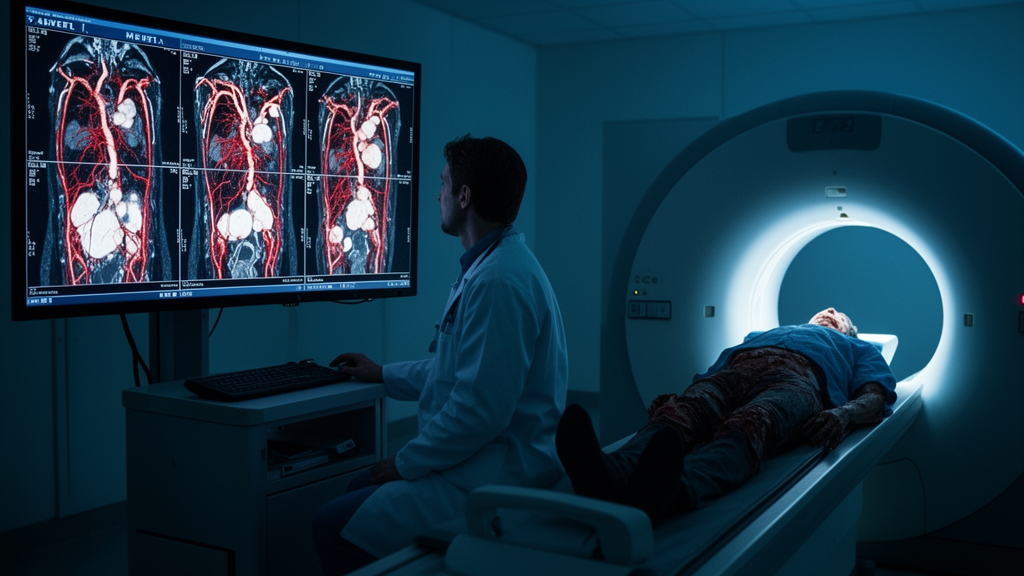
When forensic pathologists scan the bodies of the deceased with computed tomography before autopsy, they often find something puzzling: pockets of gas inside blood vessels that were never injured. This postmortem intravascular gas is one of the most frequent findings on postmortem computed tomography, known as PMCT, yet its meaning has remained stubbornly uncertain for decades. Is it a byproduct of decomposition? A clock that could tell investigators how long ago death occurred? Or a red flag pointing to something that happened before the person died, such as an air embolism? A new study published in the International Journal of Legal Medicine offers one of the clearest answers yet, based on a large and carefully filtered sample of natural deaths.
Researchers at the Department of Forensic Medicine and Toxicology at the All India Institute of Medical Sciences in New Delhi, together with a colleague from the Department of Biochemistry at Vardhman Mahavir Medical College and Safdarjung Hospital, analyzed 247 autopsy-confirmed natural deaths. The team, led by Gokul G., Abilash S., and Abhishek Yadav under the supervision of Sudhir K. Gupta, deliberately excluded cases with trauma, visible putrefaction, or invasive airway management. Each of those exclusions matters: trauma can introduce air into vessels artificially, putrefaction generates gas that swamps any earlier signal, and procedures such as intubation or resuscitation can push gas into the circulation. By stripping away these artifacts, the researchers could study intravascular gas in its cleanest possible context, the early postmortem interval in bodies that died naturally.
The technical approach was straightforward but rigorous. On pre-autopsy PMCT scans, the team graded intravascular gas on a scale from zero to three in three vascular territories: the hepatic vessels serving the liver, the coronary vessels supplying the heart, and the cerebral vessels of the brain. Grading rather than simply noting presence or absence allowed the researchers to test whether the amount of gas increased with time since death, as a decomposition-driven process would predict. Statistical analyses then evaluated two distinct questions: whether gas grade correlated with the postmortem interval, and whether gas in one vascular system was associated with gas in the others.
The results were striking. Gas appeared frequently in the hepatic vasculature, present in 50.6 percent of cases, and in the coronary vessels, present in 51.4 percent of cases. But the cerebral vasculature told a very different story: gas was found there in only 9.7 percent of cases. This asymmetry alone is informative. If intravascular gas were simply a uniform decomposition product diffusing through the entire circulatory system, one might expect it to appear more evenly across territories. Instead, the liver and heart vessels filled with gas roughly half the time while the brain’s vessels almost never did during the early postmortem period.
Even more consequential was what the correlation analysis revealed, or rather failed to reveal. Across all three vascular territories, there was no significant linear correlation between gas grade and the postmortem interval. In practical terms, this means that the amount of gas visible on PMCT cannot serve as a reliable clock for estimating time since death, at least during the early postmortem window this study examined. That finding challenges a line of research that has sought to use postmortem gas volume changes for postmortem interval estimation, including animal-model studies and investigations linking gas detected on PMCT with hypostasis and the postmortem interval. The new data suggest that during the critical early hours, gas accumulation does not progress in a predictable linear fashion that forensic investigators could convert into a time estimate.
But if gas is not a clock, what is it? The answer, according to the study, lies in its distribution pattern. The researchers found a strong systemic association between the hepatic and coronary systems, with a correlation coefficient of rho equal to 0.765. In other words, when gas appeared in the liver’s vessels, it very often appeared in the heart’s vessels as well, and vice versa. The two systems filled together, suggesting a shared underlying mechanism rather than independent local processes. This tight coupling between the portal venous system of the liver and the coronary circulation echoes earlier observations, including PMCT demonstrations of the relationship between gastrointestinal distension and hepatic portal venous gas, and analyses of cardiovascular gas in non-traumatic deaths.
The cerebral vasculature added a final layer of pattern. Cerebral gas was observed only in conjunction with hepatic and coronary gas, and isolated cerebral gas was never identified in the entire sample. The brain’s vessels, in effect, only filled when the liver and heart vessels had already filled. This hierarchical pattern, hepatic and coronary gas common and coupled, cerebral gas rare and dependent, gives forensic radiologists a reproducible systemic signature for early postmortem intravascular gas in natural deaths.
That signature has immediate practical value. When a PMCT scan shows gas distributed in exactly this way, common in the hepatic and coronary territories, rare in the cerebral circulation, and never isolated in the brain, the finding is consistent with a normal postmortem process in a natural death. Conversely, a deviation from the pattern, specifically isolated cerebral gas on PMCT, stands out as anomalous. The authors hypothesize that such findings may indicate antemortem etiologies, such as air embolism or barotrauma, in which gas entered the circulation before death and became trapped in the cerebral vasculature. This hypothesis requires future validation, but it offers a concrete, testable rule for a distinction that has long troubled forensic interpretation. Prior work has grappled with exactly this problem, including case reports differentiating putrefactive gas from air embolism in traumatic carotid-jugular arteriovenous fistula, scoping reviews of medico-legal interpretations of gas on postmortem CT, and evaluations of gas at PMCT in non-putrefied trauma and non-trauma cases. Intracranial gas on postmortem CT in traumatic cases has been particularly contested in medico-legal opinions, and gas analysis has even been used alongside postmortem imaging to diagnose causes of death through compositional analysis of the gas itself.
The study’s design choices strengthen its conclusions. Ethical clearance was granted by the AIIMS Institutional Ethics Committee, informed consent was obtained from the legally acceptable representative of each deceased person, and the work was conducted in accordance with the Declaration of Helsinki. The retrospective observational design, applied to a large consecutive sample of natural deaths with strict exclusion criteria, minimizes the confounding that has plagued smaller studies. The authors note no competing interests and no external funding, and the data generated for the study is available from the corresponding author on reasonable request.
For the growing field of forensic radiology, the implications are considerable. PMCT has become a standard component of virtual autopsy workflows since the early feasibility studies of postmortem multislice CT and MRI, and every scan raises the interpretive question of what intravascular gas means. This study provides a data-driven answer for natural deaths: during the early postmortem interval, intravascular gas follows a predictable systemic association across the hepatic, coronary, and cerebral vascular systems, and it does not track the postmortem interval in any usable linear way. The pattern itself, rather than the quantity of gas, becomes the diagnostic signal. If future validation confirms the authors’ hypothesis, isolated cerebral gas on PMCT could become a recognized indicator of antemortem air embolism or barotrauma, transforming a frequent and ambiguous finding into a targeted clue for cause-of-death investigation. In the meantime, the study gives forensic pathologists something they have lacked: a reproducible baseline for one of postmortem imaging’s most common sights.
Subject of Research: Distribution of postmortem intravascular gas on PMCT in natural deaths
Article Title: Distribution patterns of postmortem intravascular gas on PMCT in natural deaths
Article References: G., G., S., A., Yadav, A., Kumar, P., K., K., & Gupta, S. K. (2026). Distribution patterns of postmortem intravascular gas on PMCT in natural deaths. International Journal of Legal Medicine. https://doi.org/10.1007/s00414-026-04041-3
Image Credits: AI Generated
DOI: 10.1007/s00414-026-04041-3
Keywords: PMCT, postmortem intravascular gas, forensic radiology, postmortem interval, air embolism, virtual autopsy, Distribution, patterns, postmortem, intravascular, natural, deaths
News Source: Ophelia Keating. (October 17, 2026). Postmortem Gas in Blood Vessels Follows a Predictable Pattern on PMCT Scans. Scienmag.