In the field of forensic analysis there is a significant demand for objectively determining the post-mortem interval (PMI) when human skeletal remains are discovered. So far, a whole range of techniques have been used to establish the approximate time that has elapsed since the death of the individual, but they have significant drawbacks in terms of reliability and accuracy: they provide an approximate interval but not an exact date; they are relatively invasive techniques, which require staining or removal of a part of the bone, etc.
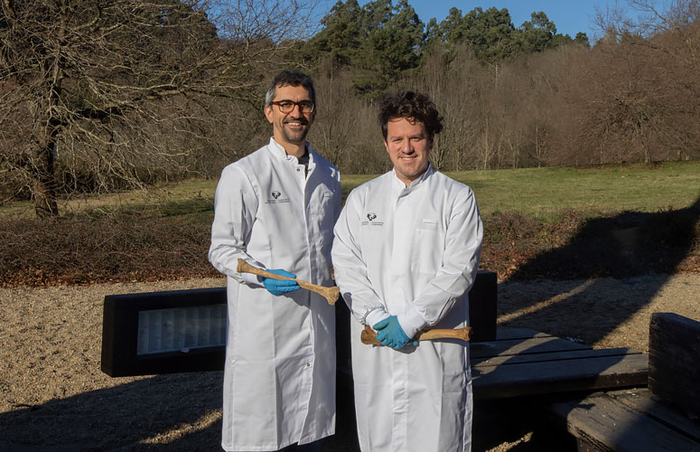
Credit: Jorge Navarro. UPV/EHU.
In the field of forensic analysis there is a significant demand for objectively determining the post-mortem interval (PMI) when human skeletal remains are discovered. So far, a whole range of techniques have been used to establish the approximate time that has elapsed since the death of the individual, but they have significant drawbacks in terms of reliability and accuracy: they provide an approximate interval but not an exact date; they are relatively invasive techniques, which require staining or removal of a part of the bone, etc.
“The aim of this research was precisely to come up with a method capable of determining the relatively accurate post-mortem interval in human remains by using non-destructive measurements,” said Luis Bartolomé, technician in the UPV/EHU’s SGIker Central Analysis Service (SCAB).
So “we analysed a set of 53 actual human skeletal remains with a known post-mortem interval provided by the Department of Legal Medicine, Toxicology and Physical Anthropology of the University of Granada. Using actual samples for the first time, we built and validated a model by combining two non-destructive tools: Raman spectroscopy and chemometrics”, explained the author of the paper.
“Raman spectra,” Bartolomé went on to explain, “contain physico-chemical information on nearly all the components of the sample; however, due to their complexity, in most cases it is not possible to differentiate between all the information they contain. Chemometrics is capable of extracting the parameters of interest from the spectra through mathematical and statistical methods”.
“By combining both techniques, we have been able to build a model in which the Raman spectrum of each set of skeletal remains analysed is associated with a post-mortem interval. Relating the spectrum to a time interval is no easy task and for this we used statistical models and logarithms that allow us to relate each spectrum to a time. So when we receive human skeletal remains for which we don’t know the time that has elapsed since death, what we do is an interpolation by inserting these data into the validated model, and that way a relatively accurate post-mortem interval can be obtained,” explained Luis Bartolomé. “The data recorded in the model developed provides valuable, potentially useful, versatile information,” he stressed.
According to the UPV/EHU researcher, “the combination of both techniques is a significant achievement for forensic medicine and anthropology. However, there is always room for improvement as these types of models perform better the more samples there are and the more varied they are; the model includes more heterogeneity and responds more robustly to a wider range of cases.”
Journal
Forensic Science International
DOI
10.1016/j.forsciint.2021.111087
Method of Research
Experimental study
Subject of Research
People
Article Title
Estimation of the post-mortem interval of human skeletal remains using Raman spectroscopy and chemometrics
Article Publication Date
29-Oct-2021