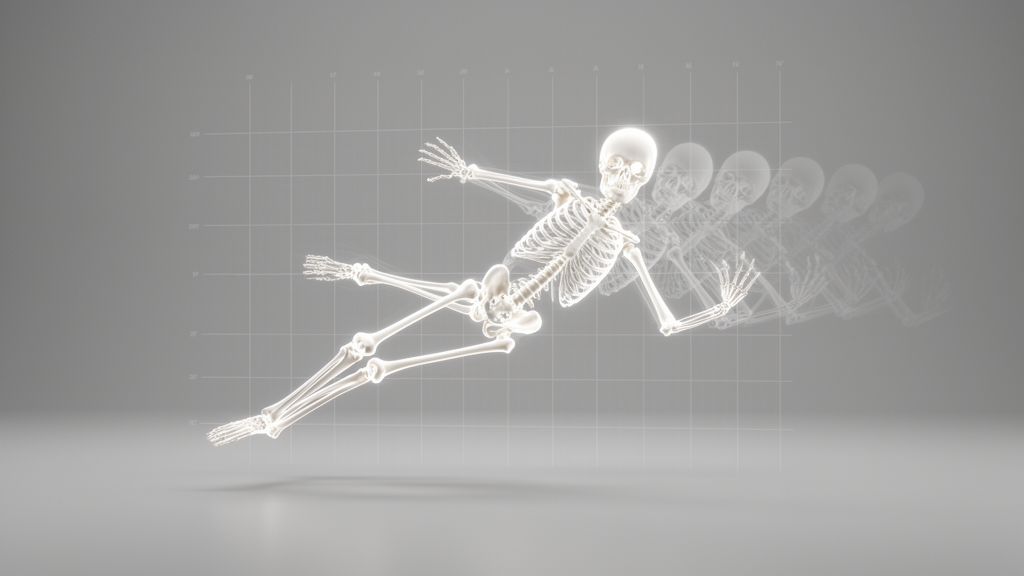
Vision-based automated fall monitoring using two-dimensional skeletal pose estimation offers an unobtrusive surveillance solution for residential and institutional care facilities, yet existing systems frequently fail when deployed across shifting camera viewpoints. In a controlled investigation evaluated on the multi-view TsetFall dataset and simulated environments, researchers Eduardo Façanha Dutra and Maria Andréia Formico Rodrigues deconstructed how data-centric enrichment techniques and sequential neural network architectures influence cross-view generalization. Their experimental results reveal that model baselines trained on single perspectives experience severe predictive degradation when tested on unseen camera angles, but sequence-aware Transformer encoders paired with optimized coordinate-level augmentations mitigate these geometric projection discrepancies, establishing near viewpoint invariance with a minimal coefficient of variation of approximately 0.005 under abundant-data training regimes.
Automated fall detection addresses an urgent global healthcare imperative, as falls represent a leading cause of unintentional injury-related fatalities worldwide, disproportionately impacting older populations experiencing age-related functional decline in balance and gait. While conventional detection technologies include wearable inertial units such as accelerometers and ambient sensors embedded within physical floors or walls, both approaches present notable operational bottlenecks. Wearable devices require strict patient compliance and can suffer from user discomfort, forgetting, or erratic wireless transmission, whereas ambient hardware offers restricted contextual visibility and demands intrusive structural installations.
Despite the inherent advantages of vision-based systems, processing raw red-green-blue video frames poses severe challenges due to background clutter, changing illumination, and varying subject clothing, which frequently lead deep networks to memorize spurious environmental correlations. Pose-based pipelines mitigate these issues by transforming raw video frames into compact, seventeen-joint two-dimensional skeletal coordinates using standardized pose estimators such as top-down High-Resolution Net architectures pre-trained on benchmark datasets. By focusing exclusively on structured anatomical keypoints, the classification pipeline operates on the underlying biomechanics of human movement rather than superficial pixel appearance. Nevertheless, testing models across cameras stationed at varying heights, distances, and tilt angles alters the planar two-dimensional projection of identical three-dimensional motions, causing sharp predictive performance collapses when architectures encounter perspectives absent from training protocols.
To rigorously diagnose these failure points, the investigators developed a multi-stage experimental framework that eliminated the inflated performance metrics common to random or within-view data splits. Their evaluation framework utilized the public TsetFall multi-camera benchmark alongside a synthetic Unity environment populated with a standard humanoid figure driven by Mixamo motion-capture sequences recorded across ten virtual camera positions. Ground-truth bounding boxes framed human subjects before extracting seventeen joint locations, while standardized super-classes aggregated complex action categories into binary fall and no-fall designations. Architectural assessments contrasted a static two-layer frame-wise Multilayer Perceptron against temporal alternatives, including a sequence-based Multilayer Perceptron and a stacked multi-head self-attention Transformer encoder configured to capture longitudinal kinematics across varying temporal window lengths.
The study established a rigorous evaluation standard using two complementary metrics: the geometric mean of sensitivity and specificity to resolve class imbalances, and the coefficient of variation to quantify performance dispersion across unseen camera perspectives. Within this testing regime, coordinate-level augmentation acted as a lightweight, non-invasive regularizer by manipulating normalized joint coordinates through horizontal reflections, vertical flips, in-plane Cartesian rotations, and additive Gaussian jitter without modifying underlying video files. The research team searched the hyperparameter space across all combinations of these four primitives, evaluating up to four concurrent transforms to discover the optimal policy that maximized target detection metrics across designated camera positions.
Empirical evaluations under synthetic-to-real transfer scenarios revealed an inverted-U performance curve governing augmentation complexity. While an unaugmented static baseline achieved an initial cross-view geometric mean of 0.5772, applying an optimal policy comprising three simultaneous geometric transforms elevated performance to 0.7792, representing a 34.99 percent gain. However, escalating to four concurrent transforms broadened variance across policies and triggered substantial performance drops. Crucially, maximizing the geometric mean did not automatically ensure cross-view stability: the configuration yielding the lowest coefficient of variation relied on two simultaneous augmentations, reducing variance from 0.6919 to 0.2020 to achieve a 70.80 percent improvement in cross-view stability, thereby underscoring a distinct operational trade-off between peak detection accuracy and cross-camera stability.
Detailed camera-wise breakdowns demonstrated that viewpoint vulnerabilities are highly heterogeneous across physical space. In specific test scenarios, such as Camera 2 in the synthetic-to-real transfer baseline, the static model suffered an acute geometric blind spot, registering a dismal geometric mean of 0.1248. Introducing the optimal coordinate augmentation policy rectified this blind spot, raising the metric to 0.9316, which represents an improvement of 646.47 percent. The discovery of such localized geometric blind spots confirmed that specific camera perspectives require targeted geometric distributions to bridge the domain shift separating synthetic skeletons from physical human recordings.
When analyzing architectural choices, sequential modeling substantially outperformed frame-wise classification across all multi-camera environments. In global viewpoint integration benchmarks where models were exposed to the complete multi-camera manifold of real footage, the sequence-aware Transformer encoder reached a geometric mean of 0.9710 with an exceptionally stable coefficient of variation of 0.0127, heavily outperforming the static Multilayer Perceptron, which attained 0.8690 with a dispersion of 0.1320. Incorporating coordinate-level augmentation further refined the Transformer’s stability, lowering its coefficient of variation to 0.0053 and elevating its geometric mean to 0.9755. This demonstrates that temporal attention mechanisms naturally extract viewpoint-invariant kinematic trajectories that remain robust against instantaneous two-dimensional planar distortions.
The role of synthetic enrichment proved highly dependent on the availability of real training data. In data-rich environments where the physical multi-view manifold was already well sampled, injecting synthetic sequences acted as a domain distractor for static models, causing their geometric mean to plunge from 0.8690 down to 0.7734 while destabilizing their coefficient of variation to 0.4662. Conversely, under extreme data scarcity simulations where real-world training was restricted to a single fall sequence, synthetic enrichment delivered decisive advantages for unstable baselines. For instance, in single-sequence stress tests exhibiting severe baseline instability, synthetic enrichment raised the geometric mean by 32.45 percent while cutting dispersion by 55.89 percent, effectively establishing plausible decision boundaries where empirical samples were otherwise absent.
These experimental findings provide actionable engineering guidelines for deploying resilient indoor safety monitoring systems. The authors recommend prioritizing sequential attention architectures over static classifiers, treating coordinate augmentations as tuned hyperparameters rather than rigid preprocessing steps, and deploying synthetic pose generation strategically during data-scarce initial phases rather than as an indiscriminate supplement to mature datasets. Acknowledging key research limitations—such as reliance on two-dimensional projections rather than three-dimensional volumetric reconstructions and the propagation of keypoint tracking errors from upstream estimators—the authors identify future investigative pathways, including semi-supervised pre-training on unlabeled activities of daily living, realistic noise modeling in synthetic generation, and temporal trajectory forecasting to anticipate falls prior to floor impact.
The project arose from diagnostic stress testing of earlier fall-detection pipelines trained on the URFall dataset. When evaluating those systems against an in-the-wild collection known as Unifall, the researchers observed two interconnected failure points: automated pose estimators degraded under visual occlusions and severe camera angles, while classifiers failed even when skeletal keypoints were accurately localized. Testing alternative algorithms, including XGBoost, revealed that limited dataset diversity formed the underlying bottleneck. To address this, the team constructed a specialized synthetic environment in Unity measuring 10 by 10 meters, centered on a 1.80-meter humanoid avatar animated with six Mixamo motion-capture sequences covering forward, backward, and impact falls. The virtual space was monitored by ten distinct camera perspectives, including four corner surveillance angles, four wall-mounted viewpoints, a smartphone-height perspective, and an overhead ceiling-mounted fish-eye lens providing a 103-degree field of view.
Rigorous training protocols prevented data leakage and standardized comparative baselines across all experimental phases. Synthetic animations were divided strictly by video identifier, allocating sequences 1, 2, 5, and 6 to training and sequences 3 and 4 to validation, while real-world multi-view assessments reserved five unseen sequences for testing. Neural models were optimized with early stopping using a 30-epoch patience threshold up to a 100-epoch ceiling, calibrating baseline hyperparameters on the Camera 1 real-world partition before applying Bayesian optimization for global multi-view training. The static reference model comprised a two-hidden-layer Multilayer Perceptron with 256 and 128 hidden units, 0.5 dropout, and a learning rate of 0.003. For temporal modeling, sequence lengths of 15, 30, and 45 frames were evaluated, while the Transformer encoder systematically varied model dimensions across 64 and 128 channels, four to eight attention heads, and depth spanning four to eight layers.
These structured evaluations also clarified subtle stability dynamics across data regimes. In global hybrid benchmarks, the Transformer preserved high robustness with a geometric mean of 0.9536 and a low coefficient of variation of 0.0309, demonstrating far greater resilience to synthetic domain noise than static baselines. Furthermore, while synthetic enrichment stabilized highly erratic baselines like Fall 25, applying it to Fall 19, which already possessed a stable baseline coefficient of variation of 0.048, actually increased cross-camera dispersion, showing that added synthetic variability can disrupt an already well-aligned real distribution.
Subject of Research: Cross-view generalization in computer vision pose-based fall detection systems
Article Title: Cross-view generalization in pose-based fall detection: disentangling the roles of 2D pose augmentation, synthetic data, and sequential architectures
Article References: Dutra, E. F., & Rodrigues, M. A. F. (2026). Cross-view generalization in pose-based fall detection: disentangling the roles of 2D pose augmentation, synthetic data, and sequential architectures. Neural Computing and Applications, 38(21), Article 881. https://doi.org/10.1007/s00521-026-12527-9
Image Credits: AI Generated
DOI: 10.1007/s00521-026-12527-9
Keywords: Fall Detection, Computer Vision, Pose Estimation, Transformers, Synthetic Data, Data Augmentation, Machine Learning, Cross-View Generalization, Cross-view, generalization, pose-based, fall
News Source: Blake Davidson. (November 9, 2026). Pose-Based Fall Detection Generalization Improves Using Sequential Transformers and Coordinate Augmentation. Scienmag.