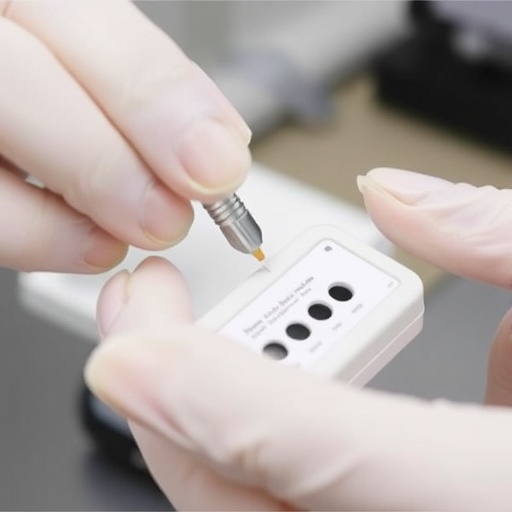
In the wake of the 2025 Mpox outbreak that extensively affected Sierra Leone, a groundbreaking scientific advancement has been reported, spearheading diagnostic methodologies and epidemic containment strategies worldwide. Scientists led by Gopal, Abay, and Payne rapidly engineered a portable, CRISPR-based assay specifically designed for Mpox detection, marking a turning point in field diagnostics of viral infections. Published in Nature Communications in 2026, this report details not just the assay’s development but also its rigorous field evaluation amidst the Sierra Leone epidemic, signaling a significant leap toward scalable, point-of-care viral detection technologies.
Mpox, a viral zoonotic disease caused by the monkeypox virus, emerged as a major public health threat during the recent outbreak in West Africa. Traditional laboratory diagnostic methods, while reliable, were hampered by infrastructural limitations, delayed response times, and logistical challenges in remote or resource-constrained regions. Addressing these issues, the research team devised a CRISPR-based diagnostic platform that is both portable and highly sensitive, ensuring rapid and accurate viral detection directly at the patient’s location.
The core technology underpinning this innovation is the programmable CRISPR-Cas system, a genome-editing tool originally adapted from microbial immune defenses, now intelligently repurposed for precise pathogen identification. This system utilizes guide RNAs specifically designed to recognize unique sequences in the Mpox viral genome. Upon successful target recognition, the CRISPR-associated enzyme Cas12 triggers collateral cleavage of reporter molecules, producing a detectable fluorescent signal. This amplification-free mechanism delivers results in under an hour, a dramatic improvement over several hours or days required by PCR-based assays.
Beyond sensitivity and speed, what truly distinguishes the assay is its field adaptability. The device is compact, battery-operated, and designed for rugged environments, eliminating dependency on fully equipped laboratories. Its user-friendly interface requires minimal technical training, empowering frontline health workers to conduct tests efficiently while managing outbreak responses onsite. The portability factor fundamentally shifts diagnostic paradigms, facilitating timely isolation measures and better epidemiological tracking.
The study, conducted across multiple remote clinics and mobile health units during the Sierra Leone outbreak, rigorously validated the assay’s performance against gold-standard PCR tests. Results demonstrated over 95% concordance, with the CRISPR test consistently ruling out false negatives and detecting infections in early stages. This high sensitivity is crucial for containing transmission chains, especially in regions where healthcare access is limited, and disease surveillance infrastructure is underdeveloped.
Importantly, the assay’s rapid turnaround time enabled near real-time public health decision-making. As field teams received immediate diagnostic feedback, they could swiftly implement containment protocols, conduct contact tracing, and mobilize resources. This capability accelerated efforts to interrupt viral spread, mitigate community transmission, and optimize allocation of medical supplies, underscoring the assay’s strategic impact beyond its technical merits.
The researchers faced numerous challenges in assay development, including designing highly specific guide RNAs that differentiate Mpox virus from closely related orthopoxviruses like smallpox and cowpox. By leveraging whole genome sequencing data and advanced bioinformatics, the team meticulously identified unique genomic regions, ensuring assay exclusivity and minimizing cross-reactivity. This rigorous specificity is essential to avoid false alarms and unnecessary quarantines during outbreak management.
Field deployment logistics included training workshops for local healthcare providers, deployment of solar-powered units for device charging, and integration with digital health record systems for streamlined data collection. The researchers also tackled reagent stability issues by formulating lyophilized components resistant to ambient temperatures, a critical factor for maintaining assay efficacy in tropical climates typical of West Africa.
The impact of this diagnostic approach extends beyond Mpox. The modular nature of CRISPR diagnostic platforms allows rapid reprogramming for emerging pathogens, presenting a versatile template for future outbreak responses. The successful application during the Sierra Leone epidemic sets a precedent for deploying similar tools against viral diseases with epidemic potential such as Ebola, Zika, or unknown pathogens, reinforcing global health security.
Moreover, the implications for decentralized testing in economically disadvantaged regions are profound. The assay democratizes access to cutting-edge molecular diagnostics, narrowing the gap between urban centers with advanced laboratories and rural communities traditionally left behind in epidemic responses. This democratization supports more equitable healthcare delivery and empowers local authorities with critical diagnostic capabilities.
Looking forward, the research team envisions further enhancements, including integrating multiplexing capabilities to detect multiple pathogens simultaneously and developing smartphone-compatible readout systems for instant data sharing with health authorities. Collaborations with governmental and nongovernmental organizations are underway to scale production and distribution, aiming for widespread adoption in endemic regions and epidemic hotspots worldwide.
This study exemplifies the transformative potential of CRISPR technologies outside the laboratory setting, highlighting a successful translation of molecular biology innovations into impactful public health tools. The rapid development cycle reflected remarkable interdisciplinary collaboration among molecular biologists, engineers, epidemiologists, and frontline healthcare workers, showcasing the importance of integrated approaches in combating infectious diseases.
In conclusion, the portable CRISPR-based Mpox assay introduced during the Sierra Leone outbreak represents a milestone in pathogen diagnostics. Its blend of speed, sensitivity, specificity, and practical usability in field conditions addresses critical gaps exposed by traditional diagnostics. As emerging infectious diseases continue to challenge global health systems, such innovations provide hope for more agile, accurate, and accessible responses, safeguarding vulnerable populations and improving epidemic preparedness worldwide.
Subject of Research: Development and field evaluation of a portable CRISPR-based assay for Mpox detection during the 2025 Sierra Leone outbreak.
Article Title: Rapid development and field evaluation of a portable CRISPR-based assay for Mpox during the 2025 Sierra Leone outbreak.
Article References:
Gopal, N., Abay, T., Payne, C. et al. Rapid development and field evaluation of a portable CRISPR-based assay for Mpox during the 2025 Sierra Leone outbreak. Nat Commun (2026). https://doi.org/10.1038/s41467-026-74034-8
Image Credits: AI Generated
Tags: CRISPR assay development and evaluationCRISPR-Cas system for pathogen identificationepidemic containment strategies 2025monkeypox virus rapid assayMpox outbreak 2025 Sierra Leoneportable CRISPR-based Mpox detectionprogrammable genome editing toolsrapid point-of-care viral diagnosticsresource-limited region diagnosticsscalable field diagnostic technologiessensitive viral infection detectionviral zoonotic disease detection