• HOME
  • NEWS
  • EXPLORE
    • CAREER
      • Companies
      • Jobs
    • EVENTS
    • iGEM
      • News
      • Team
    • PHOTOS
    • VIDEO
    • WIKI
  • BLOG
  • COMMUNITY
    • FACEBOOK
    • INSTAGRAM
    • TWITTER
Sunday, May 10, 2026
BIOENGINEER.ORG
No Result
View All Result
  • Login
  • HOME
  • NEWS
  • EXPLORE
    • CAREER
      • Companies
      • Jobs
        • Lecturer
        • PhD Studentship
        • Postdoc
        • Research Assistant
    • EVENTS
    • iGEM
      • News
      • Team
    • PHOTOS
    • VIDEO
    • WIKI
  • BLOG
  • COMMUNITY
    • FACEBOOK
    • INSTAGRAM
    • TWITTER
  • HOME
  • NEWS
  • EXPLORE
    • CAREER
      • Companies
      • Jobs
        • Lecturer
        • PhD Studentship
        • Postdoc
        • Research Assistant
    • EVENTS
    • iGEM
      • News
      • Team
    • PHOTOS
    • VIDEO
    • WIKI
  • BLOG
  • COMMUNITY
    • FACEBOOK
    • INSTAGRAM
    • TWITTER
No Result
View All Result
Bioengineer.org
No Result
View All Result
Home NEWS Science News Chemistry

Porous, ultralow-temperature supercapacitors could power Mars, polar missions

Bioengineer by Bioengineer
March 10, 2021
in Chemistry
Reading Time: 2 mins read
0
IMAGE
Share on FacebookShare on TwitterShare on LinkedinShare on RedditShare on Telegram

IMAGE

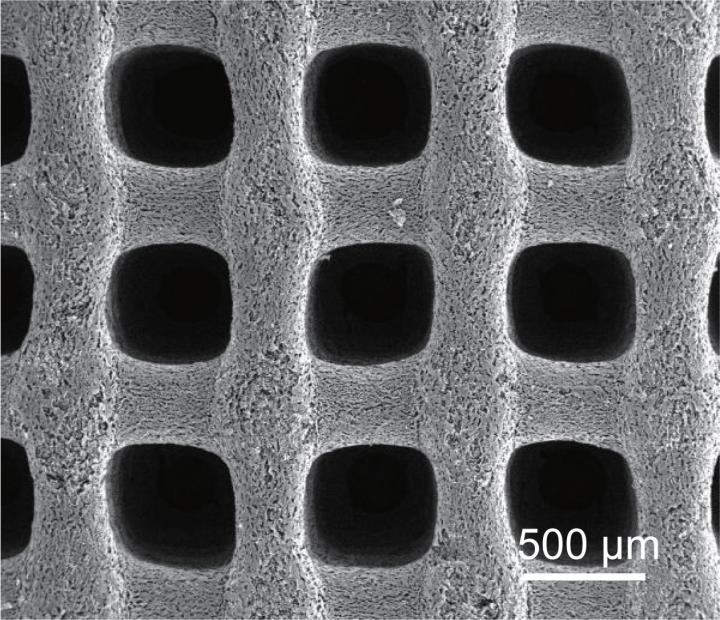
Credit: Adapted from Nano Letters 2021, DOI: 10.1021/acs.nanolett.0c04780

NASA’s Perseverance Rover recently made a successful landing on Mars, embarking on a two-year mission to seek signs of ancient life and collect samples. Because Mars is extremely cold — nighttime temperatures can drop below -112 F — heaters are required to keep the rover’s battery system from freezing. Now, researchers reporting in ACS’ Nano Letters have 3D printed porous carbon aerogels for electrodes in ultralow-temperature supercapacitors, reducing heating needs for future space and polar missions.

Jennifer Lu, Yat Li and colleagues wanted to develop an energy storage system that could operate at very low temperatures without heating units, which add weight and energy requirements to instruments and machinery, such as the Mars rovers. So the researchers 3D printed a porous carbon aerogel using cellulose nanocrystal-based ink, and then freeze-dried it and further treated the surface. The resulting material had multiple levels of pores, from the 500-μm pores in the lattice-like structure, to nanometer-sized pores within the bars of the lattice. This multiscale porous network preserved adequate ion diffusion and charge transfer through an electrode at -94 F, achieving higher energy storage capacitance than previously reported low-temperature supercapacitors. The team will collaborate with NASA scientists to further characterize the device’s low-temperature performance.

###

The authors acknowledge funding from the Merced nAnomaterials Center for Energy and Sensing, NASA, the University of California, Santa Cruz and the U.S. Department of Energy.

The paper’s abstract will be available on March 10 at 8 a.m. Eastern time here: http://pubs.acs.org/doi/abs/10.1021/acs.nanolett.0c04780

For more of the latest research news, register for our upcoming meeting, ACS Spring 2021.

Journalists and public information officers are encouraged to apply for complimentary press registration by emailing us at [email protected].

The American Chemical Society (ACS) is a nonprofit organization chartered by the U.S. Congress. ACS’ mission is to advance the broader chemistry enterprise and its practitioners for the benefit of Earth and all its people. The Society is a global leader in promoting excellence in science education and providing access to chemistry-related information and research through its multiple research solutions, peer-reviewed journals, scientific conferences, eBooks and weekly news periodical Chemical & Engineering News. ACS journals are among the most cited, most trusted and most read within the scientific literature; however, ACS itself does not conduct chemical research. As a specialist in scientific information solutions (including SciFinder® and STN®), its CAS division powers global research, discovery and innovation. ACS’ main offices are in Washington, D.C., and Columbus, Ohio.

To automatically receive news releases from the American Chemical Society, contact [email protected].

Follow us:
Twitter | Facebook

Media Contact
Katie Cottingham
[email protected]
Tags: Chemistry/Physics/Materials SciencesExperiments in SpaceNanotechnology/MicromachinesPlanets/MoonsSpace/Planetary ScienceSuperconductors/SemiconductorsTemperature-Dependent Phenomena
Share12Tweet8Share2ShareShareShare2

Related Posts

Miniature Sensor Uses Light to Detect Touch — Chemistry

Miniature Sensor Uses Light to Detect Touch

May 8, 2026
Iron Minerals Determine Whether Dissolved Organic Matter Fuels Microbes or Becomes Long-Term Carbon Storage — Chemistry

Iron Minerals Determine Whether Dissolved Organic Matter Fuels Microbes or Becomes Long-Term Carbon Storage

May 8, 2026

Kate Evans Appointed Associate Lab Director for Biological and Environmental Systems Science at ORNL

May 8, 2026

Advancing Multiscale Modeling and Overcoming Operational Challenges in Autothermal CO₂-to-Methanol Reactors

May 8, 2026
Please login to join discussion

POPULAR NEWS

  • Research Indicates Potential Connection Between Prenatal Medication Exposure and Elevated Autism Risk

    840 shares
    Share 336 Tweet 210
  • New Study Reveals Plants Can Detect the Sound of Rain

    727 shares
    Share 290 Tweet 181
  • Scientists Investigate Possible Connection Between COVID-19 and Increased Lung Cancer Risk

    68 shares
    Share 27 Tweet 17
  • Salmonella Haem Blocks Macrophages, Boosts Infection

    61 shares
    Share 24 Tweet 15

About

We bring you the latest biotechnology news from best research centers and universities around the world. Check our website.

Follow us

Recent News

Evaluating Digoxin Use in Patients with Symptomatic Rheumatic Heart Disease

Evaluating the Effectiveness and Safety of Digitalis Glycosides in Treating Heart Failure

Urdu Fall Risk Questionnaire Adapted for Elderly

Subscribe to Blog via Email

Enter your email address to subscribe to this blog and receive notifications of new posts by email.

Join 82 other subscribers
  • Contact Us

Bioengineer.org © Copyright 2023 All Rights Reserved.

Welcome Back!

Login to your account below

Forgotten Password?

Retrieve your password

Please enter your username or email address to reset your password.

Log In
No Result
View All Result
  • Homepages
    • Home Page 1
    • Home Page 2
  • News
  • National
  • Business
  • Health
  • Lifestyle
  • Science

Bioengineer.org © Copyright 2023 All Rights Reserved.