• HOME
  • NEWS
  • EXPLORE
    • CAREER
      • Companies
      • Jobs
    • EVENTS
    • iGEM
      • News
      • Team
    • PHOTOS
    • VIDEO
    • WIKI
  • BLOG
  • COMMUNITY
    • FACEBOOK
    • INSTAGRAM
    • TWITTER
Tuesday, May 5, 2026
BIOENGINEER.ORG
No Result
View All Result
  • Login
  • HOME
  • NEWS
  • EXPLORE
    • CAREER
      • Companies
      • Jobs
        • Lecturer
        • PhD Studentship
        • Postdoc
        • Research Assistant
    • EVENTS
    • iGEM
      • News
      • Team
    • PHOTOS
    • VIDEO
    • WIKI
  • BLOG
  • COMMUNITY
    • FACEBOOK
    • INSTAGRAM
    • TWITTER
  • HOME
  • NEWS
  • EXPLORE
    • CAREER
      • Companies
      • Jobs
        • Lecturer
        • PhD Studentship
        • Postdoc
        • Research Assistant
    • EVENTS
    • iGEM
      • News
      • Team
    • PHOTOS
    • VIDEO
    • WIKI
  • BLOG
  • COMMUNITY
    • FACEBOOK
    • INSTAGRAM
    • TWITTER
No Result
View All Result
Bioengineer.org
No Result
View All Result
Home NEWS Science News Biology

Popular herbicide weakens bumblebees’ color vision

Bioengineer by Bioengineer
October 13, 2022
in Biology
Reading Time: 2 mins read
0
Research experiment on bumblebees
Share on FacebookShare on TwitterShare on LinkedinShare on RedditShare on Telegram

Finnish researchers found out how Roundup, a herbicide containing glyphosate, affects the learning and memory of bumblebees. Already a small dose affected their ability to learn and memorise connections between colors and taste. The weakened fine color vision can severely impair bumblebees’ foraging and nesting success.
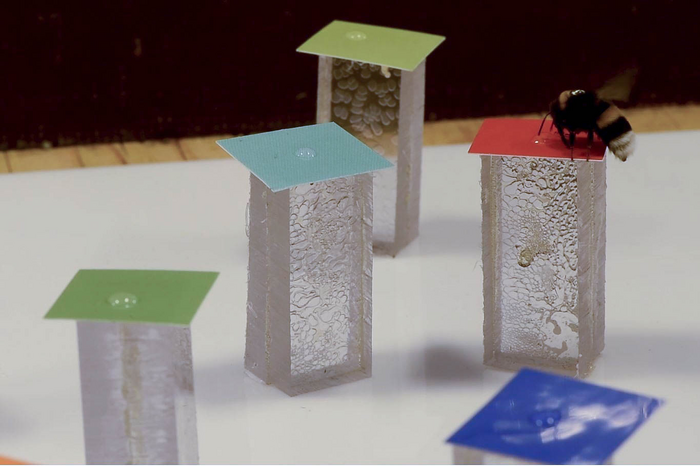
Research experiment on bumblebees

Credit: University of Turku

Finnish researchers found out how Roundup, a herbicide containing glyphosate, affects the learning and memory of bumblebees. Already a small dose affected their ability to learn and memorise connections between colors and taste. The weakened fine color vision can severely impair bumblebees’ foraging and nesting success.

In the study, bumblebees were exposed to an acute dose of herbicide that pollinating bumblebees might be exposed to in a sprayed field during the day. After the exposure, the bumblebees’ learning and memory were tested in a 10-color discrimination task, in which the bumblebees learned to associate five specific colors with a rewarding sugar solution and another five colours with an aversive quinine solution.

Control bumblebees learned to distinguish colors associated with sweet sugar water from colors associated with a bad-tasting compound and remembered what they learned after three days. Bumblebees exposed to the herbicide learned significantly less and forgot almost everything they had learned within a few days.

The researchers also found that the herbicide treatment did not affect bumblebees’ performance in an easier two-color discrimination task or a 10-odor discrimination task. The results suggest that while exposure to Roundup does not make bumblebees completely color or smell blind, it does impair their fine color vision.

“We focused on the cognitive traits of the bees because these traits determine the successful foraging and social behavior of social insects and therefore their fitness. I am really worried. Even one very small acute dose had a harmful effect on the bumblebees,” says researcher, Associate Professor Marjo Helander from the University of Turku, Finland.

“The result is even more worrying when you take into account how much glyphosate-containing herbicides are used globally,” states Helander.

“The results are quite worrying considering the importance of color vision for bumblebees. Even small disturbances in color vision can be catastrophic in terms of foraging and nesting success,” says Docent Olli Loukola from the University of Oulu, Finland.


Journal

Science of The Total Environment

DOI

10.1016/j.scitotenv.2022.159298.

Subject of Research

Animals

Article Title

Field-realistic acute exposure to glyphosate-based herbicide impairs fine-color discrimination in bumblebees

Article Publication Date

7-Oct-2022

Share12Tweet8Share2ShareShareShare2

Related Posts

New Study from The Morton Arboretum Reveals Why Mexico and Central America’s Mountain Forests Are Oak Tree Hotspots — Biology

New Study from The Morton Arboretum Reveals Why Mexico and Central America’s Mountain Forests Are Oak Tree Hotspots

May 5, 2026
Gerald Joyce Elected to Prestigious American Philosophical Society — Biology

Gerald Joyce Elected to Prestigious American Philosophical Society

May 5, 2026

Author Correction: Lipopeptide Immunity Linked to Membrane Remodelling

May 4, 2026

Study Reveals Connection Between Prenatal Chemical Exposure and Chromosomal Abnormalities in Adult Sperm

May 4, 2026

POPULAR NEWS

  • Research Indicates Potential Connection Between Prenatal Medication Exposure and Elevated Autism Risk

    834 shares
    Share 334 Tweet 209
  • New Study Reveals Plants Can Detect the Sound of Rain

    719 shares
    Share 287 Tweet 180
  • Scientists Investigate Possible Connection Between COVID-19 and Increased Lung Cancer Risk

    67 shares
    Share 27 Tweet 17
  • Salmonella Haem Blocks Macrophages, Boosts Infection

    61 shares
    Share 24 Tweet 15

About

We bring you the latest biotechnology news from best research centers and universities around the world. Check our website.

Follow us

Recent News

SIRT3-DsbA-L-TFAM Axis Limits Fatty Liver Disease

Advances in Neonatal Cell Therapies: 2025 Update

New Study from The Morton Arboretum Reveals Why Mexico and Central America’s Mountain Forests Are Oak Tree Hotspots

Subscribe to Blog via Email

Enter your email address to subscribe to this blog and receive notifications of new posts by email.

Join 82 other subscribers
  • Contact Us

Bioengineer.org © Copyright 2023 All Rights Reserved.

Welcome Back!

Login to your account below

Forgotten Password?

Retrieve your password

Please enter your username or email address to reset your password.

Log In
No Result
View All Result
  • Homepages
    • Home Page 1
    • Home Page 2
  • News
  • National
  • Business
  • Health
  • Lifestyle
  • Science

Bioengineer.org © Copyright 2023 All Rights Reserved.