Poor air quality linked to cognitive problems in babies
Credit: University of East Anglia
Poor air quality linked to cognitive problems in babies
Poor air quality could be causing cognitive deficits in babies and toddlers, according to new research from the University of East Anglia.
A new study published today reveals an association between poor air quality in India and impaired cognition in infants under two.
Without action, the negative impact on children’s long-term brain development could have consequences for life.
Lead researcher Prof John Spencer, from UEA’s School of Psychology, said: “Prior work has shown that poor air quality is linked to cognitive deficits in children, as well as to emotional and behavioural problems, which can have a severe impact on families.
“Very small particulate fragments in the air are a major concern as they can move from the respiratory tract into the brain.
“Until now, studies had failed to show a link between poor air quality and cognitive problems in babies, when brain growth is at its peak and the brain may be particularly sensitive to toxins. Our study is the first to show this association.
“We worked with families in rural India to see how in-home air quality affects infants’ cognition.”
The team collaborated with the Community Empowerment Lab in Lucknow, India – a global health research and innovation organization that works with rural communities to engage in science collaboratively.
They worked with families from a range of socio-economic backgrounds in Shivgarh, a rural community in Uttar Pradesh – one of the states in India that has been most strongly impacted by poor air quality.
They assessed the visual working memory and visual processing speed of 215 infants using a specially-designed cognition task from October 2017 to June 2019.
On one display, the tots were shown flashing coloured squares that were always the same after each ‘blink’. On a second display, one coloured square changed after each blink.
Prof Spencer said: “This task capitalises on infant’s tendency to look away from something that’s visually familiar and towards something new. We were interested in whether infants could detect the changing side and how well they did as we made the task harder by including more squares on each display.”
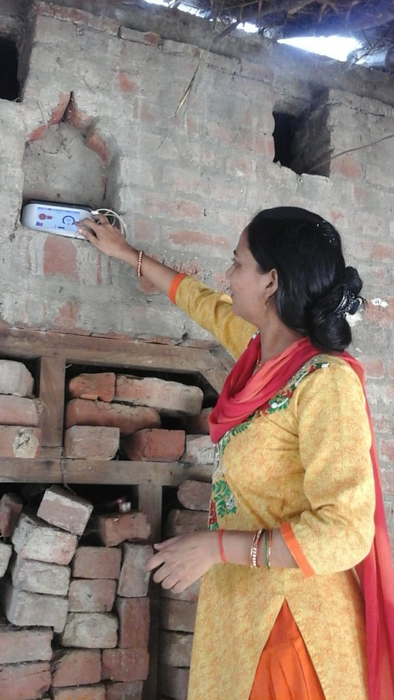
The team used air quality monitors in the children’s homes to measure emission levels and air quality. They also took into account and controlled for family socio-economic status.
“This research shows for the first time that there is an association between poor air quality and impaired visual cognition in the first two years of life, when brain growth is at its peak,” said Prof Spencer.
“Such impacts could carry forward across years, negatively impacting long-term development.
“Reversely, our research indicates that global efforts to improve air quality could have benefits to infants’ emerging cognitive abilities.
“This, in turn, could have a cascade of positive impacts because improved cognition can lead to improved economic productivity in the long term and reduce the burden on healthcare and mental health systems.
One key factor the team measured was the cooking fuel commonly used at home.
“We found that air quality was poorer in homes that used solid cooking materials like cow dung cake,” he added. “Therefore, efforts to reduce cooking emissions in homes should be a key target for intervention.”
Consistent with this aim and with the goal of improving maternal and child health, the Government of India has launched a national-level flagship program called the “Ujjwala Yojana” – a scheme that brings LPG fuel to women below the poverty line across the entire country.
This research was led by the University of East Anglia in collaboration with Durham University, the Community Empowerment Lab in Lucknow (India) and Brown University (US).
‘Poor air quality is associated with impaired visual cognition in the first two years of life: a longitudinal investigation’ is published in the journal eLife.
This publication is based on research funded in part by the Bill & Melinda Gates Foundation. The findings and conclusions contained within are those of the authors and do not necessarily reflect positions or policies of the Bill & Melinda Gates Foundation.
Journal
eLife
DOI
10.7554/eLife.83876
Method of Research
Observational study
Subject of Research
People
Article Title
Poor air quality is associated with impaired visual cognition in the first two years of life: a longitudinal investigation
Article Publication Date
25-Apr-2023