In 2024, Poland integrated simulation-based bronchoscopy training as a mandatory component of postgraduate specialisation in pulmonary diseases, concluding a nationwide reform designed to replace variable procedural exposure with standardised competency preparation. Documented as an Advancing Simulation Practice report in Advances in Simulation by researchers Michal Pirozynski and Jack Jakimowicz, the initiative transitioned from a regional pilot into an institutionalised national policy standard. Rather than functioning as a hypothesis-driven trial of educational effectiveness, the report provides a descriptive implementation analysis detailing how governance architecture, regulatory embedding, curriculum standardisation, multi-centre coordination, and external quality assurance enabled systemic adoption. The programme addressed a longstanding structural deficiency across postgraduate pulmonary education, where novice physicians historically relied on uneven clinical caseloads and informal apprenticeships before performing invasive airway procedures on patients. By establishing a mandatory simulation prerequisite, health authorities ensured equitable baseline exposure, structured practice, objective assessment, and standardized feedback for all pulmonary trainees regardless of their training centre.
Selecting flexible bronchoscopy as the primary index procedure for national reform was driven by procedural risk, technical complexity, and a steep learning curve. Operators must guide a flexible bronchoscope through the upper airway into the branching three-dimensional tracheobronchial tree while interpreting endoscopic views, evaluating anatomy, and maintaining spatial orientation. Simultaneously, clinicians must monitor vital signs, maintain physiological stability, and recognize complications. In clinical practice, flexible bronchoscopy carries recognized risks of iatrogenic complications, including arterial hypoxemia, bleeding, bronchospasm, pneumothorax, and sedation-related instability. While complication rates remain acceptable when procedures are performed by experienced clinicians, professional guidelines emphasize structured training and supervised practice to mitigate risk. For novice trainees, simultaneous cognitive and psychomotor demands make unstandardized training directly on patients an ethical and clinical vulnerability that simulation mitigates.
Prior to this nationwide reform, postgraduate procedural education in Poland lacked a unified national certification pathway for acquiring and maintaining endoscopic skills. Under traditional apprenticeship frameworks, procedural exposure depended almost entirely on local hospital case volume, supervisor availability, and institutional equipment resources. Consequently, physicians specializing in pulmonary diseases experienced substantial institutional disparities in clinical preparation. Trainees in smaller hospitals or units with limited procedural volume frequently faced restricted procedural repetitions and irregular exposure to diverse airway pathologies before assuming clinical responsibilities. Relying on opportunistic patient learning meant training centres could not guarantee comparable supervision, structured feedback, or uniform procedural complexity before live patient encounters. Recognizing that procedural exposure governed by institutional chance presented educational and patient-safety challenges, educational leaders established the simulation programme as an equity mechanism. Introducing dedicated simulation resources across regional centres decoupled foundational technical training from local clinical caseloads, providing every specialty resident comparable baseline opportunities to practice navigation, anatomical identification, and complication management in a controlled setting.
To establish a reproducible educational standard across participating institutions, a multidisciplinary expert group designed a standardized four-day, 32-hour bronchoscopy curriculum. The group included pulmonologists, bronchoscopy educators, simulation faculty, postgraduate training leaders, and project coordinators coordinated by the Medical Centre for Postgraduate Education (CMKP). The pedagogical architecture was grounded in mastery learning, deliberate practice, Kolb’s experiential learning theory, and structured debriefing. Curricular content was harmonized with national postgraduate training requirements, local needs assessments, patient-safety priorities, and international bronchoscopy guidance from the British Thoracic Society and the World Association for Bronchology and Interventional Pulmonology (WABIP) Bronchoscopy Education Project. This consensus process incorporated iterative multidisciplinary consultations consistent with a modified Delphi-informed approach. Across the 32 instructional hours, trainees completed equipment orientation, bronchoscope mechanics, tracheobronchial anatomy review, systematic airway inspection protocols, abnormality recognition, complication management, and procedural decision-making. Trainees engaged in supervised simulator practice, debriefings, and objective structured assessments, advancing by demonstrating predefined competence benchmarks under uniform standards.
The core operational thesis of the report emphasizes that simulation technology cannot achieve sustainable national adoption without a dedicated governance architecture. To translate the educational design into uniform national delivery, the leadership formulated nine national Standard Operating Procedures (SOPs) that served as the operational bridge across the multi-centre network. The creation of these SOPs was informed by literature reviews, procedural analyses from reference simulation centres, operational models from international simulation-centre networks, and formal benchmarking visits to partner institutions. An interdisciplinary expert group coordinated by CMKP translated these findings into binding operational protocols. The nine SOPs established detailed standards covering network management, trainee recruitment workflows, curriculum pacing, procedural techniques, instructional methodology, audio-video systems, learning-platform management, equipment requirements, objective assessment criteria, and instructor qualification benchmarks. This comprehensive codification ensured that participating regional simulation centres operated under identical procedural constraints, preventing local deviations from undermining national training fidelity during multi-institutional expansion.
To preserve instructional quality and evaluative consistency across centres, the governance architecture established a centralized instructor certification pathway using a structured train-the-trainer model. Program leadership mandated that faculty development and instructor calibration precede infrastructure expansion and trainee enrolment, ensuring all instructors shared common evaluative rubrics, feedback vocabulary, and instructional expectations before courses commenced. Prospective instructors completed training covering simulation pedagogy, debriefing mechanics, objective structured scoring, and adherence to SOP-defined instructional methods. Across the broader national simulation initiative, 85 instructors achieved national certification, with 46 instructors specifically certified for bronchoscopy training. Operationally, governance responsibilities were divided between central and regional tiers: CMKP exercised central oversight by maintaining SOPs, setting certification standards, and conducting external quality assurance audits. Regional centres managed local logistics and recorded training activities. External audits reviewed session delivery, trainee records, and supervisory reports; detected procedural deviations triggered corrective actions, including targeted feedback, additional coaching, or temporary suspension of course delivery until compliance was restored.
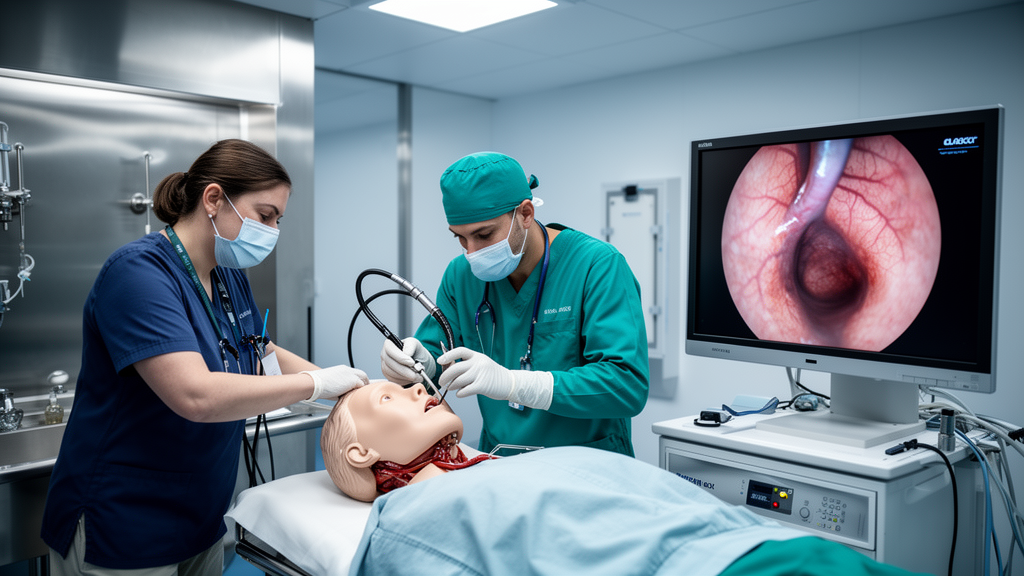
The national rollout expanded through a coordinated Network of Simulation Centres designed to provide distributed geographic access while maintaining central standardisation. Regional facilities were equipped with simulation laboratories, debriefing suites, advanced virtual endoscopic simulators, and networked audio-video systems enabling central CMKP faculty to provide remote supervision and methodological support. Across the entire national simulation programme encompassing multiple procedural specialties, the network trained 402 physicians and delivered 184 structured training cycles comprising 5,999 instructional hours, supported by the 85 certified instructors. Within the specific bronchoscopy component, 186 pulmonary medicine trainees enrolled in the standardized four-day, 32-hour courses across regional centres, and 185 completed the curriculum after one participant withdrew. This multi-institutional expansion was supported by European Union structural funding allocated through health workforce development instruments, including POWER project POWR.04.03.00-00-0291/16. More than 75 million euros in European Union cohesion-policy funding supported broader national simulation infrastructure and endoscopic capacity, with bronchoscopy operating as one key component within this larger systemic investment.
To structure implementation reflection and analyze the scale-up process, the authors utilized two recognized implementation science frameworks: the Consolidated Framework for Implementation Research (CFIR) and the RE-AIM framework (Reach, Effectiveness, Adoption, Implementation, and Maintenance). CFIR mapped key determinants across multiple domains: in the outer setting, statutory needs for uniform procedural preparation generated policy support; within intervention characteristics, the nine binding SOPs provided a reproducible educational package; the inner setting was reinforced by newly developed regional simulation infrastructure; individual characteristics were addressed through instructor certification; and the implementation process followed a staged development-testing-analysis-refinement-recommendation pathway. Simultaneously, the RE-AIM framework characterized programme outcomes by showing wide reach among pulmonary trainees, institutional adoption across regional centres and certified faculty, high implementation fidelity maintained through SOP compliance and audits, and long-term maintenance achieved when authorities incorporated the course into mandatory postgraduate training in 2024. The authors emphasized that these theoretical frameworks served retrospectively to structure operational reflection rather than prospectively as quantitative measurement instruments.
Post-course evaluation questionnaires administered immediately upon curriculum completion demonstrated high trainee satisfaction and perceived educational value. Among the 185 pulmonary trainees completing the bronchoscopy course, 89.5 percent rated the training as highly relevant to clinical practice, and 98.5 percent reported an increase in self-reported procedural confidence. However, the report cautions that these post-course survey results represent immediate learner-reaction and implementation-acceptability indicators rather than direct evidence of sustained competence, skill retention, or downstream workplace transfer. While heightened confidence and positive perceptions reflect successful course delivery and learner receptivity, self-reported impressions cannot substitute for objective performance verification. Furthermore, formal psychometric validation of internal assessment instruments and dedicated bronchoscopy tools, such as the Bronchoscopy Skills and Tasks Assessment Tool (BSTAT), were beyond the scope of this implementation report. Consequently, while the evaluation confirmed that trainees found the curriculum acceptable and relevant, establishing whether this confidence translates into superior clinical performance or patient-safety benefits requires further objective investigation.
The authors acknowledged several key methodological limitations inherent in their practice-based implementation account. First, because the report describes an educational implementation rather than a prospective controlled trial, no comparison cohort was evaluated, and no inferential statistical analysis was conducted. Second, participant feedback was gathered immediately post-course, capturing acceptability and perceived confidence rather than long-term skill retention, procedural decay, or direct workplace transfer in hospital endoscopy suites. Third, the implementation occurred within the specific Polish postgraduate regulatory framework and funding context, which may limit direct transferability to jurisdictions with decentralized medical training or alternative financing structures. Addressing these limitations outlines the future evaluation agenda for procedural simulation programmes: prospective research must examine clinical transfer, evaluate procedure logs and complication rates during supervised patient care, utilize workplace-based assessments, and measure patient-safety outcomes. Future monitoring should also incorporate systematic evaluation of equity, diversity, and regional accessibility to ensure that national simulation training standards provide durable benefits across the medical workforce.
Subject of Research: National governance and multi-centre implementation of simulation-based bronchoscopy training in postgraduate medical education
Article Title: From prototype to national standard: a governance framework for scaling simulation-based bronchoscopy training
Article References: Pirozynski, M., & Jakimowicz, J. (2026). From prototype to national standard: a governance framework for scaling simulation-based bronchoscopy training. Advances in Simulation, 11(1), Article 55. https://doi.org/10.1186/s41077-026-00452-9
Image Credits: AI Generated
DOI: 10.1186/s41077-026-00452-9
Keywords: bronchoscopy simulation, postgraduate medical education, pulmonary medicine training, procedural training, Consolidated Framework for Implementation Research, RE-AIM framework, mastery learning, deliberate practice, Standard Operating Procedures, instructor certification, Medical Centre for Postgraduate Education, simulation centres, procedural complications, flexible bronchoscopy, clinical skills training, faculty development, external quality assurance
News Source: Courtney Benton. (November 12, 2026). Poland Integrates Mandatory Simulation Bronchoscopy Training into Postgraduate Medical Specialisation. Scienmag.