


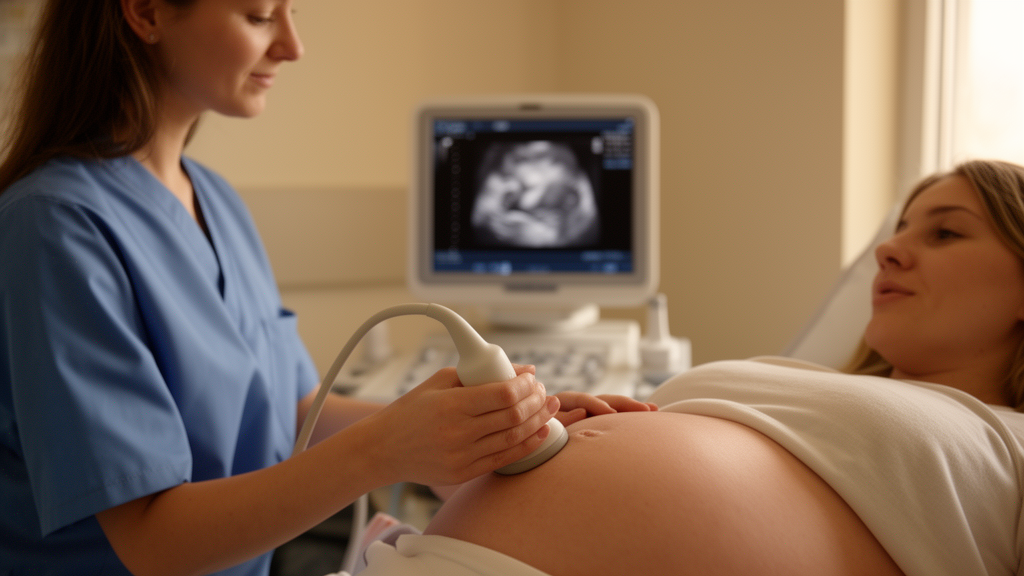
Point-of-care ultrasound (POCUS) in obstetrics and gynecology has evolved from a pragmatic bedside adjunct into a rapidly expanding clinical, educational and technological field, according to a narrative review published in Archives of Gynecology and Obstetrics. The open-access article, authored by Florian Recker and published on 14 October 2026 as volume 313, article number 291, argues that the discipline has been reshaped by handheld ultrasound systems, wireless probes, cloud-based image management, tele-ultrasound, artificial intelligence for image acquisition and interpretation, and the first specific practice guidance for POCUS in the specialty.
At the heart of the review is a definitional argument. POCUS is framed as a focused, problem-oriented and immediately actionable ultrasound examination performed and interpreted by the treating clinician at the time and place of care. It differs from conventional diagnostic ultrasound in scope, timing and purpose: it usually answers a binary or short-list clinical question, guides an intervention, triages urgency or monitors change. Comprehensive ultrasound, by contrast, involves systematic assessment, formal documentation, guideline-defined reporting and, in many obstetric and gynecologic contexts, specific credentialing. The author stresses that this distinction is not semantic but determines what a bedside scan can and cannot legitimately claim to establish.
The strongest evidence, according to the review, supports POCUS for early pregnancy triage, confirmation of fetal viability and presentation, basic assessment of placental location and amniotic fluid, intrapartum evaluation of fetal head position, and selected postpartum or gynecologic emergencies. In symptomatic first-trimester patients, delayed differentiation between viable intrauterine pregnancy, pregnancy of unknown location, early pregnancy loss and ectopic pregnancy can prolong emergency department stays or lead to critical complications. Syntheses indicate that POCUS in symptomatic first-trimester pregnancy can shorten emergency department length of stay, especially when an intrauterine pregnancy is identified. A clearly visualized intrauterine pregnancy with fetal cardiac activity in an appropriate clinical context can substantially change triage.
The reverse case carries equal weight in the review. A negative or indeterminate transabdominal POCUS examination does not exclude ectopic pregnancy, early pregnancy loss or heterotopic pregnancy, so uncertain findings require transvaginal ultrasound, serial beta-hCG algorithms and specialist review. Handheld systems have made first-trimester access more convenient, but many handheld platforms do not provide a true endocavitary probe, and without transvaginal imaging the diagnostic ceiling in early pregnancy and gynecology is low. A prospective cohort study of handheld transabdominal ultrasound for confirming a vital intrauterine pregnancy in the first trimester illustrates both the feasibility and the ceiling of the approach.
In the second and third trimesters, the review identifies strong face validity for focused questions such as fetal presentation, fetal number, fetal cardiac activity, placental site and amniotic fluid. Multiple validation studies have found high agreement between portable or handheld devices and conventional systems for selected basic obstetric tasks, findings relevant for labor wards, triage units, anesthesia teams, remote clinics and low-resource settings. Confirming breech presentation before induction, identifying transverse lie before transfer, or documenting fetal cardiac activity after maternal trauma may immediately influence management. Yet the boundary remains crucial: POCUS can support triage in suspected fetal growth restriction but cannot replace formal biometry, growth velocity assessment, Doppler surveillance and etiologic evaluation, and suspected placenta previa, vasa previa or placenta accreta spectrum requires transvaginal or expert imaging.
Intrapartum ultrasound receives particularly careful treatment. Comprehensive intrapartum sonography, as described in ISUOG guidelines, may include quantitative descent parameters such as angle of progression, head-perineum distance and midline angle, which presuppose dedicated training and standardized planes and are not established as bedside screening tools. Focused intrapartum POCUS is framed as considerably narrower: binary, categorical assessments with no measurement and immediate consequences, such as determining fetal head position before an instrumental delivery, confirming presentation, orienting the second twin, or confirming fetal cardiac activity. In suspected labor arrest, ultrasound can clarify head position but cannot by itself establish that labor has arrested or identify its cause; it should trigger senior obstetric review rather than substitute for it.
In gynecology, the review proposes a three-tier framing. Tier 1 comprises simple rule-in tasks with high immediate value, such as identifying obvious free fluid, confirming a clearly intrauterine device, or recognizing an empty uterus with a positive pregnancy test as high-risk for ectopic pregnancy. Tier 2 comprises triage tasks that may guide urgency but not definitive diagnosis, including adnexal mass assessment, suspected torsion and pelvic infection. Tier 3 comprises specialist tasks such as endometriosis mapping, ovarian cancer risk stratification and complex postoperative assessment, which should not be labeled POCUS unless performed within a formal specialist pathway. Pilot studies in low-resource settings show handheld POCUS can detect selected gynecologic pathology with reasonable sensitivity and specificity, but these data are not sufficient to support unqualified rule-out decisions, and definitive characterization of complex adnexal lesions remains dependent on standardized expert ultrasound and IOTA- or O-RADS-type risk models.
Technological progress features prominently. Handheld devices now provide diagnostically useful images for several focused tasks, and AI-enabled blind-sweep protocols allow lightly trained operators to acquire standardized video sweeps that AI can analyze for gestational age or fetal malpresentation. Gomes and colleagues demonstrated that AI applied to novice-acquired blind sweeps could estimate gestational age noninferiorly to standard fetal biometry and detect malpresentation with high discrimination in low-resource contexts, while Slimani and colleagues demonstrated end-to-end fetal biometry and amniotic fluid assessment across multiple centers. Recent reports describe FDA clearance of an AI tool for automated gestational age estimation integrated into a handheld ultrasound platform. The review also raises open questions about such tools, including the populations models were trained on, supported gestational age ranges, performance in fetal growth restriction, multiple pregnancy, maternal BMI or oligohydramnios, and responsibility when an AI-derived estimate conflicts with clinical dating. Tele-ultrasound, meanwhile, shows promising diagnostic agreement for fetal number, presentation, placental location and gestational age in selected settings, though it requires stable connectivity, data governance and clarity about responsibility.
A substantial portion of the review addresses implementation rather than devices. The author argues that the next phase of obstetric and gynecologic POCUS will depend less on device availability than on indication-specific protocols, formal training, competency assessment, documentation, image archiving, infection control, data protection, quality assurance and clear escalation rules.
Subject of Research: Point-of-care ultrasound applications, technology and governance in obstetrics and gynecology
Article Title: Point-of-care ultrasound in obstetrics and gynecology: latest advancements and evolution
Article References: Recker, F. (2026). Point-of-care ultrasound in obstetrics and gynecology: latest advancements and evolution. Archives of Gynecology and Obstetrics, 313(1), Article 291. https://doi.org/10.1007/s00404-026-08584-z
Image Credits: AI Generated
DOI: 10.1007/s00404-026-08584-z
Keywords: point-of-care ultrasound, obstetrics, gynecology, handheld ultrasound, artificial intelligence, tele-ultrasound, early pregnancy triage, intrapartum ultrasound, intrauterine device, training and credentialing, clinical governance, narrative review
News Source: Ophelia Keating. (October 29, 2026). Point-of-Care Ultrasound Reshapes Obstetric and Gynecologic Bedside Care. Scienmag.



