Integrating plasmonic metasurfaces on optical fibre tips forming so-called metafibers enrichs the functionalities of an ordinary optical fibre, yielding a variety of advanced applications such as planar waveshaping, super-resolution imaging, and ultracompact sensing. However, to date, plasmonic metafibers have predominantly explored separate bare fibres, and little attention has been paid to their practical applications in nonlinear plasmonic regimes. There are certain challenges for the widespread uptake of metafibers as regular component devices for fibre optics: a) nanofabrication suffers from inevitable mechanical vibrations and thus a poor repeatability of nanostructures due to the large aspect ratio of bare fibres; b) the connections between the functionalised bare fibres and standard optical fibres introduce potential contaminations and even damage to the plasmonic metasurfaces. Thus, methods to fabricate metafibers with a reproducible metasurface geometry and standard adapting interfaces are clearly needed.
Credit: by Lei Zhang, Huiru Zhang, Ni Tang, Xiren Chen, Fengjiang Liu, Xiaoyu Sun, Hongyan Yu, Xinyu Sun, Qiannan Jia, Boqu Chen, Benoit Cluzel, Philippe Grelu, Aurelien Coillet, Feng Qiu, Lei Ying, Wei E. I. Sha, Xiaofeng Liu, Jianrong Qiu, Ding Zhao, Wei Yan, Duanduan Wu, Xiang Shen, Jiyong Wang, and Min Qiu
Integrating plasmonic metasurfaces on optical fibre tips forming so-called metafibers enrichs the functionalities of an ordinary optical fibre, yielding a variety of advanced applications such as planar waveshaping, super-resolution imaging, and ultracompact sensing. However, to date, plasmonic metafibers have predominantly explored separate bare fibres, and little attention has been paid to their practical applications in nonlinear plasmonic regimes. There are certain challenges for the widespread uptake of metafibers as regular component devices for fibre optics: a) nanofabrication suffers from inevitable mechanical vibrations and thus a poor repeatability of nanostructures due to the large aspect ratio of bare fibres; b) the connections between the functionalised bare fibres and standard optical fibres introduce potential contaminations and even damage to the plasmonic metasurfaces. Thus, methods to fabricate metafibers with a reproducible metasurface geometry and standard adapting interfaces are clearly needed.
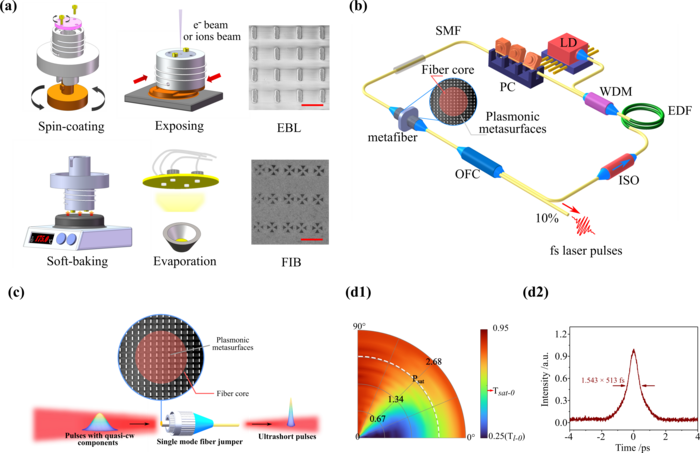
In a new paper published in Light: Advanced Manufacturing, a team of scientists, led by Professor Miu Qiu and Dr. Jiyong Wang from Key Laboratory of 3D Micro/Nano Fabrication and Characterization of Zhejiang Province, School of Engineering, Westlake University, China, and co-workers developed the methodologies that integrate well-defined metasurfaces directly on the endfaces of commercial single mode fibre jumpers (SMFJs), by using the standard planar technologies, e.g., electron-beam lithography (EBL) and focused ions beam (FIB).
“Because only standard nanofabrication techniques are required, the process flow can be accessed by worldwide cleanrooms.” Prof. Min Qiu said.
The fabricated metafibers were further implemented into the fibre laser cavities to serve as a special saturable absorber-one important optical element to general ultrashort laser pulses.
“By tuning the plasmonic resonances of the metafibres, we realized all-fiber sub-picosecond soliton mode-locking at different wavelength bands.” Prof. Xiang Shen said.
Besides of the experimental work, they also established a mathematic mode for quantifying the saturable absorption of plasmonic metasurfaces and clarify the underlying physical mechanisms of nonlinear optic effects.
“Such plasmonic metafibers provide new perspectives on ultrathin nonlinear saturable absorbers for applications where tunable nonlinear transfer functions are needed, such as in ultrafast lasers or neuromorphic circuits. The work paves the way towards ‘all-in-fibers’ optical systems for sensing, imaging, communications, and many others.” Dr. Jiyong Wang added.
Journal
Light: Advanced Manufacturing
DOI
10.37188/lam.2022.045