• HOME
  • NEWS
  • EXPLORE
    • CAREER
      • Companies
      • Jobs
    • EVENTS
    • iGEM
      • News
      • Team
    • PHOTOS
    • VIDEO
    • WIKI
  • BLOG
  • COMMUNITY
    • FACEBOOK
    • INSTAGRAM
    • TWITTER
Monday, May 11, 2026
BIOENGINEER.ORG
No Result
View All Result
  • Login
  • HOME
  • NEWS
  • EXPLORE
    • CAREER
      • Companies
      • Jobs
        • Lecturer
        • PhD Studentship
        • Postdoc
        • Research Assistant
    • EVENTS
    • iGEM
      • News
      • Team
    • PHOTOS
    • VIDEO
    • WIKI
  • BLOG
  • COMMUNITY
    • FACEBOOK
    • INSTAGRAM
    • TWITTER
  • HOME
  • NEWS
  • EXPLORE
    • CAREER
      • Companies
      • Jobs
        • Lecturer
        • PhD Studentship
        • Postdoc
        • Research Assistant
    • EVENTS
    • iGEM
      • News
      • Team
    • PHOTOS
    • VIDEO
    • WIKI
  • BLOG
  • COMMUNITY
    • FACEBOOK
    • INSTAGRAM
    • TWITTER
No Result
View All Result
Bioengineer.org
No Result
View All Result
Home NEWS Science News Chemistry

Plastic water bottles may one day fly people cross-country

Bioengineer by Bioengineer
June 3, 2019
in Chemistry
Reading Time: 3 mins read
0
IMAGE
Share on FacebookShare on TwitterShare on LinkedinShare on RedditShare on Telegram

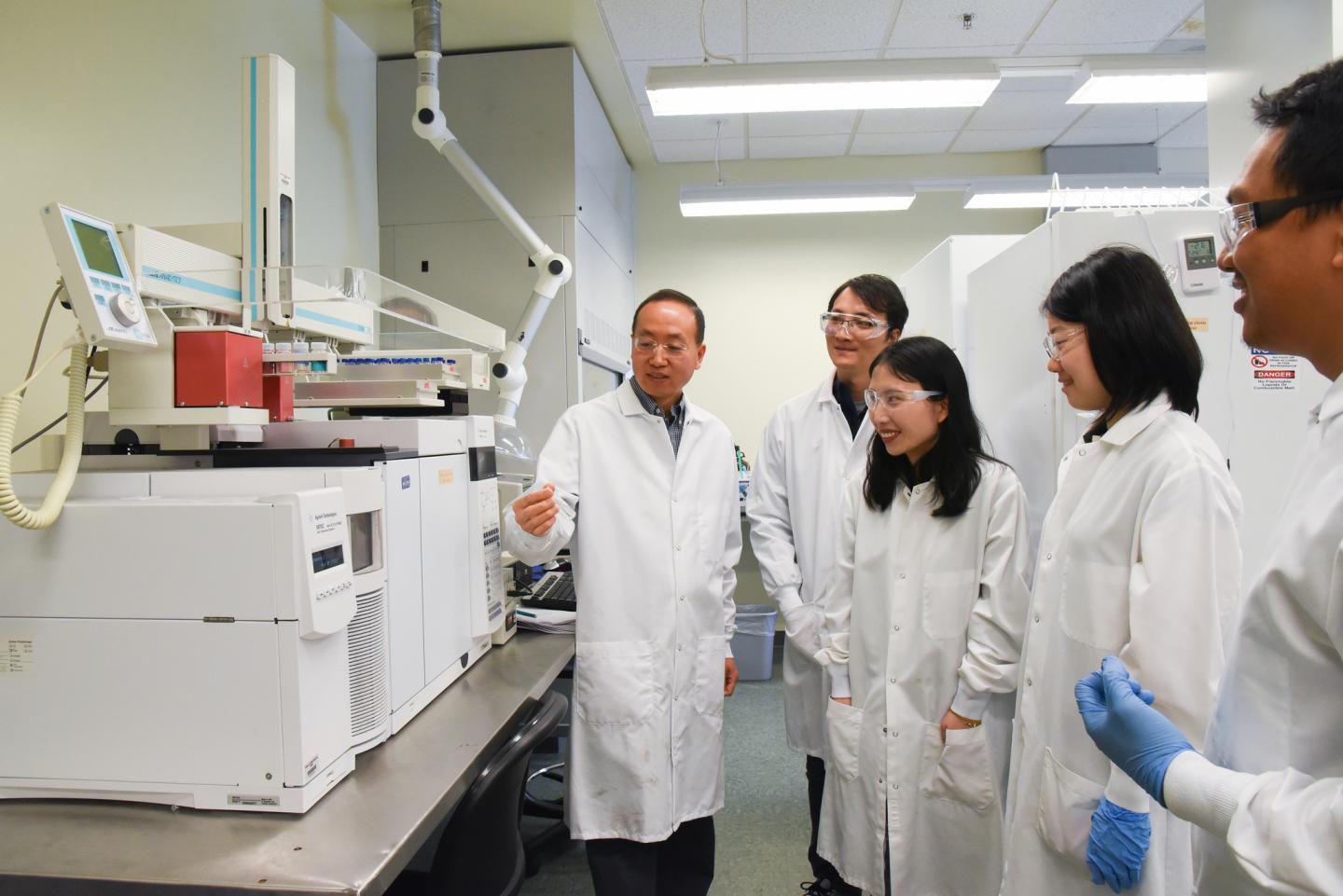
Research group has found a way to turn plastic waste products into jet fuel
IMAGE

Credit: Washington State University

RICHLAND, Wash. – A research group led by Washington State University scientists has found a way to turn daily plastic waste products into jet fuel.

In a new paper published in the journal Applied Energy, WSU’s Hanwu Lei and colleagues melted plastic waste at high temperature with activated carbon, a processed carbon with increased surface area, to produce jet fuel.

“Waste plastic is a huge problem worldwide,” said Lei, an associate professor in WSU’s Department of Biological System Engineering. “This is a very good, and relatively simple, way to recycle these plastics.”

How it works

In the experiment, Lei and colleagues tested low-density polyethylene and mixed a variety of waste plastic products, like water bottles, milk bottles, and plastic bags, and ground them down to around three millimeters, or about the size of a grain of rice.

The plastic granules were then placed on top of activated carbon in a tube reactor at a high temperature, ranging from 430 degree Celsius to 571 degrees Celsius. That’s 806 to 1,060 Fahrenheit. The carbon is a catalyst, or a substance that speeds up a chemical reaction without being consumed by the reaction.

“Plastic is hard to break down,” Lei said. “You have to add a catalyst to help break the chemical bonds. There is a lot of hydrogen in plastics, which is a key component in fuel.”

Once the carbon catalyst has done its work, it can be separated out and re-used on the next batch of waste plastic conversion. The catalyst can also be regenerated after losing its activity.

After testing several different catalysts at different temperatures, the best result they had produced a mixture of 85 percent jet fuel and 15 percent diesel fuel.

Environmental impact

According to the Environmental Protection Agency, landfills in the U.S. received 26 million tons of plastic in 2015, the most recent year statistics are available. China has recently stopped accepting plastic recycling from the U.S. and Canada. Conservative estimates by scientists say that at least 4.8 million tons of plastic enters the ocean each year worldwide.

Not only would this new process reduce that waste, very little of what is produced is wasted.

“We can recover almost 100 percent of the energy from the plastic we tested,” Lei said. “The fuel is very good quality, and the byproduct gasses produced are high quality and useful as well.”

He also said the method for this process is easily scalable. It could work at a large facility or even on farms, where farmers could turn plastic waste into diesel.

“You have to separate the resulting product to get jet fuel,” Lei said. “If you don’t separate it, then it’s all diesel fuel.”

###

This work was funded by the Agriculture and Food Research Initiative Competitive Grant no. 2014-38502-22598, 2016-67021-24533, 2018-67009-27904 from the National Institute of Food and Agriculture, United States Department of Agriculture.

Media Contact
Hanwu Lei
[email protected]

Related Journal Article

http://dx.doi.org/10.1016/j.apenergy.2019.113337

Tags: Biomedical/Environmental/Chemical EngineeringChemistry/Physics/Materials SciencesEcology/EnvironmentEnergy SourcesPollution/RemediationPolymer ChemistryTechnology/Engineering/Computer Science
Share15Tweet8Share2ShareShareShare2

Related Posts

Miniature Sensor Uses Light to Detect Touch — Chemistry

Miniature Sensor Uses Light to Detect Touch

May 8, 2026
Iron Minerals Determine Whether Dissolved Organic Matter Fuels Microbes or Becomes Long-Term Carbon Storage — Chemistry

Iron Minerals Determine Whether Dissolved Organic Matter Fuels Microbes or Becomes Long-Term Carbon Storage

May 8, 2026

Kate Evans Appointed Associate Lab Director for Biological and Environmental Systems Science at ORNL

May 8, 2026

Advancing Multiscale Modeling and Overcoming Operational Challenges in Autothermal COâ‚‚-to-Methanol Reactors

May 8, 2026
Please login to join discussion

POPULAR NEWS

  • Research Indicates Potential Connection Between Prenatal Medication Exposure and Elevated Autism Risk

    840 shares
    Share 336 Tweet 210
  • New Study Reveals Plants Can Detect the Sound of Rain

    727 shares
    Share 290 Tweet 181
  • Salmonella Haem Blocks Macrophages, Boosts Infection

    61 shares
    Share 24 Tweet 15
  • Breastmilk Balances E. coli and Beneficial Bacteria in Infant Gut Microbiomes

    57 shares
    Share 23 Tweet 14

About

We bring you the latest biotechnology news from best research centers and universities around the world. Check our website.

Follow us

Recent News

New Post-Hoc Analysis Explores Daily Oral Orforglipron Use in Adults Over 65 with Obesity, Regardless of Diabetes Status

Evaluating Digoxin Use in Patients with Symptomatic Rheumatic Heart Disease

Evaluating the Effectiveness and Safety of Digitalis Glycosides in Treating Heart Failure

Subscribe to Blog via Email

Enter your email address to subscribe to this blog and receive notifications of new posts by email.

Join 82 other subscribers
  • Contact Us

Bioengineer.org © Copyright 2023 All Rights Reserved.

Welcome Back!

Login to your account below

Forgotten Password?

Retrieve your password

Please enter your username or email address to reset your password.

Log In
No Result
View All Result
  • Homepages
    • Home Page 1
    • Home Page 2
  • News
  • National
  • Business
  • Health
  • Lifestyle
  • Science

Bioengineer.org © Copyright 2023 All Rights Reserved.