Researchers at Imperial College London have genetically engineered bacteria to grow animal- and plastic-free leather that dyes itself.
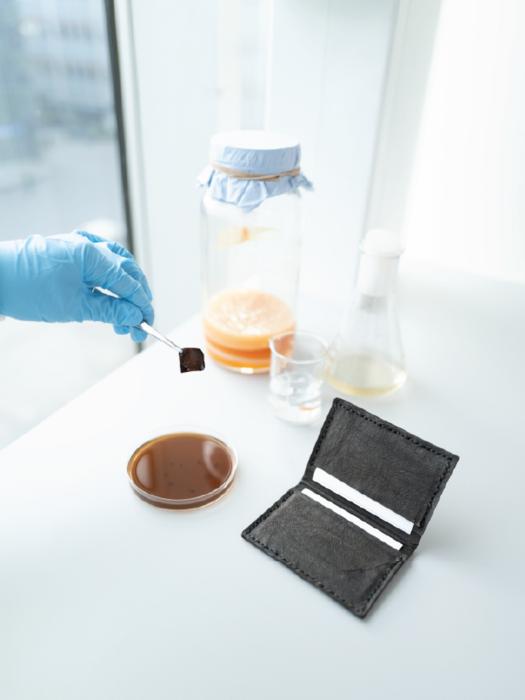
Credit: Tom Ellis/Marcus Walker/Imperial College London
Researchers at Imperial College London have genetically engineered bacteria to grow animal- and plastic-free leather that dyes itself.
In recent years, scientists and companies have started using microbes to grow sustainable textiles or to make dyes for industry – but this is the first time bacteria have been engineered to produce a material and its own pigment simultaneously.
Synthetic chemical dyeing is one of the most environmentally toxic processes in fashion, and black dyes – especially those used in colouring leather – are particularly harmful. The researchers at Imperial set out to use biology to solve this.
In tackling the problem, the researchers say their self-dyeing vegan, plastic-free leather, which has been fashioned into shoe and wallet prototypes, represents a step forward in the quest for more sustainable fashion.
Their new process, which has been published in the journal Nature Biotechnology, could also theoretically be adapted to have bacteria grow materials with various vibrant colours and patterns, and to make more sustainable alternatives to other textiles such as cotton and cashmere.
Lead author Professor Tom Ellis, from Imperial College London’s Department of Bioengineering, said: “Inventing a new, faster way to produce sustainable, self-dyed leather alternatives is a major achievement for synthetic biology and sustainable fashion.
“Bacterial cellulose is inherently vegan, and its growth requires a tiny fraction of the carbon emissions, water, land use and time of farming cows for leather.
“Unlike plastic-based leather alternatives, bacterial cellulose can also be made without petrochemicals, and will biodegrade safely and non-toxically in the environment.”
Designer collaboration
The researchers created the self-dyeing leather alternative by modifying the genes of a bacteria species that produces sheets of microbial cellulose – a strong, flexible and malleable material that is already commonly used in food, cosmetics and textiles. The genetic modifications ‘instructed’ the same microbes that were growing the material to also produce the dark black pigment, eumelanin.
They worked with designers to grow the upper part of a shoe (without the sole) by growing a sheet of bacterial cellulose in a bespoke, shoe-shaped vessel. After 14 days of growth wherein the cellulose took on the correct shape, they subjected the shoe to two days of gentle shaking at 30°C to activate the production of black pigment from the bacteria so that it dyed the material from the inside.
They also made a black wallet by growing two separate cellulose sheets, cutting them to size, and sewing them together.
As well as the prototypes, the researchers demonstrated that the bacteria can be engineered using genes from other microbes to produce colours in response to blue light. By projecting a pattern, or logo, onto the sheets using blue light, the bacteria respond by producing coloured proteins which then glow.
This allows them to project patterns and logos onto the bacterial cultures as the material grows, resulting in patterns and logos forming from within the material.
Co-author Dr Kenneth Walker, who conducted the work at Imperial College London’s Department of Bioengineering and now works in industry, said: “Our technique works at large enough scales to create real-life products, as shown by our prototypes. From here, we can consider aesthetics as well as alternative shapes, patterns, textiles, and colours.
“The work also shows the impact that can happen when scientists and designers work together. As current and future users of new bacteria-grown textiles, designers have a key role in championing exciting new materials and giving expert feedback to improve form, function, and the switch to sustainable fashion.”
Greener clothes
The research team are now experimenting with a variety of coloured pigments to use those that can also be produced by the material-growing microbes.
The researchers and collaborators have also just won £2 million in funding from Biotechnology and Biological Sciences Research Council (BBSRC), part of UK Research and Innovation (UKRI), to use engineering biology and bacterial cellulose to solve more of fashion’s problems, such as the use of toxic chromium in leather’s production lines.
Professor Ellis said: “Microbes are already directly addressing many of the problems of animal and plastic-based leather, and we plan to get them ready to expand into new colours, materials and maybe patterns too.
“We look forward to working with the fashion industry to make the clothes we wear greener throughout the whole production line.”
The authors worked closely with Modern Synthesis, a London-based biodesign and materials company, who specialise in innovative microbial cellulose products.
This work was funded by Engineering and Physical Sciences Research Council and BBSRC, both part of UKRI.
Journal
Nature Biotechnology
DOI
10.1038/s41587-024-02194-3
Article Title
Self-pigmenting textiles grown from cellulose-producing bacteria with engineered tyrosinase expression
Article Publication Date
2-Apr-2024