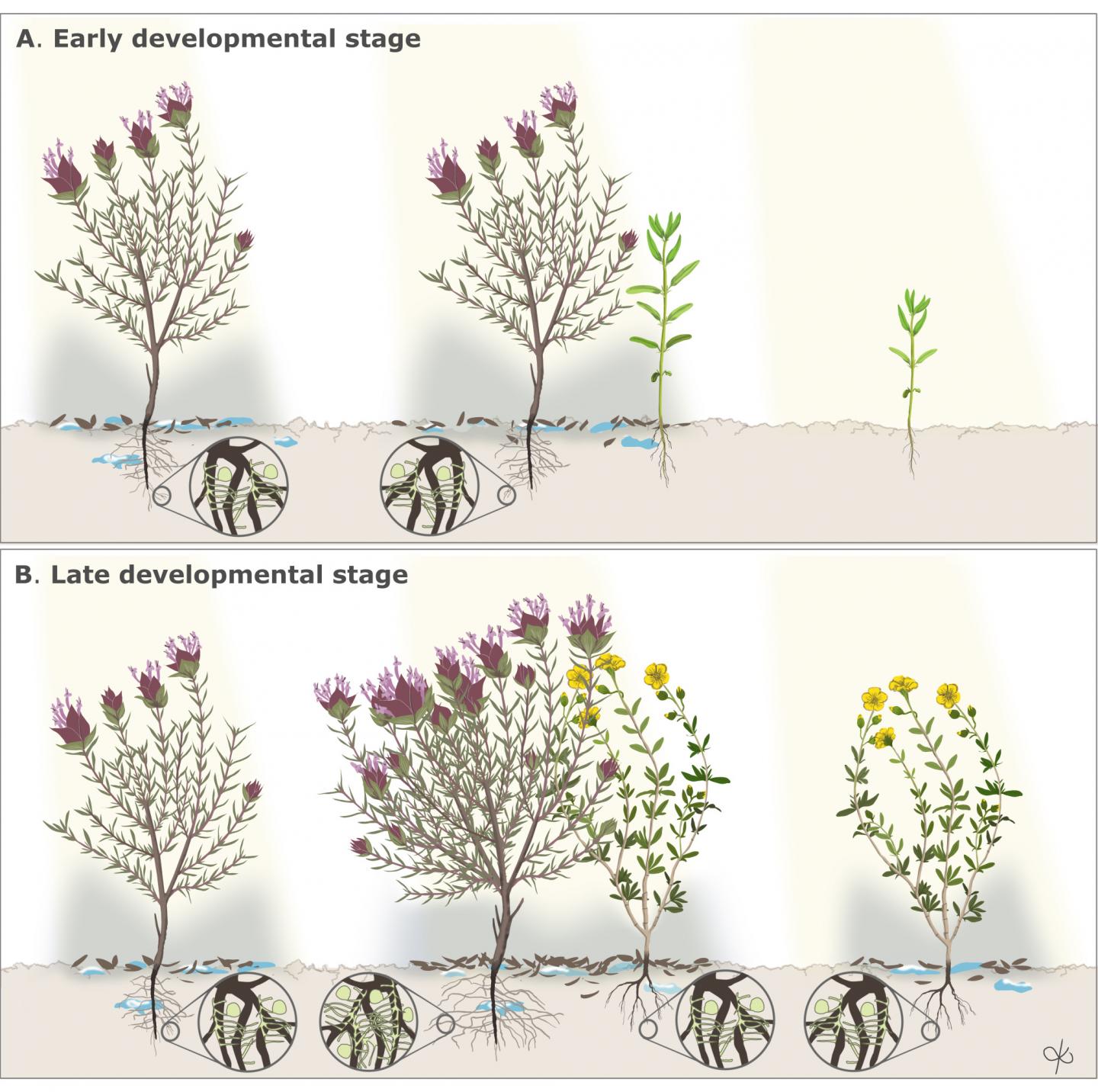
Credit: Scientific illustration created by Dr I M Berenjeno (DhramaBeren Studio, www.dharmaberen.com)
Contrary to the long-held belief that plants in the natural world are always in competition, new research has found that in harsh environments mature plants help smaller ones – and thrive as a result.
The first study to examine plant interactions in a hostile environment over their lifespan found that plants sheltering seedlings help the smaller plant survive and are more successful themselves, a processed in ecology called facilitation.
The study, led by Dr Rocio Pérez-Barrales at the University of Portsmouth and Dr Alicia Montesinos-Navarro at Desertification Research Center in Valencia, Spain, studied adult and seedling plants in the ‘ecological desert’ of gypsum soil in the south-east of Spain.
The findings could have significance for those managing harsh environments including coastal management.
Dr Pérez-Barrales said: “If you’re a seedling in a barren landscape – the top of a mountain or a sand dune, for example – and you’re lucky enough to end up underneath a big plant, your chances of survival are certainly better than if you landed somewhere on your own.
“What we have found which was surprising is an established large plant, called a ‘nurse’, shields a seedling, it also produces more flowers than the same plants of similar large size growing on their own.”
This win-win for adult and seedling plants in harsh environments has not previously been reported.
“Scientists have often looked at such plant relationships and found an adult or a seedling at one stage of its life, and made conclusions,” Dr Pérez-Barrales said. “But by studying these plants’ entire lifespan, from seed germination and establishment, growth of young plants, and flowering in adult plants, we have evidence that the benefits for both stack up over time.”
Dr Pérez-Barrales and her all-female team of scientists studied plant growth in southern Spain over three months during summer. The plants were growing in gypsum, a very poor soil, with little nutrients or water.
They found clear evidence the seedling and nurse were more likely to thrive when grown together, compared to either plant growing alone.
The seedling benefited from shade, more moisture and more nutrients, from the leaf litter of the ‘nurse’ plant, and probably higher bacteria and fungi in the soil, among other things. As it matured, the ‘nurse’ plant grew more flowers than similar plants nearby growing alone, greatly increasing her chances of producing seeds and propagating.
Other benefits of nurse-seedling partnerships include that more variety of plants growing together can trigger a positive cascade effects in the environment. For example, vegetation patches with nurse and facilitated plants with more flower density might be able to attract higher numbers and diversity of pollinators in an area, in turn supporting insect and soil life, and even provide a greater range of different fruit types for birds and mammals.
“The biggest winner for this system of nursing a plant is biodiversity,” Dr Pérez-Barrales said.
“The more biodiverse an area, the more we have a greater number of species of plants, insect life, bacteria, fungi, mammals and birds, the better the chances are of long-term healthy functioning of the environment and ecosystems.”
The research is likely to be of value to those who manage and protect plants in hostile and harsh environments, such as shingle and sand dunes ecosystems, both of which encircle the UK and are considered at high risk due to human intervention and climate change.
Most home gardeners and arable farmers plan to ensure their soil and conditions are the best they can be for optimum plant growth, but the findings might be of value to those who garden in inhospitable places.
Dr Pérez-Barrales suggested gardeners experiment with planting different species of different ages together to test which partnerships help plants thrive in any particular location.
ENDS
IMAGE – MUST CREDIT: Scientific illustration created by Dr I M Berenjeno (DhramaBeren Studio, http://www.
STUDY: https:/
###
Media Contact
Kate daniell
[email protected]
44-239-284-3743
Related Journal Article
http://dx.