Humans wouldn’t last long without plant mitochondria and chloroplasts. These essential compartments of plant cells famously capture sunlight and power plant life – and so, ultimately, provide all the food we eat.But there’s a problem: Mitochondria and chloroplasts store instructions for their building blocks in their own ”organelle” DNA or oDNA – and this can get mutated.
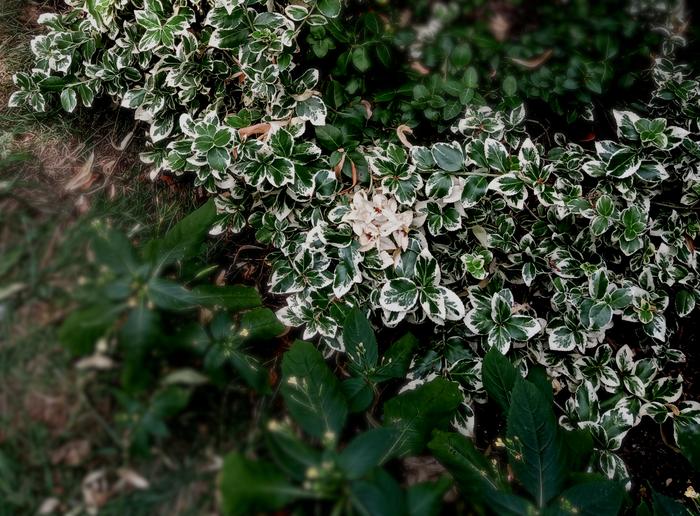
You can see mild effects of this in some “variegated” plants – where leaves get bleached and lose the ability to photosynthesise (see photo). Pretty in your garden, but no good for crops.
How do plants avoid the buildup of mutational damage over time?
Credit: Iain Johnston
Humans wouldn’t last long without plant mitochondria and chloroplasts. These essential compartments of plant cells famously capture sunlight and power plant life – and so, ultimately, provide all the food we eat.But there’s a problem: Mitochondria and chloroplasts store instructions for their building blocks in their own ”organelle” DNA or oDNA – and this can get mutated.
You can see mild effects of this in some “variegated” plants – where leaves get bleached and lose the ability to photosynthesise (see photo). Pretty in your garden, but no good for crops.
How do plants avoid the buildup of mutational damage over time?
A collaboration between the University of Bergen and Colorado State University has shed new light on this question.
Perhaps surprisingly, the answer is – in part – by exploiting randomness.
Generating diversity with randomness
If a plant inherits some amount of mutation from its mother, and passes the same amount of mutation on to each of its offspring, mutations will inevitably build up over generations and the plant’s descendants will die off. Instead, plants spread out the damage they inherit, so that while some offspring unfortunately inherit lots of mutations, others inherit far fewer. This process – which also happens in animals (including humans) – is called segregation. And it relies on the plant generating random differences between its offspring.
“The segregation process is known to be very fast in humans, and has a big effect on the inheritance of human genetic diseases,” said Dan Sloan, the head of the Colorado research team. “Remarkably, we’ve found that it’s even faster in plants.”
Agricultural implications
“Our work is really exciting because until now we had very little information about how these mutations behave in plants,” added Amanda Broz, first author on the study. “Agricultural scientists have recently become interested in understanding variation in oDNA because mitochondria and chloroplasts are so critically essential to plant growth and yield – our results are good news for crop breeders wanting to introduce new beneficial mutations.”
To understand the segregation of oDNA, the team generated plants which inherited high levels of mutations, and tracked how these mutations were distributed through the plant over time. They then used mathematical and statistical modelling to translate these experimental observations into theory describing how the plant was randomly spreading out its inherited damage. They found that a combination of processes – random distribution of oDNA when cells divide, and random overwriting of some oDNA molecules with others – could explain all their observations of plant segregation over time and from mothers to daughters. They also found some support for the idea that plants “set aside” some cells early in their lives that will end up responsible for producing the next generation – an idea currently actively debated in plant science.
“I’ve dreamed for years of exploring this process,” said Iain Johnston, corresponding author and leader of the Bergen research team. “It’s the combination of these beautiful new plant lines, detailed experiments, and modern maths and statistics that has made it possible.”
The team’s results support recent theories about how many other lifeforms maintain their power plants, and could be a step towards the manipulation of oDNA in plants – an important aspect of crop breeding and yield enhancement.
The research was supported by the European Research Council, National Science Foundation, and Peder Sather fund.
The results are published in New Phythologist. New Phytologist is a leading international journal focusing on high quality, original research across the broad spectrum of plant sciences, from intracellular processes through to global environmental change. The journal is owned by the New Phytologist Foundation, a not-for-profit organisation dedicated to the promotion of plant science. https://www.newphytologist.org/
Journal
New Phytologist
DOI
10.1111/nph.19288
Article Title
Stochastic organelle genome segregation through Arabidopsis development and reproduction
Article Publication Date
6-Nov-2023