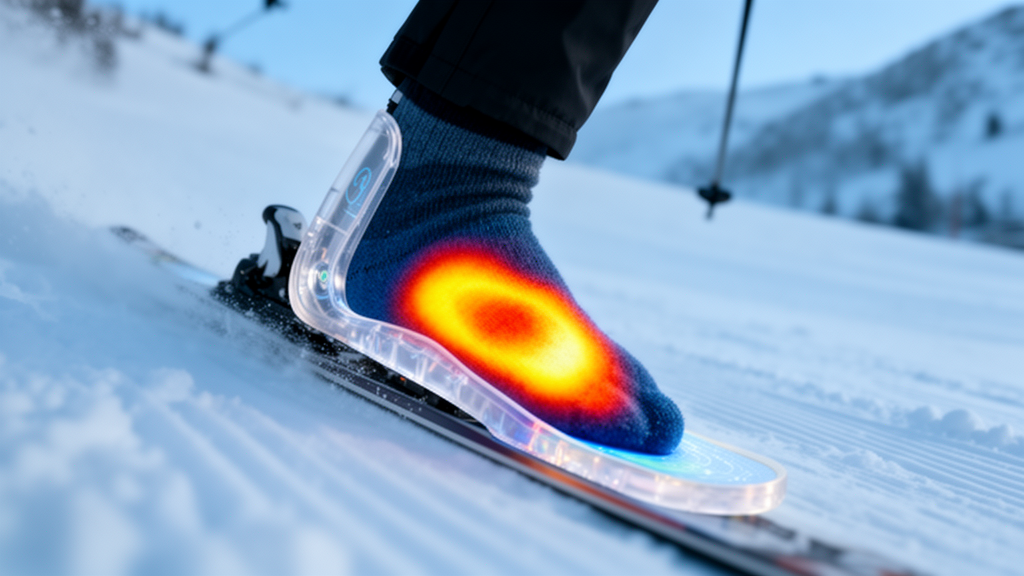
Plantar-pressure distributions recorded during simulator-based skiing training can help distinguish some levels of experience, according to a study of 27 participants using a deep-learning image classifier. The system separated beginner and novice participants with moderate discrimination, but it was less successful when identifying intermediate skiers. The results suggest that foot-pressure patterns contain information related to skiing experience, while also showing that the method is not yet a definitive assessment of proficiency.
Researchers transformed weight-shift measurements from the participants into images and used a YOLO11-based classifier to assign them to three operational groups: beginner, novice and intermediate. These groups were defined by self-reported skiing exposure rather than independently validated measures of technical ability. To test whether the model could classify participants it had not previously encountered, the team used leave-one-participant-out cross-validation, repeatedly training on data from some participants and testing on the excluded individual.
At the session level, the classifier achieved an accuracy of 0.667, a macro-F1 score of 0.489 and balanced accuracy of 0.524. These measures indicated moderate discrimination between the beginner and novice groups but limited generalization to the intermediate group. Because the study involved only 27 participants and based its experience labels on self-reported exposure, the findings establish feasibility rather than demonstrate a reliable general-purpose measure of skiing skill. The researchers also identified larger sample sizes and independently validated skiing-skill criteria as requirements before objective proficiency assessment.
The team next examined whether the classifier’s outputs changed over repeated simulator sessions. This analysis included six beginner participants. Fixed participant-dependent models were trained using only each participant’s baseline data and then applied to later sessions. Mixed-effects analyses provided tentative evidence of nonlinear changes in classifier outputs across repeated training, although the findings were sensitive to the model specification and substantial variation was observed among individuals.
Eigen-CAM visualization and biomechanical analysis offered additional information about the signals used by the classifier. The visualizations highlighted distributed features in the plantar-pressure images, while the biomechanical analyses indicated that the classifier responded to distributed plantar-pressure characteristics. Together, these analyses support the technical feasibility of extracting experience-related information from simulator-derived pressure data. They do not establish that training caused measurable improvements in real-world skiing performance, because the study took place in a simulator, included a small longitudinal sample and used self-reported experience to define groups. Overall, the study shows that plantar-pressure patterns can partially characterize skiing-experience groups and that classifier outputs may vary during repeated simulator training, but more data and independently validated skill criteria are needed before the approach can serve as an objective proficiency assessment.
Subject of Research: Deep-learning classification of skiing experience from plantar-pressure distributions measured in a ski simulator
Article Title: Exploring foot pressure patterns for skiing experience classification in a simulator-based environment
Article References: Ono, S., Atsumi, R., Kanai, H., & Koike, H. (2026). Exploring foot pressure patterns for skiing experience classification in a simulator-based environment. Scientific Reports. https://doi.org/10.1038/s41598-026-76341-y
Image Credits: AI Generated
DOI: 10.1038/s41598-026-76341-y
Keywords: plantar pressure, skiing experience, deep learning, YOLO11, ski simulator, cross-validation, biomechanics, skill classification, longitudinal training, Exploring, foot, pressure
News Source: Blake Davidson. (October 22, 2026). Plantar pressure patterns offer a partial window into skiing experience. Scienmag.