• HOME
  • NEWS
  • EXPLORE
    • CAREER
      • Companies
      • Jobs
    • EVENTS
    • iGEM
      • News
      • Team
    • PHOTOS
    • VIDEO
    • WIKI
  • BLOG
  • COMMUNITY
    • FACEBOOK
    • INSTAGRAM
    • TWITTER
Saturday, February 7, 2026
BIOENGINEER.ORG
No Result
View All Result
  • Login
  • HOME
  • NEWS
  • EXPLORE
    • CAREER
      • Companies
      • Jobs
        • Lecturer
        • PhD Studentship
        • Postdoc
        • Research Assistant
    • EVENTS
    • iGEM
      • News
      • Team
    • PHOTOS
    • VIDEO
    • WIKI
  • BLOG
  • COMMUNITY
    • FACEBOOK
    • INSTAGRAM
    • TWITTER
  • HOME
  • NEWS
  • EXPLORE
    • CAREER
      • Companies
      • Jobs
        • Lecturer
        • PhD Studentship
        • Postdoc
        • Research Assistant
    • EVENTS
    • iGEM
      • News
      • Team
    • PHOTOS
    • VIDEO
    • WIKI
  • BLOG
  • COMMUNITY
    • FACEBOOK
    • INSTAGRAM
    • TWITTER
No Result
View All Result
Bioengineer.org
No Result
View All Result
Home NEWS Science News Biology

Plant signals trigger remarkable bacterial transformation

Bioengineer by Bioengineer
April 23, 2019
in Biology
Reading Time: 2 mins read
0
IMAGE
Share on FacebookShare on TwitterShare on LinkedinShare on RedditShare on Telegram

IMAGE

Credit: Copyright Yasuyuki Hashidoko, Hokkaido University.

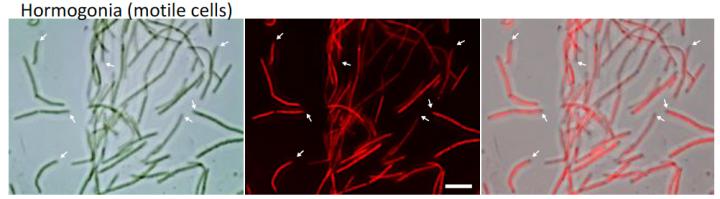
The cycad Cycas revoluta is a palm-like plant that grows on rocky coastal cliffs in the sub-tropics and tropics. It has a symbiotic relationship with the Nostoc species of bacteria that can convert nitrogen from the atmosphere into ammonia, which the host plant can then use for its growth. Scientists knew that cycad roots produce a compound that can induce Nostoc species within the soil to transform into their motile form, hormogonia, and attracting them to the roots. However, nobody has determined what exactly the compound is.

In the current study published in the journal Scientific Reports, agricultural chemist Yasuyuki Hashidoko and colleagues at Hokkaido University investigated an extract made from the “coralloid roots” of C. revoluta plants. These are specialized roots that branch out from the plant’s main root system.

They found that the extract was able to trigger the transformation of Nostoc bacteria into hormogonia. Further analyses revealed the main active elements present in the extract were a mixture of diacylglycerols; typical compounds contained in plants that are composed of two fatty acid chains linked together.

The team tested each of the diacylglycerols for their abilities to act as hormogonia-inducing factors (HIF), and found that 1-palmitoyl-2-linoleoyl-sn-glycerol showed pronounced HIF-like activity on the bacteria. The investigations also enabled the researchers to theorize which specific changes to fatty acid chain segments led to the compounds having more, less, or no HIF-like activity.

“These findings appear to indicate that some common diacylglycerols act as hormogonium-inducing signal for Nostoc cyanobacteria, enabling them to move and transfer to host plants,” the researchers conclude. “Since the bacteria can provide host plants nitrogen to help them grow, better understanding of the system could someday lead to more efficient, less fertilizer-dependent agricultural production.”

###

Media Contact
Naoki Namba
 @hokkaidouni

011-706-2185

Original Source

https://www.global.hokudai.ac.jp/blog/plant-signals-trigger-remarkable-bacterial-transformation/

Related Journal Article

http://dx.doi.org/10.1038/s41598-019-39647-8

Tags: BiochemistryBiodiversityBiologyBiomechanics/BiophysicsCell BiologyPlant Sciences
Share13Tweet8Share2ShareShareShare2

Related Posts

New Study Uncovers Mechanism Behind Burn Pit Particulate Matter–Induced Lung Inflammation

New Study Uncovers Mechanism Behind Burn Pit Particulate Matter–Induced Lung Inflammation

February 6, 2026

DeepBlastoid: Advancing Automated and Efficient Evaluation of Human Blastoids with Deep Learning

February 6, 2026

Navigating the Gut: The Role of Formic Acid in the Microbiome

February 6, 2026

AI-Enhanced Optical Coherence Photoacoustic Microscopy Revolutionizes 3D Cancer Model Imaging

February 6, 2026
Please login to join discussion

POPULAR NEWS

  • Robotic Ureteral Reconstruction: A Novel Approach

    Robotic Ureteral Reconstruction: A Novel Approach

    82 shares
    Share 33 Tweet 21
  • Digital Privacy: Health Data Control in Incarceration

    63 shares
    Share 25 Tweet 16
  • Study Reveals Lipid Accumulation in ME/CFS Cells

    57 shares
    Share 23 Tweet 14
  • Breakthrough in RNA Research Accelerates Medical Innovations Timeline

    53 shares
    Share 21 Tweet 13

About

We bring you the latest biotechnology news from best research centers and universities around the world. Check our website.

Follow us

Recent News

Succinate Receptor 1 Limits Blood Cell Formation, Leukemia

Palmitoylation of Tfr1 Drives Platelet Ferroptosis and Exacerbates Liver Damage in Heat Stroke

Oxygen-Enhanced Dual-Section Microneedle Patch Improves Drug Delivery and Boosts Photodynamic and Anti-Inflammatory Treatment for Psoriasis

Subscribe to Blog via Email

Enter your email address to subscribe to this blog and receive notifications of new posts by email.

Join 73 other subscribers
  • Contact Us

Bioengineer.org © Copyright 2023 All Rights Reserved.

Welcome Back!

Login to your account below

Forgotten Password?

Retrieve your password

Please enter your username or email address to reset your password.

Log In
No Result
View All Result
  • Homepages
    • Home Page 1
    • Home Page 2
  • News
  • National
  • Business
  • Health
  • Lifestyle
  • Science

Bioengineer.org © Copyright 2023 All Rights Reserved.