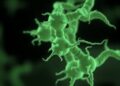
A research team at the VIB-KU Leuven Center for Microbiology has developed a novel screening method to identify antimicrobial properties of volatile substances. With this assay, they tested the vapour-phase-mediated activity of 175 essential oils (EOs) and 37 EO components. Approximately half of them proved active against the most drug-resistant type of Candida. In a context of fungi showing increasing drug resistance, these findings may be useful in both medical and agricultural applications.
The research project, led by prof. Patrick Van Dijck, is rooted in the growing problem of antifungal drug resistance. Candida cells, for example, are quickly becoming tolerant to fluconazole, the most-used antifungal drug. Next to exploring experimental new techniques, scientists also seek to repurpose existing substances. Plant essential oils (EOs), metabolites obtained by steam distillation or cold citrus peel pressing, may offer interesting opportunities: they are made up of compounds that help protect the plant against microbial or herbivore attacks.
Identifying EOs and their compounds
In the VIB-KU Leuven Center for Microbiology, Adam Feyaerts gathered a collection of 175 different EOs, constituting a collection of over one thousand different small molecules. The aim was to identify biologically active compounds present in these complex mixtures. They therefore developed a new class of assay that allowed to identify new volatile substances with antifungal activities over a distance.
Prof. Patrick Van Dijck (VIB-KU Leuven): "We screened our whole collection of EOs for vapor-phase mediated antifungal activity against two human fungal pathogens, Candida albicans and Candida glabrata. Interestingly, we found that approximately half of the EOs and their compounds had vapour-phase-mediated activity against both Candida species. Surprisingly, C. glabrata, the most drug-resistant species of the two was on average even more susceptible. In contrast, none of the currently used antifungals showed any vapour-phase-mediated activity."
Numerous potential applications
This is now the first simple test to look for the vapor-phase-mediated antimicrobial activity of molecules. The same assay could also be used to test other biological activity. And although these findings still have to be confirmed in clinical trials, potential applications are numerous.
Co-author Adam Feyaerts (VIB-KU Leuven): "Our findings are for instance a starting point for the development of molecules that could also be used in vaporizers. After all, volatiles can access otherwise hard to reach areas. Think of possibilities such as maintaining hygiene in hospitals or treat patients with lung infections. There are agricultural options too, such as preventing post-harvest contamination or protecting crops against pests."
###
Note: The lab of Patrick Van Dijck is part of the VIB-KU Leuven Center for Microbiology
Publication
Essential oils and their components are a class of antifungals with potent vapour-phase-mediated anti-Candida activity, Feyaerts et al., Scientific Reports paper, 2018
Questions from patients
A breakthrough in research is not the same as a breakthrough in medicine. The realizations of VIB researchers can form the basis of new therapies, but the development path still takes years. This can raise a lot of questions. That is why we ask you to please refer questions in your report or article to the email address that VIB makes available for this purpose: [email protected]. Everyone can submit questions concerning this and other medically-oriented research directly to VIB via this address.
Media Contact
Sooike Stoops
[email protected]
32-924-41166
@VIBLifeSciences
http://www.vib.be