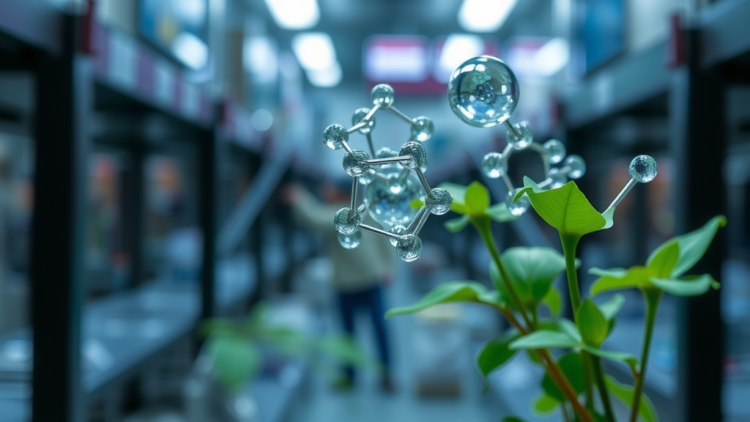
A sweeping review published in The Science of Nature argues that some of the most important tools for building nanomaterials are already growing in fields, forests, and compost heaps. The work, led by Sumera Nazneen of Anwarul Uloom College in Hyderabad with colleagues from institutions across India and Indonesia, examines how secondary metabolites—the vast catalog of bioactive compounds that plants, fungi, and microorganisms produce for defense and signaling—can serve as the reducing, stabilizing, and capping agents that turn dissolved metal ions into functional nanoparticles. The review, published in volume 113 of the journal, positions these molecules as a greener alternative to the harsh chemical reagents and energy-intensive processes that have historically dominated nanomaterial production.
Secondary metabolites occupy a curious place in biology. Unlike primary metabolites such as sugars, amino acids, and nucleotides, which are essential for growth and reproduction, secondary metabolites are optional extras from the organism’s point of view. Yet they are anything but optional for the ecosystems around them. Alkaloids deter herbivores, flavonoids shield leaves from ultraviolet radiation, tannins inhibit microbial attacks, and terpenoids perfume flowers to attract pollinators. What has captured the attention of nanotechnologists is that many of these compounds carry functional chemical groups—hydroxyl, carbonyl, and carboxyl moieties among them—that are ideally suited to mediating the transformation of metal salts into nanoscale particles suspended in water.
The core chemistry is conceptually simple. When an extract rich in phenolic acids or flavonoids is mixed with, say, a silver nitrate solution, the electron-donating capacity of the metabolites reduces silver ions to metallic silver atoms. These atoms then nucleate and grow into clusters, a process classically described by the LaMer model of monodisperse hydrosol formation, first articulated in 1950. Crucially, the same metabolites that drive the reduction also adsorb onto the surfaces of the growing particles, forming a stabilizing shell that prevents the clusters from clumping together into bulk precipitate. This dual role—reductant and capping agent in one molecule—is what makes plant and microbial extracts so attractive as single-pot synthesis media.
The review catalogs the major phytochemical players in detail. Flavonoids such as hesperidin, naringin, and diosmin have been shown to generate silver nanoparticles with demonstrable antibacterial effects. Tannins, the astringent polyphenols abundant in many woody plants, can reduce gold salts to produce nanoparticles that have been coated onto cotton textiles for the catalytic degradation of Congo red dye. Terpenoids have been credited with mediating a range of metal and metal oxide syntheses with biomedical relevance. Saponins, alkaloids, and phenolic acids round out the roster, each contributing characteristic functional groups that influence how quickly ions are reduced and how the resulting particles are shaped and stabilized.
Perhaps the most consequential point the authors emphasize is that the identity and concentration of the metabolites directly govern the physical properties of the nanoparticles that emerge. Particle size, morphology, surface charge, and colloidal stability all depend on which molecules are present and in what proportions. Because different plant species, and even different tissues within the same plant, harbor distinct metabolic profiles, the choice of extract becomes a design variable. A leaf extract rich in one class of polyphenol may yield small, spherical silver particles, while a seed extract dominated by tannins may produce larger, anisotropic structures. This tunability, the review suggests, is both an opportunity and a challenge: it offers enormous flexibility but demands careful standardization of extracts if reproducible, scalable production is the goal.
The advantages over conventional synthesis routes are laid out clearly. Physical methods such as laser ablation and sputtering, and chemical methods relying on borohydrides, hydrazine, or organic solvents, typically demand high energy inputs, generate toxic byproducts, or leave hazardous residues on particle surfaces. Green synthesis with secondary metabolites operates at or near ambient conditions, uses water as the preferred solvent, and produces particles whose organic coating is often biocompatible by default. That last point matters enormously for biomedical applications, where residual chemical surfactants can compromise cell viability and trigger inflammatory responses. The review notes that reduced toxicity, lower energy requirements, and cost-effectiveness are the recurring advantages cited across the literature it surveys.
On the application side, the breadth is striking. Biologically synthesized metal and metal oxide nanoparticles have demonstrated antimicrobial activity against bacterial and fungal pathogens, antioxidant capacity relevant to oxidative-stress disorders, and anticancer and anti-inflammatory effects documented across numerous cell and preclinical studies. Silver nanoparticles made with potato steroidal alkaloids have been deployed against phytopathogenic fungi, while zinc oxide nanoparticles biosynthesized through microbial routes show antimicrobial promise. In environmental remediation, iron-based nanoparticles produced with plant extracts serve as adsorbents for water treatment, and silver nanoparticles paired with nano-fibrillated cellulose from citrus peel waste have been used to remove cadmium and chromium from contaminated water. Catalytic degradation of industrial dyes, colorimetric detection of metal ions, and biosensing round out the environmental and analytical applications.
Agriculture emerges as a particularly promising frontier. The review highlights the role of metal and metal oxide nanoparticles in crop stress management, including the mitigation of heavy metal toxicity in plants, as well as nanosensing of biotic threats. Nanoparticles are being explored as components of fertilizers and pesticides, as delivery vehicles in precision farming, and as tools in plant biotechnology, including the emerging use of nanoparticles to advance CRISPR-Cas genetic engineering of plants. The biocompatibility and colloidal stability conferred by metabolite capping layers make these particles plausible candidates for agricultural formulations that must survive field conditions without harming soil microbiota. The authors also point to biomedical devices and food technology as sectors where green-synthesized particles could find roles, from antimicrobial fabrics to food preservation systems.
The review does not shy away from the field’s limitations. Reproducibility remains a persistent concern, since natural extracts vary with season, geography, plant age, and extraction protocol. The precise molecular mechanisms by which particular metabolites reduce particular metal ions are still being worked out, and scaling laboratory successes to industrial production volumes poses engineering challenges that green chemistry has not yet fully solved. Studies of fungal production of copper oxide nanoparticles, for example, have taken a physiological and metabolic approach to identify which secondary metabolites are actually responsible, underscoring how much fundamental biochemistry remains to be mapped. Toxicological questions about the nanoparticles themselves, particularly in food applications, also demand continued scrutiny.
What the review ultimately makes the case for is a convergence of two traditionally separate domains: natural products chemistry and materials science. The authors argue that deliberately leveraging plant- and microbe-derived metabolites offers a sustainable path to scalable nanoparticle production capable of meeting global needs in medicine, agriculture, and environmental management. As demand for nanomaterials grows across sectors, the prospect of manufacturing them with molecules that organisms already produce—rather than with petrochemical reagents and energy-hungry reactors—represents exactly the kind of cross-disciplinary innovation that green chemistry advocates have long promised. The next step, the review implies, is moving from elegant laboratory demonstrations to standardized, mechanistically understood, industrially viable processes, a transition that will require chemists, biologists, and engineers to speak the same molecular language.
Subject of Research: Green synthesis of metal and metal oxide nanoparticles using plant and microbial secondary metabolites
Article Title: Significance of secondary metabolites for synthesis of metal and metal oxide nanoparticles and their applications
Article References: Nazneen, S., Azra, B. H., Keerthi, M. M., Ashraf, A. M., Rajasekar, G., Rasool, A., & Anand, A. (2026). Significance of secondary metabolites for synthesis of metal and metal oxide nanoparticles and their applications. The Science of Nature, 113(5), Article 120. https://doi.org/10.1007/s00114-026-02168-2
Image Credits: AI Generated
DOI: 10.1007/s00114-026-02168-2
Keywords: secondary metabolites, green synthesis, nanoparticles, metal oxide nanoparticles, phytochemicals, flavonoids, tannins, antimicrobial, environmental remediation, biomedicine, agriculture, sustainable nanotechnology
Cite Scienmag News
APA MLA Chicago
Denise Maddox. (September 24, 2026). Plant Chemicals Take Center Stage in Greener Nanoparticle Manufacturing. Scienmag. https://scienmag.com/plant-chemicals-take-center-stage-in-greener-nanoparticle-manufacturing/
Denise Maddox. “Plant Chemicals Take Center Stage in Greener Nanoparticle Manufacturing.” Scienmag, 24 September 2026, https://scienmag.com/plant-chemicals-take-center-stage-in-greener-nanoparticle-manufacturing/. Accessed 24 September 2026.
Denise Maddox. “Plant Chemicals Take Center Stage in Greener Nanoparticle Manufacturing.” Scienmag. September 24, 2026. https://scienmag.com/plant-chemicals-take-center-stage-in-greener-nanoparticle-manufacturing/
Copy citation Download RIS
Tags: agricultureantimicrobialbio-inspired green synthesis of metal nanoparticlesbioactive compounds for green nanomaterial productionbiomedicineeco-friendly alternatives to chemical reagents in nanotechnologyenvironmental remediationenvironmentally friendly nanoparticle manufacturingflavonoidsgreen synthesismetal oxide nanoparticlesnanoparticlesnatural capping agents from plants and fungiphytochemicalsplant defense compounds in nanoparticleplant secondary metabolites in nanoparticle synthesisplant-based reducing agents for nanotechnologyrole of alkaloids and flavonoids in nanomaterial synthesissecondary metabolitessecondary metabolites as stabilizing agents in nanomaterialssustainable nanomaterials from biological sourcessustainable nanotechnologytannins