• HOME
  • NEWS
  • EXPLORE
    • CAREER
      • Companies
      • Jobs
    • EVENTS
    • iGEM
      • News
      • Team
    • PHOTOS
    • VIDEO
    • WIKI
  • BLOG
  • COMMUNITY
    • FACEBOOK
    • INSTAGRAM
    • TWITTER
Tuesday, September 1, 2026
BIOENGINEER.ORG
No Result
View All Result
  • Login
  • HOME
  • NEWS
  • EXPLORE
    • CAREER
      • Companies
      • Jobs
        • Lecturer
        • PhD Studentship
        • Postdoc
        • Research Assistant
    • EVENTS
    • iGEM
      • News
      • Team
    • PHOTOS
    • VIDEO
    • WIKI
  • BLOG
  • COMMUNITY
    • FACEBOOK
    • INSTAGRAM
    • TWITTER
  • HOME
  • NEWS
  • EXPLORE
    • CAREER
      • Companies
      • Jobs
        • Lecturer
        • PhD Studentship
        • Postdoc
        • Research Assistant
    • EVENTS
    • iGEM
      • News
      • Team
    • PHOTOS
    • VIDEO
    • WIKI
  • BLOG
  • COMMUNITY
    • FACEBOOK
    • INSTAGRAM
    • TWITTER
No Result
View All Result
Bioengineer.org
No Result
View All Result
Home NEWS Science News

Plant-based protein intake may reduce kidney disease risk

Bioengineer by Bioengineer
July 31, 2023
in Science News
Reading Time: 2 mins read
0
Association of Plant Protein Intake With Risk of Incident CKD
Share on FacebookShare on TwitterShare on LinkedinShare on RedditShare on Telegram

Plant-based diets confer various health benefits, including lowering the risk of cardiovascular disease and certain cancers. However, the relationship between plant protein intake and the risk of chronic kidney disease (CKD) remains unclear. This study led by Ga Young Heo aimed to investigate the association between plant protein intake and the development of CKD. Using the UK biobank study data, the researchers found that participants with a higher plant protein intake had a lower risk of developing CKD. This finding suggests that a higher dietary intake of plant-based protein may be beneficial for kidney health and provide insight into dietary interventions to prevent CKD in primary care settings.
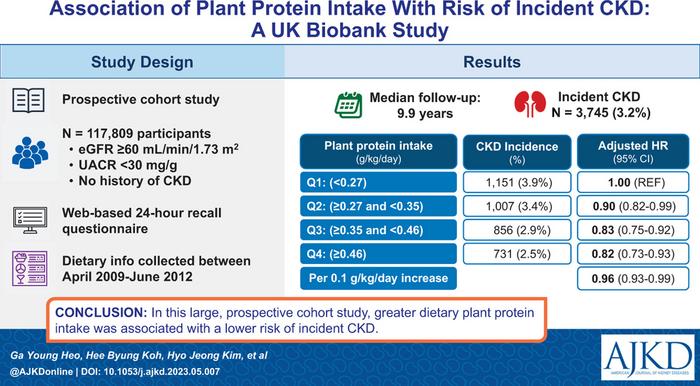
Association of Plant Protein Intake With Risk of Incident CKD

Credit: AJKD 2023

Plant-based diets confer various health benefits, including lowering the risk of cardiovascular disease and certain cancers. However, the relationship between plant protein intake and the risk of chronic kidney disease (CKD) remains unclear. This study led by Ga Young Heo aimed to investigate the association between plant protein intake and the development of CKD. Using the UK biobank study data, the researchers found that participants with a higher plant protein intake had a lower risk of developing CKD. This finding suggests that a higher dietary intake of plant-based protein may be beneficial for kidney health and provide insight into dietary interventions to prevent CKD in primary care settings.

ARTICLE TITLE: Association of Plant Protein Intake With Risk of Incident CKD: A UK Biobank Study

AUTHORS: Ga Young Heo, MD, Hee Byung Koh, MD, Hyo Jeong Kim, MD, Kyung Won Kim, MD, Chan-Young Jung, MD, Hyung Woo Kim, MD, Tae Ik Chang, MD, PhD, Jung Tak Park, MD, PhD, Tae-Hyun Yoo, MD, PhD, Shin-Wook Kang, MD, PhD, and Seung Hyeok Han, MD, PhD

DOI: 10.1053/j.ajkd.2023.05.007


Journal

American Journal of Kidney Diseases

DOI

10.1053/j.ajkd.2023.05.007

Article Title

Association of Plant Protein Intake With Risk of Incident CKD: A UK Biobank Study

Article Publication Date

28-Jul-2023
Share12Tweet8Share2ShareShareShare2

Related Posts

β-Sitosterol from Ipomoea carnea Jacq. As a promising anti-inflammatory agent: Evidence from in silico modeling and in vitro validation

β-Sitosterol from Ipomoea carnea Jacq. As a promising anti-inflammatory agent: Evidence from in silico modeling and in vitro validation

August 31, 2026
Design, fabrication and characterization of a wearable Fiber Bragg grating sensor for cardiorespiratory monitoring using finger plethysmography

Design, fabrication and characterization of a wearable Fiber Bragg grating sensor for cardiorespiratory monitoring using finger plethysmography

August 31, 2026

KAIST opens the era of industrial-scale microbial foods, proposing growth strategies for the next-generation protein market

August 31, 2026

Virologist awarded $2 million NIH grant to investigate how virus-infected cells live and die

August 31, 2026

POPULAR NEWS

  • β-Sitosterol from Ipomoea carnea Jacq. As a promising anti-inflammatory agent: Evidence from in silico modeling and in vitro validation

    29 shares
    Share 12 Tweet 7
  • Design, fabrication and characterization of a wearable Fiber Bragg grating sensor for cardiorespiratory monitoring using finger plethysmography

    29 shares
    Share 12 Tweet 7
  • KAIST opens the era of industrial-scale microbial foods, proposing growth strategies for the next-generation protein market

    29 shares
    Share 12 Tweet 7
  • Virologist awarded $2 million NIH grant to investigate how virus-infected cells live and die

    29 shares
    Share 12 Tweet 7

About

We bring you the latest biotechnology news from best research centers and universities around the world. Check our website.

Follow us

Recent News

β-Sitosterol from Ipomoea carnea Jacq. As a promising anti-inflammatory agent: Evidence from in silico modeling and in vitro validation

Design, fabrication and characterization of a wearable Fiber Bragg grating sensor for cardiorespiratory monitoring using finger plethysmography

KAIST opens the era of industrial-scale microbial foods, proposing growth strategies for the next-generation protein market

Subscribe to Blog via Email

Success! An email was just sent to confirm your subscription. Please find the email now and click 'Confirm' to start subscribing.

Join 85 other subscribers
  • Contact Us

Bioengineer.org © Copyright 2023 All Rights Reserved.

Welcome Back!

Login to your account below

Forgotten Password?

Retrieve your password

Please enter your username or email address to reset your password.

Log In
No Result
View All Result
  • Homepages
    • Home Page 1
    • Home Page 2
  • News
  • National
  • Business
  • Health
  • Lifestyle
  • Science

Bioengineer.org © Copyright 2023 All Rights Reserved.