A team of University of Waterloo researchers has created smart, advanced materials that will be the building blocks for a future generation of soft medical microrobots.
Credit: University of Waterloo
A team of University of Waterloo researchers has created smart, advanced materials that will be the building blocks for a future generation of soft medical microrobots.
These tiny robots have the potential to conduct medical procedures, such as biopsy, and cell and tissue transport, in a minimally invasive fashion. They can move through confined and flooded environments, like the human body, and deliver delicate and light cargo, such as cells or tissues, to a target position.
The tiny soft robots are a maximum of one centimetre long and are bio-compatible and non-toxic. The robots are made of advanced hydrogel composites that include sustainable cellulose nanoparticles derived from plants.
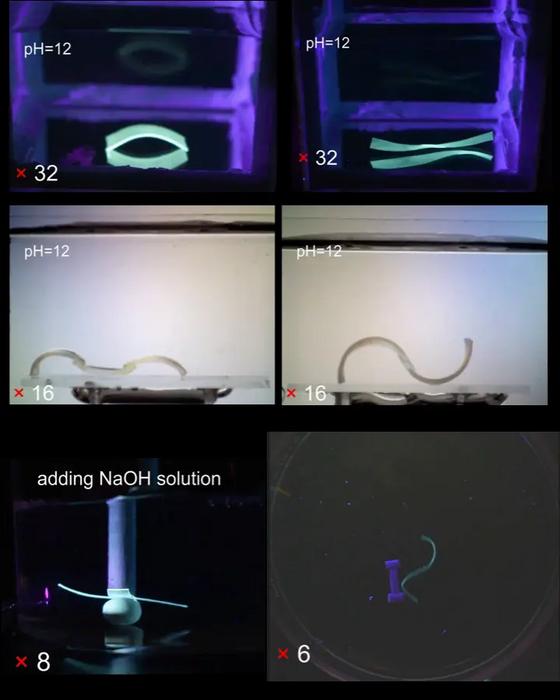
This research, led by Hamed Shahsavan, a professor in the Department of Chemical Engineering, portrays a holistic approach to the design, synthesis, fabrication, and manipulation of microrobots. The hydrogel used in this work changes its shape when exposed to external chemical stimulation. The ability to orient cellulose nanoparticles at will enables researchers to program such shape-change, which is crucial for the fabrication of functional soft robots.
“In my research group, we are bridging the old and new,” said Shahsavan, director of the Smart Materials for Advanced Robotic Technologies (SMART-Lab). “We introduce emerging microrobots by leveraging traditional soft matter like hydrogels, liquid crystals, and colloids.”
The other unique component of this advanced smart material is that it is self-healing, which allows for programming a wide range in the shape of the robots. Researchers can cut the material and paste it back together without using glue or other adhesives to form different shapes for different procedures.
The material can be further modified with a magnetism that facilitates the movement of soft robots through the human body. As proof of concept of how the robot would maneuver through the body, the tiny robot was moved through a maze by researchers controlling its movement using a magnetic field.
“Chemical engineers play a critical role in pushing the frontiers of medical microrobotics research,” Shahsavan said. “Interestingly, tackling the many grand challenges in microrobotics requires the skillset and knowledge chemical engineers possess, including heat and mass transfer, fluid mechanics, reaction engineering, polymers, soft matter science, and biochemical systems. So, we are uniquely positioned to introduce innovative avenues in this emerging field”.
The next step in this research is to scale the robot down to submillimeter scales.
Shahsavan’s research group collaborated with Waterloo’s Tizazu Mekonnen, a professor from the Department of Chemical Engineering, Professor Shirley Tang, Associate Dean of Science (Research), and Amirreza Aghakhani, a professor from the University of Stuttgart in Germany. They published their results last month in Nature Communications.
Journal
Nature Communications